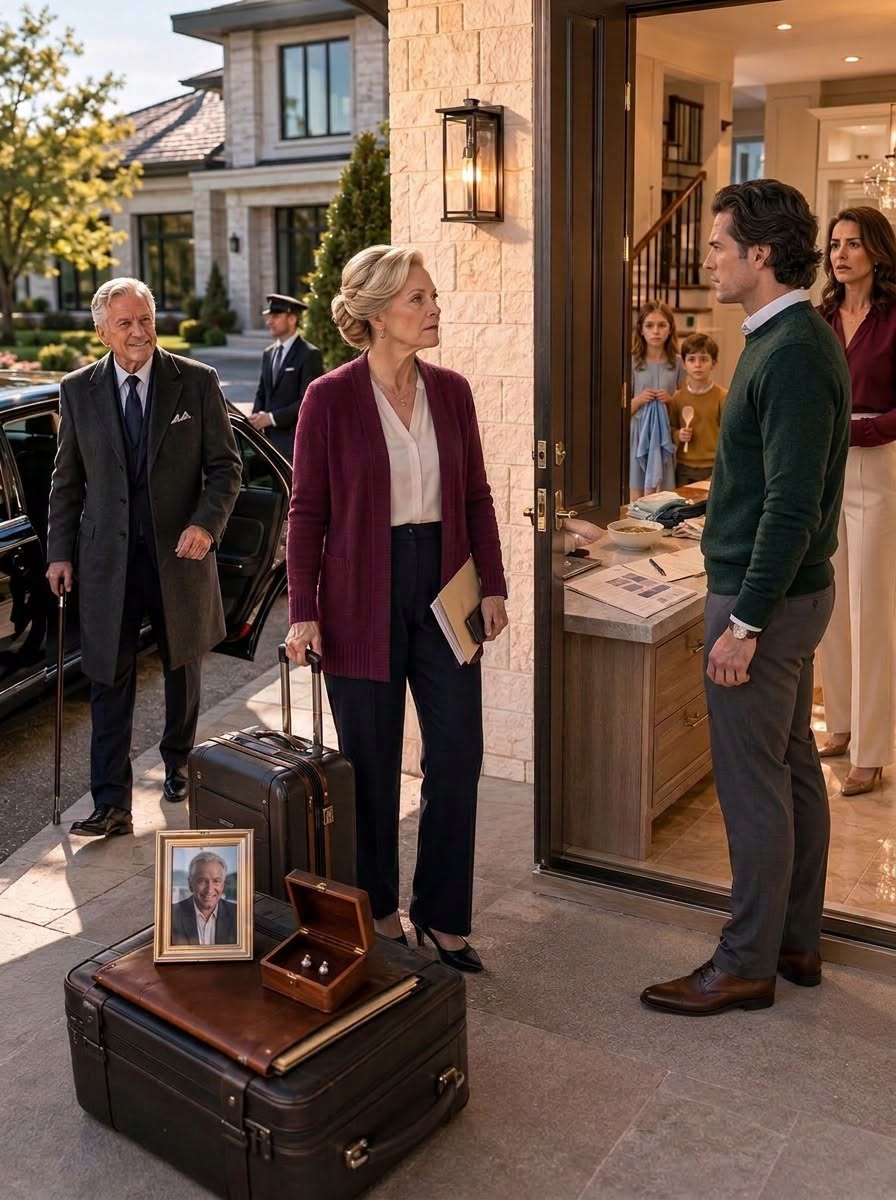
“If you won’t move into assisted living, pack your bags and leave my house now,” my son said, certain I had nowhere else to go.
I didn’t argue. I folded my clothes, closed my suitcase, and waited. An hour later, a limousine pulled into the driveway.
The assisted-living brochure lay open on the kitchen island beside a blue pen. Daniel stood behind it with both hands against the granite. His wife, Vanessa, was beside him. They looked as if they had already discussed the decision and needed only to get me to agree.
“This place has gardens, transportation, and full-time staff,” Daniel said. “You’d be comfortable.”
“I’m comfortable here.”
Vanessa looked at him, then at me. “That’s the problem, Margaret. You’ve become too comfortable.”
I glanced around the kitchen. I had made breakfast there, packed the children’s lunches, washed their bedding, and started chicken soup because my grandson had a cold. I wasn’t listing those things to claim they made the house mine. I wanted to understand what they meant by comfortable.
“What exactly have I become comfortable doing?”
Daniel exhaled. “Mom, please don’t make this difficult.”
For three years, that sentence had been his way of ending disagreements. Don’t make it difficult when the downstairs suite, which he had said would be mine, became Vanessa’s office. Don’t make it difficult when I moved into the storage room beside the laundry. Don’t make it difficult when dinner guests arrived without warning and I was expected to cook.
I had tried not to make things difficult. By then, I understood that meant I was supposed to accept each change without making Daniel say what it was doing to me.
Vanessa tapped the brochure. “Lily needs your room for a study. The current arrangement no longer works.”
My room barely fit a twin bed, a dresser, and three boxes of my things. The children already had bedrooms.
“It’s not only about space,” Daniel said. “It’s about planning for your future.”
“I’m sixty-eight.”
“No one said you were helpless.”
“Then why are you choosing where I live?”
Neither of them answered at once. Daniel looked down at the brochure, then back at me.
“If you refuse, pack your bags and leave my house now.”
He said my house as if the words settled the matter. Three years earlier, he had persuaded me to sell my paid-off apartment and move in with his family.
He promised I would never be lonely again. Part of the money from the sale went into his business, and another portion helped renovate the house.
I had spent forty years sewing wedding gowns, one fitting and one careful stitch at a time. That work paid for Daniel’s education, helped build my retirement, and bought the apartment I later sold. I had moved because I trusted my son’s promise. Now I was being told I had no place there.
I smiled. Vanessa’s expression changed.
“Why are you smiling?” she asked.
“Because I finally understand there’s nothing left here to save.”
I turned off the soup and went to the storage room. I set my suitcase on the bed and began packing. Three sweaters, two pairs of pants, my sewing shears, a framed photograph of my late husband, Thomas, and the letters he had written during business trips.
I wasn’t sure what I would need for the next few days. I packed what I knew I couldn’t leave behind.
When I opened my mother’s wooden jewelry box, I stopped. My grandmother’s sapphire brooch was gone. So was the gold bracelet Thomas had given me on our twenty-fifth anniversary.
Vanessa appeared in the doorway.
“Are you almost done?”
“Where is my jewelry?”
“What jewelry?”
“The brooch and the bracelet. They were in this box.”
“You probably misplaced them.”
“I didn’t.”
She folded her arms. “You’ve been forgetting things lately.”
I looked at her. Her answer had come quickly, and she was already explaining my memory to me instead of answering about the jewelry. I took a photograph of the empty drawer with my phone and placed the box in my suitcase.
Then I sent one message: Harold, you once said that if I ever needed a door opened, I should call. Is that still true?
His reply came almost immediately. Always. Where are you?
Harold Bennett had been Thomas’s closest friend and business partner for more than thirty years. He had built a successful hotel company and was one of the most respected businessmen in Chicago. He attended Daniel’s graduation, visited Thomas in the hospital, and called me every month after the funeral.
I always told him I was fine. That morning, I finally told the truth.
When I came back out, Daniel was waiting near the kitchen.
“Where are you going?”
“An old friend is coming.”
“You could stay until we arrange transportation to the residence.”
“No.”
“Mom, don’t turn this into a performance.”
I zipped the suitcase. “You already printed the program.”
He glanced at Vanessa. She looked away from him and toward the brochure.
No one apologized. No one asked me to sit down and reconsider. I took the two suitcases to the front hall and waited.
An hour later, a long black limousine stopped in the driveway. Daniel looked through the front window.
“Who did you call?”
The driver stepped out first. Harold emerged from the rear seat in a charcoal overcoat, leaning lightly on a polished cane. Daniel opened the door.
“Mr. Bennett?”
Harold looked past him and saw me standing near the stairs with my suitcases.
“Maggie.”
He crossed the porch and took both my hands.
“You came,” I whispered.
“You called.”
Daniel moved closer. “This is a private family matter.”
Harold glanced toward the assisted-living brochure on the island. “So I see.”
Vanessa stepped into the hallway. “We offered Margaret a safe and appropriate option. She chose to react emotionally.”
“I chose to leave after being told to leave,” I said.
Daniel’s voice softened, but his words did not. “Mom, we can discuss this later.”
“You had three years.”
Harold reached for my larger suitcase. When the driver offered to take it, Harold shook his head.
“I’ve got this one.”
My granddaughter Lily appeared near the staircase, her eyes wet.
“Grandma, are you coming back?”
I knelt and held her. “This isn’t goodbye.”
“Where will you live?”
“Somewhere I’m welcome.”
Daniel looked away. Lily held on to me a little longer, then let go. I stood, took my smaller suitcase, and walked out with Harold. No one stopped us.
From the car, I could see Daniel on the porch. He hadn’t followed. The limousine pulled away, and the house disappeared behind us.
Harold didn’t ask me to explain everything at once. He asked whether I had what I needed for the evening. I said I had my clothes and the photograph of Thomas. Then, after a pause, I told him about the jewelry.
“Did you ask Vanessa?” he said.
“I did.”
“And?”
“She said I’d misplaced it. Then she said I was forgetting things.”
Harold nodded. He didn’t tell me he knew who had taken it or make a promise he couldn’t keep. He said he would help me ask Daniel for a proper answer.
At his penthouse overlooking Lake Michigan, the elevator opened into a quiet foyer. A housekeeper carried one suitcase toward a guest suite. Harold carried the other. The room was offered to me for as long as I needed it.
“I don’t want to impose,” I said.
“You aren’t imposing. You called me.”
“I should have called sooner.”
“Maybe. But you called now.”
That first evening, I sat with my suitcases still closed. I had left the house, but I hadn’t yet decided how to handle my things or what to say to Daniel. The jewelry bothered me, though not only because it was valuable. The bracelet had belonged to a particular part of my life with Thomas. The brooch had come down through my family. Being told I had forgotten them was another way of being told I could not trust my own memory.
The next morning, I called Daniel. Harold stayed nearby, not to speak for me, but because I wanted someone else to hear the conversation.
“Did you find my brooch and bracelet?” I asked.
There was a pause. “Vanessa said they weren’t in the box.”
“They were there before I packed.”
“I know you think that.”
“I’m not asking what I think. I’m asking whether either of you found them.”
Daniel lowered his voice. “Mom, this is not a good time to start another argument.”
“I left without them. I want them back.”
He went quiet. Then he said he would look.
Later that day, he called again. This time Vanessa was with him. Harold was still in the room, and I put the call on speaker so there would be no confusion about what was said.
Daniel began carefully. “We found the jewelry.”
“Where?”
Vanessa answered before he could. “It was in my office drawer. I put it there when I was sorting things in the room.”
“You told me I had misplaced it,” I said.
“I didn’t know where it was then.”
“You said I’d been forgetting things.”
Vanessa paused. “I was frustrated. You were packing, and I thought you might have put it somewhere else.”
Daniel cut in. “We should have checked before we said anything.”
The explanation didn’t change what had happened. Vanessa had moved my jewelry, then told me I was forgetful when I asked for it. Daniel had stood beside her while she did it.
“Are you bringing it?” I asked.
“Yes,” Daniel said. “I’ll bring it over.”
When he arrived, Harold answered the door. Daniel came in carrying a small box. He set it on the table and opened it. The sapphire brooch and the gold bracelet were inside.
I checked them myself. They were mine.
Daniel stood with his hands at his sides. “Vanessa shouldn’t have said you misplaced them.”
“No,” I said. “She shouldn’t have.”
“I should have asked her to look before I took her word for it.”
I waited. I wasn’t looking for a speech. I wanted him to say plainly what he had done.
“I told you to leave,” he said. “I shouldn’t have.”
The apology did not undo the ultimatum or the years of being moved into smaller spaces. I accepted the jewelry and told him I wasn’t coming back to live in the house.
He glanced toward the guest suite. “You can come home. We can sort things out.”
“You called it your house when you told me to leave.”
“I was angry.”
“You were sure I had nowhere else to go.”
He rubbed his forehead. “I thought the residence made sense. Vanessa thought Lily needed the room. I went along with it.”
“That doesn’t make it my decision.”
“No.” He looked at the box. “It doesn’t.”
I told him I would collect the rest of my belongings when I was ready, with him there. I wasn’t going to move back into the storage room or wait for another arrangement to be made for me. He nodded, but he did not try to argue.
Before he left, he asked whether Lily could see me. I said yes. I wanted to see her. I also told him that visits could not be treated as a reason I had to return to the house.
“She misses you,” he said.
“I miss her too.”
He carried that answer back with him. The next time I saw Lily, it was for a visit arranged with Daniel. She asked whether I was staying at Harold’s.
“For now,” I told her.
“Can I come see you?”
“Yes.”
Daniel didn’t interrupt. Vanessa wasn’t there. Lily sat beside me and told me about school while I listened. I did not tell her the adults’ version of events or ask her to choose between us.
When I was ready, Daniel helped bring the rest of my belongings to Harold’s. The jewelry came with me. My photograph of Thomas and his letters were already in my room. I did not return to the storage room, and I did not agree to assisted living simply because Daniel had chosen it.
I stayed in Harold’s guest suite. I had somewhere to live, my family pieces back in my possession, and the choice about where I would go was mine.