PART 2: THEY SOLD THE HOUSE I HELPED THEM BUY—THEN CAME BACK FOR MINE
THEY SOLD THE HOUSE I HELPED THEM BUY—THEN CAME BACK FOR MINE
What Happened in Part 1:
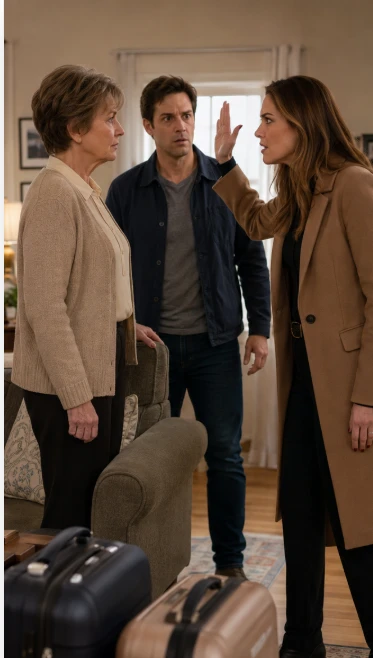
At sixty-four, Bessie Mitchell believed she understood the son she had raised—until Terrence and his wife, Lennox, appeared at her door with suitcases and nowhere to live. Months earlier, they had sold the beautiful colonial Bessie had helped them purchase with $40,000 from her retirement savings, receiving $620,000 from the sale. Instead of using the money to secure their future, Lennox revealed that it had been spent on debts, luxury purchases, family gifts, vacations, car upgrades, and a $300,000 investment in a friend’s boutique. With nothing left, Terrence and Lennox expected to move into Bessie’s modest two-bedroom home while they tried to recover financially. Bessie realized that their real safety net was not a plan at all—it was her house, her savings, and the retirement she had worked three decades to protect. She refused, and Lennox’s polished composure shattered as she raised her hand toward Bessie’s face.
PART 2
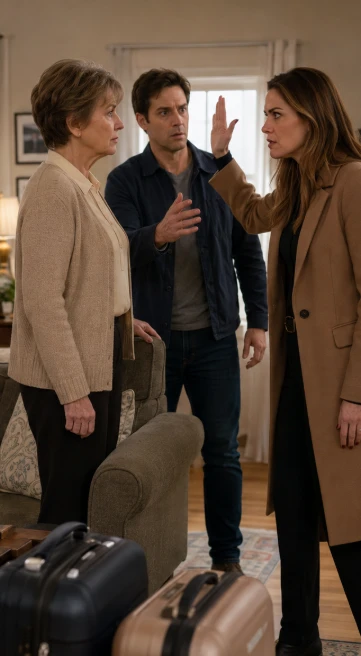
Lennox’s hand never reached me.
Terrence caught her wrist halfway through the swing.
For one suspended second, the three of us stood there as if someone had stopped time.
Lennox stared at him.
Terrence stared at her.
And I stared at my son’s fingers wrapped around his wife’s wrist, not roughly, not violently, but firmly enough to prevent something none of us could ever pretend had almost not happened.
“Let go of me,” Lennox whispered.
Terrence did.
She jerked her arm against her chest.
His face had gone pale.
“What were you doing?”
“I wasn’t going to hit her.”
“You swung at my mother.”
“I lost my temper.”
“You raised your hand.”
“I said I lost my temper!”
Her voice filled my little living room, bounced off the framed photographs on the wall, and seemed to linger among thirty years of birthdays, graduations, Christmas mornings, and ordinary Sunday dinners.
I surprised myself by speaking quietly.
“You need to leave.”
Lennox turned toward me.
There was still anger in her eyes, but something else had appeared beneath it.
Fear.
Not fear of me.
Fear of losing control of whatever arrangement she had assumed was already settled.
“Bessie—”
“No.”
I pointed toward the front door.
“You both need to go.”
Terrence looked at the suitcases.
“Mom, we don’t have anywhere—”
“I know.”
That hurt to say.
I wanted to solve it.
Every instinct I had developed as his mother screamed at me to open the spare bedroom, make up the bed, put soup on the stove, tell him everything would be all right.
That was what I had always done.
When he was eleven and forgot his science project, I drove back home for it.
When he was nineteen and his car transmission failed, I paid half the repair bill.
When he and Lennox had found the colonial on Maple Street and were short on the down payment, I had transferred $40,000 before I gave myself enough time to become afraid of what that meant for my retirement.
I had called those things love.
Standing in my living room, I wondered how many of them Terrence had quietly learned to call rescue.
“I can help you find a motel for tonight,” I said. “I can help you make phone calls. I can make dinner and send it with you. But you’re not moving in.”
Lennox laughed once.
It wasn’t amusement.
“So your own son can sleep in a motel?”
“My own son sold a six-hundred-and-twenty-thousand-dollar house.”
“You don’t understand what happened.”
“Then explain it.”
She opened her mouth.
Nothing came.
Terrence lowered his head.
I watched that movement and knew there was more.
“What haven’t you told me?”
“Nothing,” Lennox said immediately.
Terrence remained silent.
I looked at him.
“Terrence.”
He finally raised his eyes.
“There were taxes. Fees. We didn’t actually have the whole six-twenty available.”
“I understand that. You still had hundreds of thousands of dollars.”
“I know.”
“Did you know what she was spending?”
Lennox folded her arms.
“Oh, this is wonderful.”
I ignored her.
“Did you?”
Terrence rubbed both hands over his face.
“At first.”
My stomach tightened.
“What does that mean?”
“It means I knew about some things.”
“The jewelry?”
“Yes.”
“Her mother’s car?”
“Yes.”
“The credit-card debt?”
A pause.
“Yes.”
“The boutique?”
A longer pause.
“Yes.”
I felt something inside me settle.
Not soften.
Settle.
Until then, some small foolish part of me had been constructing an explanation in which Terrence had been deceived completely. I wanted him to have been helpless because helplessness was easier for a mother to forgive than consent.
“You knew,” I said.
“I thought we could recover.”
“With what?”
“My salary.”
“How much do you make?”
“Seventy-eight thousand.”
“And you thought your salary would replace half a million dollars?”
His jaw tightened.
“When you say it like that—”
“How else should I say it?”
He had no answer.
Lennox grabbed the handle of one suitcase.
“Come on.”
Terrence didn’t move.
She turned.
“Terrence.”
“Where are we going?”
“My mother’s.”
“She told us no.”
“My sister’s, then.”
“Your sister has four kids in a three-bedroom house.”
“We’ll figure it out.”
There were those words again.
We’ll figure it out.
Words that sounded hopeful until you realized nobody had actually figured out anything.
Terrence looked at me.
For a moment, I saw him at eight years old after breaking my kitchen window with a baseball.
Waiting for me to fix the world.
“I’m sorry, Mom.”
I swallowed.
“So am I.”
They left.
I closed the door behind them and leaned my forehead against the wood.
Then my knees trembled.
I had expected relief.
Instead I cried.
Not because I regretted saying no.
I cried because doing the right thing had not felt strong.
It had felt terrible.
They spent that night at a roadside motel near the interstate.
I knew because Terrence texted me at 10:43.
We found somewhere. We’re okay.
I stared at the message for several minutes.
Then I replied.
I love you. We’ll talk tomorrow.
I nearly added, You can come home if you need to.
My thumb hovered over the screen.
Then I deleted the sentence.
At sixty-four, I learned that sometimes love meant leaving words unsent.
The next morning, I woke at five even though I had been retired for nearly two years. Thirty-six years working payroll for a regional hospital had trained my body to distrust sleeping late.
I made coffee.
Outside, October rain streaked the windows.
My house seemed unusually quiet.
I looked around the kitchen and remembered when Terrence used to sit at the table eating cereal before school, one sneaker tied, the other untied, always asking me questions when I was trying to leave for work.
Why did birds know where south was?
Why did grown-ups drink coffee if they hated the taste at first?
Why did houses cost so much?
That last memory almost made me laugh.
Instead my phone rang.
Terrence.
I answered immediately.
“Are you all right?”
“Yes.”
His voice sounded exhausted.
“Where’s Lennox?”
“Asleep.”
“What’s wrong?”
“Can I come over?”
I hesitated.
“Alone?”
“Yes.”
“Then come.”
He arrived forty minutes later wearing yesterday’s clothes.
I poured him coffee.
He didn’t drink it.
“Mom, I need to tell you something.”
I sat across from him.
“All right.”
“I lied yesterday.”
There are sentences a mother recognizes as doorways.
You know something is waiting on the other side, and you know that once you hear it, you will never be able to return to the room you were standing in before.
“About what?”
“The boutique.”
I waited.
He pulled several folded sheets of paper from his jacket.
“I started going through our bank records last night.”
“You hadn’t seen them before?”
“Lennox handled most of our finances after we sold the house.”
I closed my eyes briefly.
“Terrence.”
“I know.”
“No, I don’t think you do.”
“I trusted my wife.”
“Trusting your wife is not the problem. Refusing to know where your own money is going is.”
His expression tightened, but he nodded.
“I know that now.”
He spread the pages across my table.
There were account statements, transfer confirmations, and handwritten notes.
“I thought the boutique investment was three hundred thousand.”
“That’s what she said.”
“That’s what she told me too.”
He pushed one page toward me.
“Only one hundred and eighty thousand went to the boutique.”
I looked at him.
“Where did the rest go?”
“That’s what I wanted to know.”
He tapped another transfer.
$120,000.
I read the recipient name.
L.M. HOLDINGS.
“What is that?”
“I don’t know.”
“Could it belong to the boutique?”
“I called Jonah.”
“Your accountant?”
He nodded.
“He checked the business registration. It doesn’t belong to the boutique. It doesn’t belong to Lennox’s friend, either.”
I looked again.
L.M.
“Lennox Mitchell?”
“That was my first thought.”
“Did you ask her?”
“No.”
“Why not?”
He looked toward the window.
“Because I’m scared she’ll have an answer.”
I frowned.
“Wouldn’t an answer be better?”
“Not if it’s the answer I think it is.”
He finally picked up his coffee, but his hands shook slightly.
“Three months before we sold the house, she wanted me to sign something. She said it was paperwork related to the boutique. I told her I’d look at it later.”
“And?”
“She got angry. Said I never supported anything she wanted.”
“Did you sign it?”
“No.”
“Then what?”
“She stopped asking.”
I leaned back.
“So?”
“So now I’m wondering if she found another way.”
“To do what?”
“I don’t know.”
The answer frustrated me, but his fear seemed genuine.
He gathered the statements.
“I have to talk to her.”
“Not while you’re angry.”
“I’m not angry.”
“Yes, you are.”
He looked at me sharply.
“You’re just frightened enough that you haven’t noticed yet.”
That quieted him.
I reached across the table.
“I’m going to tell you something you may not like.”
“Okay.”
“You are not a victim of every part of this.”
His eyes dropped.
“You agreed to spending. You ignored your accounts. You accepted explanations because challenging them would have been uncomfortable.”
“I know.”
“But if she hid money from you, that is different. You need facts before accusations.”
He nodded.
For the first time since yesterday, I felt I was speaking not to the little boy I had raised but to the man he needed to become.
“Call the bank,” I said. “Call Jonah. Figure out exactly what that transfer was.”
He looked almost disappointed.
“You’re not going to do it?”
“No.”
A strange expression passed across his face.
Then, unexpectedly, he smiled.
It was small and tired.
“Right.”
“What?”
“You would’ve done it for me before.”
“I probably would have.”
“And now?”
“Now I’m making coffee.”
That tiny smile remained.
“Probably overdue.”
“For both of us.”
By Friday, Terrence had rented a furnished room from a coworker named Marcus.
Lennox was staying with her cousin.
They were no longer sleeping under the same roof.
I did not celebrate that.
Marriages are complicated things, and anybody who tells you they can understand one from outside is usually guessing.
Still, I noticed Terrence sounded different on the phone.
More awake.
More embarrassed, perhaps.
But embarrassment can be useful when it becomes honesty rather than shame.
He began listing everything.
The watches.
The clothing.
The vacations.
The furniture they had sold for less than half what they paid.
A luxury SUV upgrade that had cost nearly $19,000 after trade-in adjustments.
A family loan Lennox had never mentioned.
When the numbers were written down, they seemed less like a storm that had struck them and more like hundreds of small doors they had willingly walked through.
Then there was L.M. Holdings.
On Monday, Terrence called me.
“I found it.”
His voice made me sit down.
“What is it?”
“A limited liability company.”
“Owned by whom?”
There was a pause.
“Lennox.”
I looked through the window at the maple tree beside my driveway.
Its leaves had gone almost completely gold.
“What does the company own?”
“That’s the problem.”
“What?”
“I don’t know yet.”
“Then keep looking.”
“Mom, there’s more.”
My fingers tightened around the phone.
“The account still exists.”
I stopped breathing for a moment.
“What account?”
“The account the $120,000 was transferred into.”
I stood slowly.
“And?”
“There’s money in it.”
“How much?”
“One hundred seventeen thousand, four hundred and twelve dollars.”
I sat back down.
For nearly a week, I had believed my son and his wife had nothing.
They had stood in my living room beside their suitcases.
They had asked for my spare bedroom.
They had allowed me to believe every dollar was gone.
And somewhere, hidden behind a company Terrence claimed he did not know existed, more money remained than I had earned in some of my best working years.
“Does Lennox know you found it?”
“No.”
“When are you going to tell her?”
“I asked her to meet me tonight.”
“Where?”
“A coffee shop.”
“Good.”
“Mom?”
“Yes?”
“There’s something else.”
I closed my eyes.
“What now?”
“Jonah searched the company registration.”
“And?”
“L.M. Holdings wasn’t created after we sold the house.”
The room seemed suddenly colder.
“It was created eleven months before.”
Before the sale.
Before the boutique.
Before the money supposedly disappeared.
Before Lennox stood in my living room and told me there was nothing left.
Terrence’s next words came quietly.
“I think my wife had been planning something long before either of us knew the house was going to be sold.”
And neither of us yet understood that the hidden $117,000 was not the most important thing Lennox had been keeping from him.