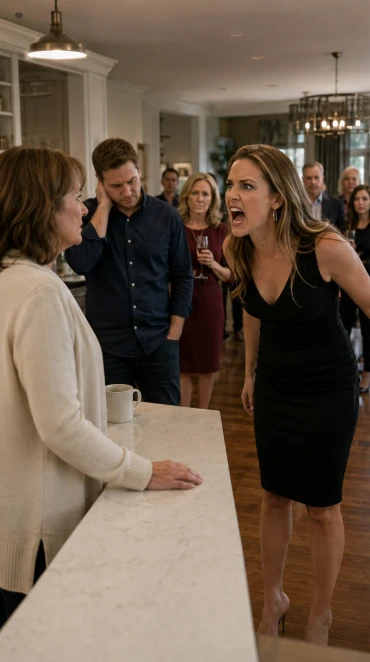
“Where is the food, Chelsea?”
Harper’s voice struck the kitchen harder than the door she had just shoved open.
I remained beside the spotless counter, one hand resting near my untouched coffee mug.
Her eyes moved from me to the cold oven, then toward the empty dining table beyond the doorway.
Fourteen conversations in the living room faded into an uneasy silence.
Champagne glasses stopped clinking.
Someone lowered the music.
Harper stared at me as though I had deliberately ruined an event I had never agreed to host.
“You knew everyone was coming,” she said.
“I knew you invited them.”
Her jaw tightened.
“That means the same thing.”
“No,” I said. “It doesn’t.”
My son Liam appeared behind her, already wearing the expression he used whenever he wanted trouble to disappear by itself.
“Mom,” he murmured.
I looked at him.
He immediately glanced away.
Harper stepped farther into my kitchen.
Her heels struck the hardwood with sharp, deliberate clicks.
“My family drove all the way here expecting dinner.”
I could see several relatives watching from the living room entrance.
Her mother, Denise, stood nearest the doorway with a champagne flute pressed against her chest.
Harper pointed at the empty table.
“You had one job tonight.”
The insult was delivered slowly.
She wanted everyone to hear it.
Liam rubbed the back of his neck.
“Harper, maybe we should just order something.”
She spun toward him.
“No.”
Her voice sharpened.
“She knew what I needed.”
Then she faced me again.
“My family shouldn’t have to wait for you.”
Nobody moved.
The refrigerator hummed behind me.
An old wall clock ticked above the pantry door.
I watched Harper’s face carefully.
There was no embarrassment there.
No hesitation.
She believed the room belonged to her.
She believed I would lower my head and start apologizing.
Instead, I pulled my chair away from the breakfast table.
The legs scraped loudly across the floor.
Harper’s expression changed slightly.
I stood.
“Are you finished?”
She blinked.
Then she laughed once.
It was a small, dismissive sound.
“Finished?”
“Yes.”
Her relatives shifted behind her.
Liam finally looked directly at me.
Harper folded her arms.
“Chelsea, don’t start acting dramatic.”
I almost smiled.
For four months, I had listened to that word whenever I objected to something happening inside my own home.
Privacy was dramatic.
Boundaries were dramatic.
Respect was dramatic.
Apparently, refusing to cook for uninvited guests was dramatic too.
I reached into the pocket of my cardigan.
My fingers closed around the spare house key.
I placed it on the counter.
The metal made a clean little click.
Harper glanced down.
“What is that supposed to mean?”
“It means we’re finally going to be clear.”
Her smile disappeared.
I had imagined this moment many times.
In every version, I thought my hands might shake.
They didn’t.
My voice remained steady.
“This house belongs to me, Harper.”
Denise lowered her glass.
Harper gave an exaggerated sigh.
“We know that.”
“No,” I said. “You don’t.”
The room behind her became completely still.
A distant New Year’s broadcast continued silently on the television.
Bright graphics flashed across the screen.
Nobody paid attention.
I looked at my son.
Then I looked at his wife.
“Your party is over.”
Harper stared at me.
I gestured toward the entryway, where winter coats covered almost every hook and chair.
“Everyone can collect their things.”
Her mouth opened.
I continued before she could speak.
“And you and Liam can pack yours.”
Liam’s face went pale.
“Mom.”
“You’re leaving tonight.”
For several seconds, nobody seemed certain whether I had actually said it.
Harper recovered first.
“You can’t be serious.”
“I have never been more serious.”
She took a step toward me.
“This is insane.”
“No.”
I met her eyes.
“What became insane was pretending this arrangement could continue.”
That sentence landed differently.
Even Harper heard it.
Her relatives began looking at her instead of me.
The clock ticked toward the hour.
Somewhere outside, fireworks cracked above another neighborhood.
Harper’s face flushed.
“You’re throwing us out on New Year’s Eve?”
“I’m ending an arrangement you stopped respecting months ago.”
Liam whispered my name again.
I ignored him.
Harper laughed nervously.
“You’re unbelievable.”
“Maybe.”
I picked up the key again.
“But I’m still the homeowner.”
That was where the room changed.
Not loudly.
Not dramatically.
The change happened in people’s faces.
Until that moment, Harper had been directing the evening.
She had welcomed guests.
She had announced plans.
She had described my rooms as though they belonged to her.
Now everyone understood something she had carefully avoided mentioning.
Nothing in that house was hers.
Not the kitchen.
Not the dining room.
Not the bedroom upstairs.
Not the walls she had discussed removing.
Not even the front door she had opened for fourteen people without asking me.
Denise finally spoke.
“Harper, what exactly is going on?”
Harper turned quickly.
“Nothing.”
Denise looked toward me.
“It doesn’t sound like nothing.”
“Mom, please.”
Harper’s confidence flickered.
I noticed it immediately.
For the first time that night, she wanted privacy.
Unfortunately for her, she had invited an audience.
Denise stepped into the kitchen.
She was a well-dressed woman in her early sixties with silver earrings and a careful expression.
“Chelsea,” she said, “did you know we were all coming tonight?”
“I learned about it after Harper had already invited everyone.”
Denise looked at her daughter.
“You told me Chelsea wanted to host.”
Harper’s shoulders stiffened.
“I said we were having it here.”
“That isn’t what you said.”
A cousin near the doorway cleared his throat.
Someone else suddenly became very interested in a champagne label.
Harper’s eyes flashed.
“This is ridiculous.”
I said nothing.
She had spent months filling every silence with her version of events.
I decided to let the silence work against her.
The first few weeks after Liam and Harper arrived had not looked dangerous.
They looked temporary.
That distinction mattered.
My husband, Paul, had died three years earlier.
Afterward, the four-bedroom house outside Columbus became painfully quiet.
The quiet was worst in winter.
Ohio evenings arrived early, and every room seemed larger after sunset.
Liam called one November afternoon and asked whether he and Harper could stay for several months.
Their apartment lease was ending.
They wanted to save money for a future down payment.
He sounded embarrassed asking.
I told him he never needed to feel embarrassed asking his mother for help.
When they arrived, I honestly felt relieved.
The hallway had footsteps again.
The kitchen had conversation again.
Some evenings, Liam sat with me while football played on television.
For a short while, I thought sharing the house might help all of us.
Harper seemed grateful too.
She hugged me on their first night.
“Thank you, Chelsea.”
I remembered her smile.
“We won’t be in your way.”
I believed her.
My expectations were simple.
Clean whatever you use.
Pay for your personal groceries.
Ask before inviting people.
Stay out of my bedroom.
Those were not complicated rules.
Harper agreed to every one.
Liam agreed too.
Within days, little things began changing.
Shoes collected beside the staircase.
Coffee cups remained on tables.
Wet towels appeared over bathroom doors.
None of it seemed worth a fight.
I reminded them gently.
Liam apologized.
Harper usually smiled.
Then she left the same mess the next day.
The kitchen became the first real problem.
Harper loved cooking when someone else cleaned afterward.
One Friday evening, she made pasta for herself and Liam.
Sauce covered the stove.
A pan soaked in the sink.
Parmesan remained open on the counter overnight.
The next morning, she walked past everything.
I called from the breakfast table.
“Harper, you forgot the kitchen.”
She looked around.
“Oh.”
Then she smiled.
“I’ll get it later.”
By afternoon, nothing had changed.
I cleaned only the section I needed.
She came downstairs around four.
“You didn’t finish?”
“I didn’t start.”
She stared at me.
“The dishes.”
“They’re yours.”
She looked genuinely offended.
“You were already in here.”
“So?”
She shrugged.
“I figured you’d just do them.”
That was the first time I understood how differently we viewed my retirement.
To me, retirement meant forty-three working years had ended.
To Harper, retirement apparently meant unlimited availability.
“I clean after myself,” I said.
She gave a tiny laugh.
“Okay.”
The laugh bothered me more than an argument would have.
It suggested my answer was temporary.
Two days later, I found her inside my bedroom.
She stood near the closet with one of my old leather handbags in her hands.
The bag had belonged to my mother.
I had kept it because she carried it to Liam’s high school graduation.
Harper held it against herself in the mirror.
“You don’t mind, right?”
I stopped in the doorway.
“Yes.”
Her smile slipped.
“I’m just borrowing it.”
“You didn’t ask.”
“I’m asking now.”
“No.”
She stared at me for several seconds.
Then she placed the handbag on the bed.
“You’re kind of territorial.”
“It’s my bedroom.”
“I wasn’t stealing anything.”
“I didn’t say you were.”
She rolled her eyes.
“You’re making it feel weird.”
I waited until she left.
That afternoon, I drove to a hardware store near Westerville.
I bought a strong lock for my bedroom door.
The clerk asked whether I wanted installation screws.
“I want everything that comes with it.”
Back home, I installed it myself.
Paul had taught me to use basic tools years earlier.
The lock took twenty minutes.
Harper noticed immediately.
By dinner, Liam came looking for me.
“Mom, can we talk?”
I knew what was coming.
“Sure.”
He leaned against the kitchen island.
“Harper thinks the lock is a little much.”
“What does Harper need from my bedroom?”
“That’s not the point.”
“It’s exactly the point.”
He sighed.
“She feels like you don’t trust her.”
“She entered my private room without permission.”
“She was borrowing a purse.”
“She was taking a purse before asking.”
Liam rubbed his forehead.
“Can we not turn everything into a battle?”
I looked at him for a long moment.
“Your wife entered my bedroom.”
He looked toward the floor.
“I know.”
“And somehow I’m the person creating a problem?”
“That’s not what I meant.”
“It’s what you came downstairs to tell me.”
He didn’t answer.
That silence became his role in the months that followed.
Harper pushed.
Liam softened her words.
I objected.
Liam asked me to be flexible.
At first, I kept thinking he would eventually notice the pattern.
Instead, he adjusted to it.
Harper began inviting friends over.
Sometimes she asked.
Usually she informed me.
One Saturday, I returned from the grocery store and found six people watching football in my living room.
Their shoes were scattered across the entryway.
Two strangers were sitting on Paul’s old leather recliner.
A cooler rested against my coffee table.
Harper waved from the couch.
“Chelsea, you’re back.”
I stood holding two grocery bags.
“So I am.”
One of her friends smiled awkwardly.
Harper continued watching the television.
“We’re just hanging out.”
“I can see that.”
She finally noticed my expression.
“It’s okay, right?”
I looked around.
“At this point, does the answer matter?”
Her friends went quiet.
She laughed as though I had made a joke.
That night, the kitchen looked terrible.
Glasses covered the counters.
Food had hardened inside two baking dishes.
Something sticky spread beneath the refrigerator handle.
I left it.
The next morning, Harper came downstairs in slippers.
She stopped in the kitchen.
“Oh.”
I drank my coffee.
She glanced at me.
“You haven’t cleaned up yet?”
“I cleaned what I used.”
She frowned.
“Liam and I both work full-time.”
“I know.”
“You’re home all day.”
“I’m retired.”
“Exactly.”
I put my mug down.
“Retired means I stopped working.”
She stared.
“It doesn’t mean I became your housekeeper.”
Her expression hardened.
“I didn’t say housekeeper.”
“You didn’t need to.”
She grabbed a paper towel and wiped the counter aggressively.
“You know, helping wouldn’t kill you.”
“Neither would asking before filling my house with strangers.”
She threw the towel into the trash.
“This doesn’t feel very welcoming.”
I almost laughed.
“You’ve been here six weeks.”
“So?”
“You are not a guest anymore.”
She looked genuinely confused.
“That sounds mean.”
“It’s practical.”
When Liam came home, he found us barely speaking.
He asked what happened.
Harper told him I had embarrassed her.
She did not mention the uninvited guests.
She did not mention the kitchen.
She did not mention expecting me to clean everything.
Liam came into the laundry room later.
“Could you maybe be gentler with her?”
I folded a towel.
“Did she tell you what happened?”
“She told me enough.”
“That wasn’t my question.”
He exhaled.
“Mom.”
I looked up.
“Ask her how many people were here yesterday.”
He paused.
“How many?”
“Six.”
He frowned.
“She didn’t tell me that.”
“Ask whether she asked me first.”
His face changed.
Still, he did not go confront her.
He simply said, “I’ll talk to her.”
I never heard the conversation.
Nothing improved.
By December, Harper had begun discussing my house as though it were a shared asset.
She suggested replacing my dining table.
She criticized the wallpaper in the upstairs hallway.
She wanted smart locks.
She wanted newer appliances.
She wanted to convert Paul’s workshop into an exercise room.
I rejected each suggestion.
She kept making more.
One afternoon, I heard her giving someone a video tour on her phone.
“This wall could totally come down.”
She was standing between my dining room and kitchen.
I stepped into view.
“That wall is staying.”
She jumped.
Then she laughed.
“I was brainstorming.”
“Brainstorm about your future house.”
Her face cooled.
“You know, eventually Liam will inherit this place.”
The sentence stopped me.
She noticed.
“What?”
“Nothing.”
I walked away.
I did not answer because the thought bothered me.
Not because inheritance was impossible.
Because she had already started treating my death as a real estate plan.
A few nights later, I heard their voices from the kitchen.
They thought I was upstairs.
I had come down quietly for water.
Harper was speaking first.
“I’m saying it makes financial sense.”
Liam sounded tired.
“She’s not going to do that.”
“You haven’t even asked.”
“Because I know her.”
“Then convince her.”
I stopped near the hallway.
“Convince her of what?”
Neither spoke for several seconds.
Harper recovered first.
“We were talking about finances.”
I stepped into the kitchen.
“Whose?”
Liam stood near the sink.
Harper sat at the island with a tablet.
“Our future.”
“That sounds private.”
“It involves the house.”
I looked at Liam.
He looked miserable.
“What about my house?”
Harper placed both hands on the counter.
“If you transferred ownership, we could use the equity more efficiently.”
I stared at her.
She kept talking.
“We could renovate.”
“We?”
“You’d still live here.”
“How generous.”
She frowned.
“I’m trying to think long-term.”
“For whom?”
“For everyone.”
Liam finally spoke.
“Mom, I didn’t bring this up.”
Harper snapped toward him.
“You said we needed options.”
“I didn’t say this.”
She rolled her eyes.
Then she turned toward me again.
“You don’t need four bedrooms.”
I felt something settle coldly inside my chest.
“What do you suggest?”
“There’s space downstairs.”
“The basement?”
“It could be finished beautifully.”
“You want me to sign away my home and move into my basement?”
She lifted both palms.
“You’re making it sound awful.”
“How should it sound?”
“Practical.”
That word again.
I looked at Liam.
He said nothing.
His silence hurt more than Harper’s proposal.
I did not expect him to attack his wife.
I expected him to remember who had given him a place to live.
I expected one sentence.
That’s enough.
He never said it.
I left the kitchen.
Harper called after me.
“We were just discussing possibilities.”
I went upstairs.
My bedroom lock clicked behind me.
That night, I understood something important.
My boundaries were not failing because they were unclear.
They were failing because Harper believed persistence would eventually erase them.
Liam’s avoidance made that belief stronger.
The next morning, I changed how I responded.
I stopped explaining.
When Harper asked about the house again, I said no.
When she complained about my rules, I said they remained.
When she invited people without asking, I stayed out of the event.
I no longer cooked extra meals.
I stopped doing shared laundry.
I stopped smoothing tension for Liam.
The house grew uncomfortable.
That was not accidental.
Comfort had become Harper’s greatest weapon.
She depended on everyone else protecting it.
If I stayed quiet, she won.
If Liam avoided conflict, she won.
If guests laughed awkwardly, she won.
By Christmas week, she seemed almost angry that I had not surrendered.
Then came New Year’s Eve.
She announced her plans at breakfast.
“Fourteen people are coming.”
I looked up from the newspaper.
“When?”
“New Year’s Eve.”
“That’s tomorrow.”
“I know.”
“You invited fourteen people here?”
She opened the refrigerator.
“They’re family.”
“Your family.”
She turned.
“Liam’s family too.”
“Not my guests.”
She shut the refrigerator harder than necessary.
“They already made plans.”
“You should have asked before they made them.”
Her eyes narrowed.
“Are you seriously going to make this difficult?”
“I’m not making anything difficult.”
“My mother loves roast beef.”
I waited.
“And?”
“Scalloped potatoes too.”
I actually laughed.
Harper stared at me.
“What?”
“Nothing.”
“You know how to make both.”
“I do.”
“Great.”
She walked away.
I called after her.
“Harper.”
She stopped.
“I did not agree to cook.”
She looked over her shoulder.
“You’re going to let everyone show up without dinner?”
“They’re your guests.”
She shook her head.
“This is exactly what I mean.”
“What do you mean?”
“You make everything harder than it has to be.”
Then she left.
I watched her disappear upstairs.
I did not repeat myself.
She had heard me.
The next day, she went to a salon shortly after lunch.
Liam remained home.
He moved through the house cleaning nervously.
Around three, he came into the kitchen.
“Mom.”
I kept chopping vegetables for my own soup.
“Yeah?”
“Are you really not making dinner?”
“No.”
He leaned on the doorway.
“She thinks you are.”
“I told her I wasn’t.”
He closed his eyes briefly.
“She probably thought you were angry.”
“I was very clear.”
“Could we just get through tonight?”
I put down the knife.
“Meaning?”
“Make something simple.”
“For fourteen people?”
“I’ll help.”
“That isn’t the point.”
He sighed.
“I know.”
“Do you?”
He looked exhausted.
“I’m trying to keep everybody happy.”
“That is impossible.”
“I know that too.”
“Then stop trying.”
His expression softened.
“She’s my wife.”
“And I am your mother.”
“I know.”
“This isn’t about choosing between us.”
“It feels like it.”
“It feels that way because you refuse to tell her when she is wrong.”
He looked toward the hall.
I lowered my voice.
“She tried to turn my house into your financial plan.”
“I didn’t agree with that.”
“You also didn’t stop her.”
He flinched.
“I should have.”
“Yes.”
That single word seemed to hurt him.
I did not soften it.
He needed to feel something.
“I’m sorry.”
I studied his face.
“Are you?”
“Yes.”
“Then act differently.”
He nodded.
For a moment, I thought perhaps he would.
At six, Harper’s relatives began arriving.
The first car pulled into my driveway under a clear, freezing sky.
Then another followed.
Soon the street glittered with headlights and holiday lights.
People came carrying champagne, desserts, flowers, and wrapped bottles.
Several thanked me for hosting.
I corrected the first person.
“This is Harper’s gathering.”
He looked confused.
“Oh.”
Harper arrived shortly after the first guests.
Her hair had been styled.
Her makeup was perfect.
She swept through the house as though entering a venue prepared for her.
She hugged cousins.
She poured drinks.
She never asked about dinner.
That told me she still believed I would surrender.
I sat in the kitchen with my coffee.
From the next room, I heard her giving a tour.
“This room definitely needs brighter paint.”
Someone laughed.
Then I heard Denise.
“I always liked traditional colors.”
Harper replied quickly.
“We’ll modernize everything eventually.”
We.
I closed my eyes.
Another relative asked about the wall between the dining room and kitchen.
Harper explained how she wanted it removed.
Someone mentioned resale value.
She responded confidently.
“We’re not planning to sell anytime soon.”
I opened my eyes.
Even Liam looked uncomfortable.
He caught my gaze from across the living room.
This time, I held it.
He looked away.
At seven-thirty, the guests began drifting toward the dining room.
There was no food.
There were no serving dishes.
No roast beef.
No potatoes.
No appetizers from me.
Harper finally noticed.
She walked into the kitchen.
Her face was still pleasant.
“Where did you put everything?”
I sipped my coffee.
“What everything?”
“The food.”
“There isn’t any.”
She stared.
The pleasant expression vanished.
“You’re joking.”
“No.”
“You seriously didn’t cook?”
“I told you yesterday.”
Her eyes widened.
“You knew my family was coming.”
“Yes.”
“And you did nothing?”
“I stayed out of your event.”
Her breathing changed.
“Chelsea.”
I waited.
“Where is the food?”
“You keep asking the same question.”
Her cheeks reddened.
Behind her, voices softened.
People could hear us.
She realized that too.
Instead of lowering her voice, she raised it.
“You had one job tonight.”
I stood after that.
I had already lived the moment many times privately.
Now I watched everyone else experience it.
Harper’s relatives were not cruel people.
Some looked embarrassed.
Some looked puzzled.
Some clearly wanted to disappear.
They had arrived believing an older woman had happily prepared a family dinner.
Now they were learning something else.
Denise stepped closer.
“Harper, did you ask Chelsea to host?”
“I told her.”
“That isn’t what I asked.”
Harper’s eyes flashed.
“Why are you taking her side?”
“I’m asking a question.”
“This has nothing to do with you.”
Denise glanced toward the crowded living room.
“You invited my entire family.”
“I know.”
“To someone else’s house?”
Harper stiffened.
“It’s Liam’s home too.”
I answered before Liam could.
“No.”
Everyone looked at me.
“He lives here.”
Harper scoffed.
“Same thing.”
“It is not.”
Liam swallowed.
“Harper.”
She turned toward him.
“What?”
He hesitated.
That hesitation almost destroyed the little courage I thought he had found earlier.
Then something changed.
Maybe it was the humiliation on my face.
Maybe it was fourteen witnesses.
Maybe he finally became tired of himself.
“She did tell you she wasn’t cooking.”
Harper went still.
I looked at him.
Denise looked at him too.
Harper’s voice dropped.
“What?”
“Yesterday.”
He spoke more clearly.
“Mom said she wasn’t cooking.”
A cousin near the doorway quietly set down his glass.
Harper stared at her husband.
“You knew?”
“Yes.”
“And you didn’t tell me?”
“I thought you understood.”
She laughed in disbelief.
“You thought I understood?”
“You heard her.”
Harper stepped closer to him.
“You could have called me.”
“You could have listened.”
The sentence surprised everyone.
Especially Harper.
She stared at him as if he had spoken another language.
I did not rescue him.
Liam took a slow breath.
“She also told us to ask before inviting people.”
Harper’s face changed again.
Now she looked cornered.
“This is my family.”
“That doesn’t matter.”
His voice remained quiet.
“This is still Mom’s house.”
There it was.
The sentence I had waited months to hear.
It came too late to save the arrangement.
But it came.
Harper looked toward me.
“So this is what you wanted?”
“No.”
I shook my head.
“I wanted respect before fourteen people were standing in my living room.”
She laughed bitterly.
“You set me up.”
“I warned you.”
“You knew this would happen.”
“I knew you would either listen or ignore me.”
Her eyes sharpened.
“And you just sat here?”
“Yes.”
“That’s cruel.”
“No.”
I kept my voice level.
“Cruel would be pretending you could keep treating me this way.”
The wall clock began chiming.
It was not midnight.
It marked the hour with a deep, familiar sound.
Paul had bought that clock during our twentieth anniversary trip.
I listened to every note.
The room remained silent until it stopped.
Then I put the spare key on the counter.
“This house is mine.”
Harper rolled her eyes.
“You already said that.”
“I’m saying it because you keep behaving otherwise.”
She opened her mouth.
I continued.
“You enter rooms without permission.”
Her expression tightened.
“You invite guests without asking.”
Several relatives shifted.
“You expect me to clean after you.”
Denise slowly lowered her head.
“You discussed taking ownership of this house.”
That sentence changed the room.
Denise looked up sharply.
“What?”
Harper’s eyes widened.
“Chelsea.”
I did not stop.
“You suggested I transfer the property so you could use the equity.”
Denise stared at her daughter.
“You did what?”
“It wasn’t like that.”
“You also suggested moving me downstairs.”
“I said we could renovate.”
“You said I didn’t need my bedroom.”
Harper’s voice rose.
“That is not what I meant.”
Liam spoke quietly.
“It is basically what you said.”
She turned on him.
“You’re unbelievable.”
He looked ashamed.
“No.”
His voice cracked slightly.
“I’ve been unbelievable.”
That silenced her.
He rubbed both hands over his face.
“I should have stopped this months ago.”
Nobody interrupted.
I watched my son look toward me.
His eyes were wet.
“I kept thinking if I didn’t pick a side, things would calm down.”
I said nothing.
He swallowed.
“But not picking a side was still a choice.”
For the first time in months, I felt something loosen inside my chest.
Not forgiveness.
Not yet.
Recognition.
That mattered.
Harper stared between us.
“So now everyone is against me.”
Denise shook her head.
“Stop doing that.”
Harper looked at her mother.
“Doing what?”
“Turning every consequence into persecution.”
The words hit harder than shouting.
Harper’s face went pale.
Denise set her glass on the counter.
“You told us Chelsea invited everyone.”
Harper looked away.
“You told me she loved hosting.”
“She used to.”
I spoke quietly.
“I still do.”
Denise glanced toward me.
“I simply prefer knowing I’m hosting.”
A few people gave awkward, sympathetic smiles.
Harper folded her arms tightly.
“This whole thing is being blown out of proportion.”
I picked up the key.
“No.”
I held it between two fingers.
“This ends tonight.”
Liam’s face tensed.
Harper looked almost relieved.
“Great.”
She laughed sharply.
“Then everyone can go.”
“Yes.”
Her relief vanished.
I nodded toward the entrance.
“The party is over.”
Several people exchanged glances.
Nobody argued.
Denise reached for her coat first.
That seemed to make Harper panic.
“Mom, seriously?”
Denise turned.
“What would you like me to do?”
“Stay.”
“For what?”
“It’s New Year’s Eve.”
Denise’s expression softened, but her voice remained firm.
“We can celebrate somewhere else.”
Harper looked humiliated.
I understood that feeling.
She had given it to me many times.
I did not enjoy watching it happen to her.
That surprised me.
I had expected satisfaction.
Instead, I mostly felt tired.
Guests began gathering coats.
Someone quietly started collecting bottles.
A cousin apologized to me.
“You don’t owe me an apology.”
He nodded toward Harper.
“Still.”
I understood.
The room emptied gradually.
No one stormed out.
No one shouted.
That made everything worse for Harper.
The departure felt orderly.
Final.
Denise paused beside me before leaving.
“I’m sorry.”
“You didn’t know.”
“No.”
She glanced toward her daughter.
“But I should have asked more questions.”
I nodded.
“That makes two of us.”
She squeezed my hand once.
Then she left.
Harper stood in the living room as the last relatives disappeared through the front door.
Outside, engines started.
Headlights moved across my walls.
Within minutes, the house became quiet again.
Harper turned toward me.
“There.”
Her voice trembled.
“You got what you wanted.”
I shook my head.
“No.”
She stared.
“What more could you possibly want?”
“Your things packed.”
The words came softly.
That made them stronger.
Liam looked at me.
“Tonight?”
“Yes.”
Harper laughed again.
This time, there was fear beneath it.
“You can’t put us on the street.”
“I’m not putting you on the street.”
“Where are we supposed to go?”
“You have jobs.”
“You have savings.”
“You have family nearby.”
I paused.
“And you have options.”
Harper looked at Liam.
“Say something.”
He remained still.
“Liam.”
He finally answered.
“She’s right.”
Harper stared.
“What?”
“We need to leave.”
“You’re choosing her.”
“No.”
He shook his head.
“I’m accepting what we did.”
“What we did?”
He looked directly at her.
“Yes.”
Her eyes narrowed.
“I didn’t hear you complaining when we were saving money.”
“I should have.”
“I didn’t hear you complaining when she cooked.”
“I should have helped.”
“I didn’t hear you complaining when I talked about renovating.”
“That was different.”
“How?”
“Because it wasn’t ours.”
His voice strengthened.
“It was never ours.”
Harper’s eyes filled.
“So that’s it?”
Liam looked devastated.
“I don’t know.”
Neither did I.
That uncertainty was honest.
I had no magical answer for their marriage.
I had no desire to become the reason they stayed together or separated.
I simply knew they could not remain in my house.
“Pack what you need tonight,” I said.
“You can return for the rest tomorrow.”
Harper turned toward the stairs.
She stopped halfway there.
“You really planned this.”
“No.”
She looked back.
“I decided it.”
“When?”
I thought about that.
“Probably the night you discussed moving me into my basement.”
She looked away.
For once, she had no response.
They went upstairs.
I stayed in the kitchen.
The wall clock kept ticking.
Outside, fireworks appeared above rooftops.
Red sparks reflected against the windows.
I expected to feel triumphant.
Instead, I felt grief.
I remembered Liam at seven years old, running through that hallway with muddy sneakers.
I remembered his first school dance.
I remembered Paul teaching him to drive.
I remembered the first Christmas after college, when he surprised us by coming home early.
A house keeps every version of a family.
That is what makes conflict inside one so painful.
Thirty minutes later, Liam came downstairs carrying two suitcases.
Harper followed with a large overnight bag.
Her face had changed.
The anger was gone.
She looked exhausted.
I stepped toward the front door.
Liam stopped beside me.
“I’m sorry.”
I looked at him.
“For tonight?”
“For all of it.”
Harper stared at the floor.
I crossed my arms.
“I believe you’re sorry now.”
He nodded.
“That isn’t the same as fixing it.”
“I know.”
“You need to understand why you let this happen.”
“I do.”
“No.”
I shook my head.
“You’re beginning to.”
He accepted that.
Harper finally spoke.
“I’m sorry too.”
I turned toward her.
Her voice was quiet.
“I shouldn’t have invited everyone.”
I waited.
She swallowed.
“And I shouldn’t have yelled at you.”
I kept waiting.
She seemed uncomfortable.
Then she added something harder.
“I shouldn’t have talked about the house like it was mine.”
That was the apology that mattered.
Still, apologies do not erase patterns.
“Thank you for saying that.”
She looked up hopefully.
I opened the front door.
Cold air entered immediately.
Her hope disappeared.
“Chelsea.”
“You still need to leave.”
She nodded slowly.
For the first time, she seemed to understand that forgiveness and access were different things.
Liam loaded the suitcases into their car.
Harper stood outside near the porch.
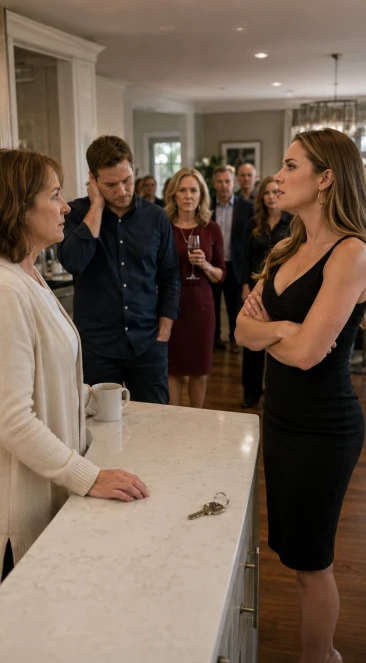
I remained inside.
Before leaving, Liam came back alone.
“Can I call you tomorrow?”
“Yes.”
He looked relieved.
“But don’t call to convince me to change my mind.”
“I won’t.”
“Call if you want to talk.”
He nodded.
“I do.”
I touched his arm.
It was the first affectionate gesture I had given him all evening.
His eyes closed for a second.
“Happy New Year, Mom.”
The words nearly broke me.
“Happy New Year, Liam.”
He walked down the steps.
I watched their car leave.
Then I closed the door.
At midnight, I was alone.
The television counted down from ten.
I stood in the kitchen with a small glass of sparkling cider.
When the city erupted in fireworks, I did not celebrate loudly.
I simply looked around.
The house was mine again.
That should have been the ending.
It wasn’t.
Consequences take longer than midnight.
The next afternoon, Liam called.
He and Harper were staying with Denise temporarily.
His voice sounded exhausted.
“Mom, can I come over tomorrow?”
“Yes.”
“Harper too?”
I hesitated.
“Yes.”
They arrived at noon.
Harper looked different without the clothes and confidence she wore during the party.
She carried a cardboard box.
“What’s that?”
“Things I borrowed.”
My stomach tightened.
She placed the box on the dining table.
Inside were several kitchen utensils, two books, a small decorative tray, and one scarf.
I stared.
“You took these?”
She looked embarrassed.
“Not exactly.”
“What does that mean?”
“I used them upstairs.”
“And never returned them.”
“Yes.”
I lifted the scarf.
It had belonged to my sister.
Harper’s face reddened.
“I’m sorry.”
I placed it back.
“Anything else?”
“No.”
“Are you sure?”
“Yes.”
I believed her.
Mostly.
Then she removed something from her purse.
My mother’s leather handbag.
I went still.
“I thought I returned that.”
“You put it on my bed.”
“I took it later.”
I closed my eyes.
Liam looked horrified.
“Harper.”
“I know.”
She sounded ashamed.
“I kept meaning to bring it back.”
I touched the worn leather.
My mother’s initials were still faintly visible inside.
Something inside me hardened again.
“That lock wasn’t dramatic.”
Harper looked down.
“No.”
“It was necessary.”
“Yes.”
Liam stood silently.
I looked at him.
“This is what you defended.”
His face tightened.
“I didn’t know she still had it.”
“You knew enough.”
He nodded.
“I did.”
That mattered too.
Not an excuse.
An admission.
We spent two hours talking.
Nothing about the conversation felt cinematic.
There were long pauses.
There were uncomfortable corrections.
Harper cried once.
I did not rush to comfort her.
Liam apologized repeatedly.
I told him repetition was not repair.
“What does repair look like?” he asked.
“Different behavior.”
He nodded.
“That sounds obvious.”
“It usually is.”
Harper wiped her eyes.
“Do you hate me?”
“No.”
She looked surprised.
“I don’t trust you.”
That answer hurt her more.
I continued.
“Those are different things.”
She nodded slowly.
“Can I fix that?”
“Maybe.”
“How?”
“Not by asking me how.”
She frowned.
I almost smiled.
“You have to figure out what respect looks like when nobody is forcing you.”
She looked toward the handbag.
“I understand.”
“I hope you do.”
They found a small rental apartment two weeks later.
It was not glamorous.
The building stood near a busy road.
Their kitchen was smaller than my pantry.
Liam sent me a picture after they moved in.
Two cardboard boxes served as a coffee table.
His message said, “We’re learning.”
I replied, “Good.”
I did not offer furniture.
That was deliberate.
For years, I had confused helping my son with preventing discomfort.
He needed some discomfort now.
So did Harper.
A month passed.
Then another.
Liam began visiting on Sundays.
At first, he came alone.
We drank coffee.
We talked about ordinary things.
Work.
Weather.
Football.
Then slowly, we discussed harder things.
He told me he had been afraid of conflict since childhood.
That surprised me.
“You and Dad barely fought.”
“I know.”
He looked down.
“That’s why I never learned how.”
I thought about Paul.
He had been gentle, but direct.
Maybe Liam had mistaken peace for the absence of disagreement.
“Conflict isn’t always failure,” I said.
“I’m figuring that out.”
“What does Harper think?”
“She hates that sentence.”
I laughed.
He smiled.
It felt good.
Not perfect.
Good.
Harper stayed away until March.
Then she called me herself.
“Chelsea?”
“Yes?”
“Could I take you to lunch?”
I almost said no.
Instead, I agreed.
We met at a diner near Worthington.
Nothing fancy.
Red booths.
Bottomless coffee.
A waitress who called everyone honey.
Harper arrived first.
That surprised me.
She stood when I approached.
“Thanks for coming.”
“You’re welcome.”
We ordered sandwiches.
For several minutes, neither of us mentioned New Year’s Eve.
Then Harper put down her fork.
“I was awful.”
I looked at her.
“That’s a broad statement.”
She gave a weak smile.
“I made a list.”
“Of awful things?”
“Yes.”
Despite myself, I laughed.
She pulled folded paper from her purse.
I raised an eyebrow.
“You actually made a list.”
“I needed to.”
She unfolded it.
“I treated your home like it was Liam’s future property.”
I said nothing.
“I treated your time like it belonged to me.”
Still nothing.
“I used being busy as an excuse.”
She swallowed.
“I also kept pushing because Liam usually avoided saying no.”
That one was important.
“And?”
She glanced toward the paper.
“I knew he hated conflict.”
“Did you use that?”
“Yes.”
Her answer came quickly.
No defense.
No excuse.
I appreciated that.
She continued.
“I told myself I was more decisive.”
“What were you really?”
She thought carefully.
“Controlling.”
I leaned back.
“That’s closer.”
She nodded.
“I’ve been seeing someone.”
“A therapist?”
“Yes.”
I had not expected that.
She looked nervous.
“I didn’t want to tell you because it sounds like I’m trying to earn points.”
“You’re not.”
“Good.”
She folded the paper again.
“I’m doing it because I don’t like who I became.”
That sentence changed something.
Not everything.
Something.
“I don’t want you to become anyone for me,” I said.
“I know.”
“You need to do it for yourself.”
“I am.”
We finished lunch.
When the check came, Harper picked it up.
I reached for my wallet.
She shook her head.
“No.”
“This is not repayment.”
“I know.”
“It’s lunch.”
I studied her.
Then I let her pay.
Outside, wind moved through bare trees.
Spring had not quite arrived.
Harper stood beside her car.
“Can I ask something?”
“You just did.”
She laughed.
The sound felt natural.
“Do you think you’ll ever trust me again?”
“I don’t know.”
She nodded.
That answer hurt her.
But she accepted it.
“I’ll keep trying anyway.”
That was the right answer.
By summer, the relationship had changed.
Harper never entered my house without knocking.
Even when the door was unlocked.
She asked before bringing anyone.
She returned dishes immediately.
The changes were almost comically ordinary.
That made them believable.
Liam changed too.
He became more direct.
Sometimes that meant disagreeing with me.
I welcomed it.
One afternoon, I suggested they save more aggressively.
He shook his head.
“Mom, that’s our decision.”
For half a second, I felt offended.
Then I laughed.
“What?”
“Nothing.”
I smiled.
“Good answer.”
He looked suspicious.
“You’re not mad?”
“No.”
“I’m impressed.”
He laughed too.
That was the strange gift hidden beneath a terrible New Year’s Eve.
We all learned boundaries.
Even me.
I learned that boundaries without consequences are merely requests.
Harper learned that confidence does not create ownership.
Liam learned that avoiding conflict can quietly support the person causing it.
The house changed as well.
I repainted the upstairs hallway.
Not because Harper wanted it changed.
Because I did.
I chose a warm cream color.
I hired someone to repair the porch.
I converted one spare bedroom into a reading room.
Paul’s workshop remained untouched.
Some spaces deserved continuity.
Others deserved new life.
In November, nearly eleven months after the confrontation, Denise called me.
Her invitation surprised me.
“We’re planning New Year’s Eve early this year.”
I laughed.
“That seems wise.”
She laughed too.
“We’re hosting.”
“At your house?”
“Definitely at my house.”
I heard amusement in her voice.
“Harper suggested I ask whether you’d come.”
I paused.
“Did Harper invite me?”
“She asked me to.”
“Interesting.”
“She said it was my house, so I should decide.”
I smiled.
“She’s learning.”
“She is.”
I agreed to attend.
On December 31, I arrived carrying scalloped potatoes.
Not fourteen servings.
Twenty.
Denise opened the door.
“Chelsea.”
She hugged me.
“You cooked.”
“I volunteered.”
“That distinction has become very important around here.”
We both laughed.
Harper appeared from the kitchen.
She stopped when she saw the dish.
“You made those?”
“Yes.”
Her face softened.
“You didn’t have to.”
“I know.”
That was the point.
Liam came behind her.
He kissed my cheek.
“Happy New Year, Mom.”
“Almost.”
The party was smaller that year.
Everyone seemed more careful around the memory of the previous one.
Nobody mentioned it directly.
They did not need to.
At dinner, Harper raised her glass.
I braced myself.
She looked around the table.
“I want to thank Mom for hosting.”
Denise nodded grandly.
“You’re welcome.”
Harper continued.
“And Chelsea for bringing food she was actually asked to bring.”
A few people laughed.
I did too.
The tension dissolved.
Later, near midnight, Harper joined me beside the back window.
Snow had begun falling lightly.
“You okay?” she asked.
“Yes.”
She nodded toward the party.
“Better than last year?”
“Considerably.”
She smiled.
Then she became serious.
“I think about that night a lot.”
“So do I.”
“I hated you for about three days.”
“Only three?”
She laughed.
“Maybe five.”
“I’m honored.”
Then her smile faded.
“I thought you were humiliating me.”
“I was protecting myself.”
“I know that now.”
She stared outside.
“I didn’t know the difference then.”
That sentence stayed with me.
Behind us, everyone began gathering for the countdown.
Liam called from the living room.
“One minute.”
Harper turned.
“Coming.”
Then she looked at me again.
“Chelsea?”
“Yes?”
“Thank you for not pretending everything was fine afterward.”
I studied her.
“That would have been easier.”
“I know.”
“Easy wasn’t helping anyone.”
She nodded.
We returned to the living room.
At midnight, everyone counted together.
Ten.
Nine.
Eight.
I watched Liam reach for Harper’s hand.
She took it.
Seven.
Six.
Denise handed me a glass.
Five.
Four.
Outside, snow covered the quiet suburban street.
Three.
Two.
One.
The room erupted.
People hugged.
Someone opened champagne.
Liam crossed the room and hugged me tightly.
“Happy New Year.”
I held him.
“Happy New Year.”
Harper waited beside him.
Then she opened her arms uncertainly.
I stepped forward.
Her hug was careful.
Not performative.
Not possessive.
Just careful.
That mattered.
When we separated, she smiled.
“No yelling this year.”
“I appreciate the effort.”
She laughed.
A few minutes later, I walked toward the kitchen.
Denise’s house was full of noise.
Someone had already left two plates beside the sink.
I stared at them.
Harper appeared beside me.
She followed my gaze.
“Oh no.”
I raised one eyebrow.
She grabbed both plates immediately.
“Not happening again.”
I laughed so hard I had to hold the counter.
Harper laughed too.
For the first time, the memory no longer felt like an open wound.
It felt like a scar.
Visible.
Permanent.
But healed enough to touch.
Near one in the morning, I drove home.
Snow moved through the headlights.
My neighborhood was almost silent.
When I entered my house, the hallway felt peaceful rather than empty.
I hung my coat.
I checked the front door.
Then I walked into the kitchen.
The old clock ticked above the pantry.
The same clock.
The same room.
The same counter where I had placed that spare key one year earlier.
I opened the drawer.
The key was still there.
I picked it up.
For months, I had thought of that tiny piece of metal as the symbol of the night I forced my son out.
Now I understood it differently.
The key represented something I had nearly forgotten.
A door can be opened out of love.
It can also be closed for the same reason.
I returned the key to the drawer.
Then I turned off the kitchen light.
Before heading upstairs, I paused in the hallway.
Paul’s photograph sat on the small table near the stairs.
He was smiling from a summer afternoon many years earlier.
I touched the frame.
“You would have hated that whole mess,” I whispered.
The house remained quiet.
I smiled anyway.
“And you would have told me to stand my ground.”
Outside, distant fireworks flashed beyond the neighborhood.
Inside, nothing needed fixing.
Not tonight.
I climbed the stairs slowly.
At the top, I passed my bedroom door.
The heavy lock still remained.
I considered removing it.
Then I changed my mind.
Not because I expected Harper to cross that boundary again.
Because some lessons deserve a physical reminder.
I touched the lock once.
Then I continued toward bed.
The following morning, Liam sent me a photograph.
It showed Harper standing in their small apartment kitchen.
She was washing dishes while glaring theatrically at the camera.
His message said, “She says this proves personal growth.”
I laughed.
A second message arrived.
“She also says not to tell you I left the plates there.”
I typed back.
“Some lessons require repetition.”
Three dots appeared.
Then Liam replied.
“Fair.”
I set the phone down beside my coffee.
Morning light spread across the kitchen.
The house was quiet.
But it was not lonely anymore.
There is a difference between being alone and being erased.
For months, I had been surrounded by people while slowly disappearing inside my own home.
Now I stood alone in the room and felt completely present.
That was the real reversal.
Not throwing out a party.
Not silencing Harper.
Not even reclaiming the house.
It was remembering that love did not require surrender.
Family did not require permission to disrespect you.
Helping someone did not mean handing over your dignity.
And forgiveness did not require returning to the arrangement that caused the harm.
I lifted my coffee.
The old clock ticked steadily above me.
Another year had begun.
My son still had work to do.
Harper did too.
So did I.
Nothing had become perfect.
That was why I trusted the peace.
Perfect endings belong to stories people tell when they are afraid of complicated truths.
Real families change slowly.
They apologize badly.
They try again.
They relapse into old habits.
They correct themselves.
They learn.
Sometimes they even laugh about the night everything finally broke.
I looked toward the dining room.
Last year, fourteen strangers had waited there for a meal I never promised.
This year, sunlight covered the empty table.
I thought about inviting Liam and Harper for dinner next Sunday.
Then I smiled.
I picked up my phone.
I typed one message.
“Dinner Sunday, if you’re free.”
Liam answered almost immediately.
“We’d love to come.”
A second message followed.
“Should we bring anything?”
I stared at the screen.
Then I typed.
“Yes.”
Another pause.
“What?”
I smiled.
“Respect.”
Three dots appeared.
Then Harper sent the reply herself.
“Already packed.”
I laughed alone in my kitchen.
This time, the sound belonged there.