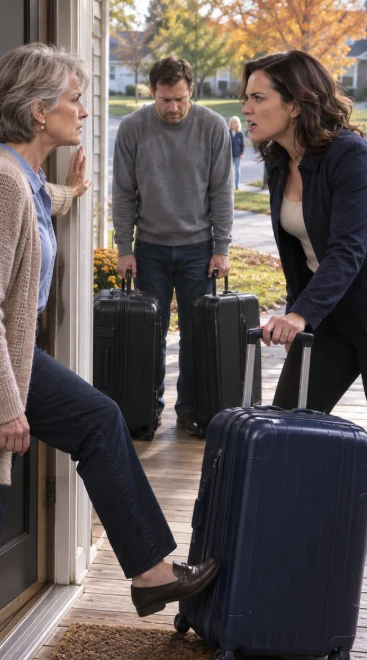
“We’re staying here,” Amanda announced, pushing a navy suitcase toward my open doorway before I had invited anyone inside.
I planted one hand against the doorframe and stopped the suitcase with my shoe.
“No, you’re not.”
For several seconds, nobody moved.
My son Michael stood behind his wife holding two more suitcases. His shoulders sagged beneath a gray sweatshirt, and his eyes remained fixed on the porch boards.
Amanda stared at me as though I had answered a very simple question incorrectly.
“What did you say?”
“You heard me.”
One suitcase wheel clicked against the threshold.
Across the street, Linda Harper stopped collecting mail from her curbside box.
Two houses down, a lawn mower suddenly went quiet.
Amanda glanced toward the neighbors before turning back to me.
“We just lost everything, Dorothy.”
“I know.”
“And you’re standing there acting like strangers showed up asking for a hotel room.”
“You showed up with luggage and no invitation.”
Michael finally lifted his head.
“Mom, can we please just go inside?”
“No.”
His expression changed.
Amanda gave a short, humorless laugh and reached for the suitcase again.
I kept my foot against it.
“Take your luggage.”
“We have nowhere else.”
“That doesn’t make this decision yours.”
Something in Amanda’s face hardened.
She moved closer until only the threshold separated us.
“After everything, you owe us.”
Michael flinched.
I looked at him, waiting for him to object.
He said nothing.
That silence hurt more than Amanda’s words.
“My house is not your emergency plan,” I said.
Amanda’s eyes widened.
“Your house?”
“Yes.”
“This family has spent years carrying you.”
“That isn’t true.”
“Oh, please.”
“Amanda,” Michael said weakly.
She ignored him.
“You’ve always had somewhere to land because Michael never tells you no.”
I looked at my son.
He stared toward the street.
Amanda pointed into my hallway.
“You have three bedrooms.”
“I know.”
“You live alone.”
“That is not an invitation.”
“You’re unbelievable.”
“Maybe.”
October leaves moved across the sidewalk in the breeze.
Amanda lowered her voice.
“We sold our house.”
“That was your decision.”
“We trusted a financial plan.”
“That was also your decision.”
Michael swallowed.
“Mom, we made a mistake.”
The shame on his face was real.
For a second, I almost softened.
Then Amanda nudged the suitcase forward again.
That tiny movement changed everything.
She was not asking for shelter.
She was assuming possession.
I pushed the suitcase back with my shoe.
Its wheels rattled across the porch.
Amanda stared at it.
Then at me.
“Don’t embarrass me.”
I nearly smiled at the irony.
“You came to my house without asking.”
“We’re family.”
“Family asks.”
“Family helps.”
“Helping does not mean surrendering your front door.”
Michael lowered one suitcase to the porch.
“Can everyone stop?”
Nobody answered him.
Amanda stepped closer.
“You have no idea what we’ve been through.”
“I know you believe you lost six hundred twenty thousand dollars.”
Her nostrils flared.
Michael glanced toward Linda.
“Mom.”
“I didn’t announce it.”
Amanda folded her arms.
“You think saying the number makes you better than us?”
“No.”
“You’ve been waiting for me to fail.”
I studied her.
Her voice was angry, but beneath the anger I heard something else.
Fear.
I had noticed it before.
For months, actually.
I had ignored it.
I would not anymore.
“Amanda, take the luggage and leave my porch.”
Michael stepped forward.
“Mom, please.”
“You should have called.”
“We didn’t know what you’d say.”
“You knew.”
His silence answered.
Amanda looked between us.
Then she scoffed.
“Fine.”
For one hopeful second, I thought she meant they would leave.
Instead, she reached toward another suitcase.
“We’ll talk about this inside.”
I blocked the doorway again.
“No.”
Her hand came up quickly during the argument.
There was a sudden contact against my cheek.
The sound carried farther than I expected.
Someone across the street gasped.
Michael dropped the suitcase he was holding.
Its handle struck the porch with a hollow bang.
Nobody spoke.
My cheek stung.
Amanda stared at me, appearing almost surprised by what had happened.
Then her expression closed.
“You kept provoking me.”
Michael looked horrified.
“Amanda.”
“What?”
“What did you just do?”
“Oh, don’t start.”
“She never touched you,” Michael said.
“I moved your luggage away from my doorway,” I added.
Amanda looked toward Linda.
“Wonderful. Now the neighborhood gets a performance.”
I touched my cheek once.
My fingers trembled.
Not because I was afraid.
Something inside me had become remarkably calm.
For months, I had wondered whether I was being too suspicious.
Too rigid.
Too protective of myself.
That doubt disappeared on my porch.
I looked at Michael.
“Take the luggage.”
“Mom.”
“Take it.”
“Amanda shouldn’t have done that.”
“No.”
“But we can fix this.”
“You cannot fix something while pretending it did not happen.”
“I’m not pretending.”
“You arrived expecting my answer not to matter.”
“That wasn’t me.”
“You carried the suitcases.”
His mouth opened.
Nothing came out.
Amanda threw up her hands.
“This is ridiculous.”
I stepped backward and reached for the door.
She immediately moved toward the suitcase nearest the entrance.
“No,” I said.
“What are you doing?”
“Ending the conversation.”
“Dorothy.”
I started closing the door.
Michael stepped forward.
“Mom, what are you doing?”
“Protecting my home.”
The opening narrowed.
Amanda moved closer.
“Dorothy, don’t you dare.”
The door shut.
I turned the deadbolt.
Silence lasted less than two seconds.
Then the bell rang.
Once.
Twice.
Again.
“Mom,” Michael called.
I stood in the hallway.
“Mom, open the door.”
Amanda said something behind him that I could not make out.
Michael knocked again.
I looked toward the framed photograph on my entry table.
My late husband Robert smiled from beneath an old Boston Red Sox cap.
The photograph had been taken near Cape Cod fourteen summers earlier.
He had been gone six years now.
Some mornings, that still felt impossible.
The bell rang again.
I picked up my phone and scrolled to a name I had saved three months earlier.
Margaret Ellis — Attorney.
She answered on the second ring.
“Dorothy?”
“It happened.”
Her voice changed immediately.
“They came?”
“With suitcases.”
“And?”
“I refused.”
Another knock sounded.
Margaret heard it.
“Are they still outside?”
“Yes.”
“Did either of them get inside?”
“No.”
“Good.”
I hesitated.
“There was also a physical incident with Amanda.”
Margaret became silent.
“Are you hurt?”
“My cheek stings. I’m otherwise okay.”
“Any dizziness?”
“No.”
“Any bleeding?”
“No.”
“Did anyone see what happened?”
“At least one neighbor.”
Michael knocked again.
“Mom, please talk to me.”
Margaret’s voice stayed precise.
“Do not open the door.”
“I wasn’t planning to.”
“If they refuse to leave, contact local police.”
I looked toward Robert’s photograph.
“What about the other matter?”
A pause.
Then Margaret said something that made me grip the phone more tightly.
“We received the bank response this morning.”
My heartbeat changed.
“All of it?”
“Enough.”
Outside, Amanda called my name.
Margaret lowered her voice.
“Dorothy, the money did not disappear in the way Michael believes.”
I stared at the wall.
For weeks, I had expected those words.
Hearing them still felt unreal.
“Where did it go?”
“I want to go through the records carefully before we draw final conclusions.”
“Give me the important part.”
She exhaled.
“Most of the large transfers were authorized through Amanda’s access.”
“We knew that.”
“We now know where several of those transfers landed.”
My throat tightened.
“Where?”
“Accounts Michael does not appear to know about.”
The bell rang again.
I barely heard it.
“How much?”
“We are still tracing the full amount.”
“How much have you confirmed?”
“Just over four hundred thousand dollars moved through accounts or entities connected directly to Amanda.”
I sat on the hallway bench.
“And the rest?”
“Some went toward debts and business obligations.”
“Michael’s?”
“That is where it becomes complicated.”
“Margaret.”
“Not primarily his, based on what we have so far.”
I stared toward the front door.
On the other side stood my son.
He believed his future had vanished.
He had sold his house.
He had followed his wife to my porch because he thought they had nowhere else to go.
And Amanda apparently knew more about their financial position than she had told him.
“She told Michael the investment collapsed.”
“That is the story Michael gave us.”
“Did it?”
“Not exactly as described.”
I closed my eyes.
“What happens now?”
“The preservation request was filed this morning.”
I opened my eyes.
“You already submitted it?”
“You told me not to wait if the banking records confirmed your concern.”
“I remember.”
“We received confirmation before nine.”
It was not even eleven.
“What does that mean?”
“If the order remains in place, certain identified funds cannot simply be transferred away while the civil review proceeds.”
A strange calm came over me.
Amanda’s knocking no longer sounded intimidating.
It sounded desperate.
Margaret continued.
“Do not tell Amanda what we found.”
“I won’t.”
“Do not confront her about the money.”
“I understand.”
“Do not make public accusations.”
“I understand.”
“And Dorothy?”
“Yes?”
“Photograph your cheek.”
I looked toward the hallway mirror.
A red mark had started to show.
“I will.”
“Then document what happened and call the police if they stay.”
Outside, Michael finally said loudly:
“Mom, we’re leaving.”
Amanda answered sharply.
A suitcase rolled across the porch.
Then another.
I moved toward the front window and stayed behind the curtain.
Michael was loading luggage into their SUV.
Amanda stood beside it with her arms folded.
Even through the glass, I could feel her anger.
Linda remained near the sidewalk with her phone in her hand.
Amanda noticed her.
Their eyes met.
Linda did not look away.
Michael closed the rear hatch.
Amanda climbed into the passenger seat.
He remained outside for several seconds.
Then he looked toward my front door.
I almost opened it.
That impulse hurt.
He was still my son.
The boy who used to run into my bedroom during thunderstorms.
The teenager Robert taught to drive.
The adult man who had just carried suitcases onto my porch without asking whether I wanted him there.
All three versions existed at once.
Michael finally got into the SUV.
They drove away.
I stayed behind the curtain until the taillights disappeared.
Then I called Linda.
She answered immediately.
“Are you okay?”
“Yes.”
“I saw what happened.”
“I know.”
“Do you need me?”
I looked around my suddenly silent hallway.
“Could you come over?”
“I’m already walking.”
Thirty seconds later, she knocked softly.
I checked the peephole before opening the door.
Linda entered wearing gardening gloves, her silver hair tied behind her head.
The moment she saw my face, her expression hardened.
“That woman.”
“I know.”
“I recorded part of it.”
I stared at her.
“You did?”
“When the argument got louder.”
She held up her phone.
“I didn’t expect the rest.”
“Neither did I.”
“You want the video?”
“Yes.”
She sent it immediately.
Then we sat at my kitchen table.
Linda made coffee because I seemed to have forgotten how.
“You looked different when you closed the door,” she said.
“Different how?”
“Like you had already decided something.”
I wrapped both hands around the mug.
“I had.”
She waited.
I trusted Linda.
But Margaret’s warning remained in my head.
“I’m handling something through an attorney.”
Linda nodded.
“That sounds sensible.”
“I can’t discuss it yet.”
“Then don’t.”
She reached across the table.
“I’m here anyway.”
My eyes suddenly burned.
That nearly undid me.
Not Amanda.
Not the argument.
Kindness.
“I keep thinking about Michael.”
“Of course.”
“He looked ashamed.”
“He should.”
“He also looked lost.”
Linda nodded.
“Both can be true.”
Robert used to say something similar.
People were rarely just one thing.
Love did not erase weakness.
Weakness did not erase responsibility.
By afternoon, I had made a police report and documented the condition of my cheek.
Linda provided the portion of video she had captured.
The officer taking my statement remained calm and professional.
He asked whether I wanted Amanda formally notified not to return to the property without permission.
“Yes,” I said.
That word was becoming easier.
That evening, Margaret called again.
“The preservation order was granted.”
I stood at the kitchen window.
Porch lights glowed along the street.
“What does that mean tonight?”
“It means we have time.”
“To do what?”
“To trace the money without worrying that identified funds may be moved before we can document them.”
I closed my eyes.
“Michael still doesn’t know.”
“No.”
“He believes he has nowhere to live because everything disappeared.”
“I know.”
“That feels cruel.”
“So would warning Amanda before your son has independent advice and the records are secured.”
I hated that she was right.
“What if he calls?”
“Listen.”
“Tell him anything?”
“Tell him he should retain an attorney who represents only him.”
“He’ll ask why.”
“Tell him you cannot discuss financial records involving Amanda.”
“He’ll think I’ve lost my mind.”
“Perhaps.”
Margaret paused.
“He may also begin asking questions he should have asked earlier.”
Michael called at 8:17 that night.
I watched his name on the screen until the ringing nearly stopped.
Then answered.
“Mom.”
“Michael.”
A long silence.
“I’m sorry.”
My fingers tightened around the phone.
“For what?”
“For today.”
“That covers a lot.”
“I’m sorry we showed up without asking.”
“Okay.”
“I’m sorry Amanda yelled.”
I waited.
“And?”
He breathed.
“I’m sorry about what happened on the porch.”
“Thank you.”
“She’s upset.”
“That does not excuse it.”
“I know.”
“Do you?”
Another pause.
“She says you pushed the suitcase toward her.”
“I moved luggage away from my doorway.”
“I know.”
“Linda recorded part of the encounter.”
Silence.
“Recorded?”
“Yes.”
“What exactly?”
“Enough.”
He groaned.
I sat on the edge of my bed.
“Where are you?”
“A motel near Route 9.”
My chest tightened.
“Do you have enough money?”
“For a few nights.”
“Amanda said everything was gone.”
“That’s basically true.”
“Basically?”
“We still have credit cards.”
I looked toward Robert’s empty side of the bed.
“Michael, you need your own attorney.”
“What?”
“Someone who represents only you.”
“Why?”
“I cannot explain everything yet.”
“Mom, what are you talking about?”
“You need independent legal advice.”
His voice sharpened.
“Did you hire a lawyer because of us?”
“I already had an attorney.”
“Before today?”
“Yes.”
Silence.
“What does that mean?”
“I am protecting myself.”
“From me?”
“That depends on the choices you make next.”
He became completely quiet.
I hated saying it.
I also meant it.
When he spoke again, he sounded younger.
“I don’t understand what’s happening.”
“Then start asking questions.”
“About what?”
“Your finances.”
His breathing changed.
“What about them?”
“I cannot say more.”
“Why?”
“Because attorneys are already reviewing records.”
“Something legal?”
“Yes.”
“About Amanda?”
I closed my eyes.
“Hire your own lawyer, Michael.”
The call ended a few minutes later.
Afterward, I cried.
Not dramatically.
I simply sat beside Robert’s photograph and cried until my face hurt.
I was mourning several things at once.
My son’s trust.
My own mistakes.
The marriage he believed he had.
The family I had pretended remained intact.
By morning, grief had become something more useful.
Purpose.
Margaret met me at her office in Worcester the next day.
Her law firm occupied a renovated brick mill near downtown.
She had represented Robert’s business years earlier.
At sixty-three, she wore the same calm expression whether discussing contracts or family emergencies.
She closed her office door.
“We have more.”
A folder sat on her desk.
“How much more?”
“Seven significant transfers followed the sale of Michael and Amanda’s house.”
I leaned forward.
“Michael thought those funds went into investments.”
“Some initially did.”
“Initially?”
“They were later moved.”
“Where?”
“To several accounts and entities associated with Amanda.”
My stomach tightened.
Margaret turned a page.
“One company was established eight months before the house sale.”
“Who controls it?”
“Amanda appears to.”
I stared.
“Michael said they met the financial adviser together.”
“They did.”
“So how did this happen?”
“The adviser appears legitimate based on the preliminary records.”
“Then where did things change?”
“After the initial deposits.”
“Who authorized the later transfers?”
“Most appear to have been made through Amanda’s access.”
I shook my head.
“She told Michael the adviser made bad investments.”
“We have not found records supporting that exact explanation.”
“Where did the money go?”
“Some paid private debts.”
“Whose?”
“Predominantly obligations connected to Amanda.”
“What kind?”
“Credit cards, personal loans, and expenses associated with a business venture.”
“She had a business?”
“A property venture that does not appear to have performed well.”
Margaret slid another document toward me.
The figure beside the company name was more than two hundred thousand dollars.
“She put that much into it?”
“At minimum.”
“Without Michael knowing?”
“That is what his independent attorney will need to determine with him.”
“And the remaining money?”
“Some is still traceable.”
“How much?”
“Enough that partial recovery appears possible.”
For the first time in months, I felt something close to relief.
Michael believed every dollar had vanished.
That apparently was not true.
Margaret folded her hands.
“There is another point.”
I braced myself.
“What?”
“Your name appears in older financial records.”
“Mine?”
“Not as an owner.”
“Then how?”
“As the original source of several years of family assistance.”
That part was not a secret.
After Robert died, I had sold our old Victorian house outside Boston.
Michael and Amanda were struggling then.
They promised I would never have to face retirement alone.
I helped them repeatedly.
Part of their down payment.
Renovations.
A year of property taxes during Michael’s layoff.
Later, Amanda summarized all of that as:
“Dorothy helped once.”
“What does that change?” I asked.
“Perhaps little legally by itself.”
“And practically?”
“It shows substantial prior support.”
“And now they came expecting more.”
“Yes.”
I looked toward the window.
“You think Amanda assumed I would say yes.”
“I think the possibility should be considered.”
“That’s speculation.”
“It is.”
Margaret tapped the folder.
“These transfers are records.”
That distinction mattered.
We did not need to invent motives.
The documents were enough.
Three days later, Michael called again.
He sounded exhausted.
“I hired somebody.”
“An attorney?”
“Yes.”
“Good.”
“He asked Amanda for full account access.”
I remained silent.
“She got angry.”
“I’m sorry.”
“Mom, what did you find?”
“I told you what I could.”
“You knew there was something wrong.”
“I suspected it.”
“Why?”
“Because Amanda’s explanations about the losses kept changing.”
“When?”
“For months.”
“You never told me.”
“I tried.”
“When?”
“Last Christmas.”
Silence.
I remembered the conversation clearly.
At Christmas, Amanda said their money was temporarily locked in an investment.
In March, she blamed market conditions.
By July, she blamed an adviser.
Michael dismissed every question I asked.
“Mom, you worry too much,” he had said.
Now he sounded different.
“What exactly did you ask me at Christmas?”
“Whether you had reviewed the statements yourself.”
Silence.
“You told me Amanda handled finances.”
“I remember.”
“I asked again in March.”
“I remember that too.”
“You told me to stay out of your marriage.”
“I know.”
The words carried pain now instead of irritation.
“Michael, what did your attorney find?”
“Accounts I’ve never seen.”
I closed my eyes.
“I’m sorry.”
“You knew?”
“I learned about them from Margaret.”
“Why does your attorney have records tied to my finances?”
“Because some of the transactions intersect with funds I previously provided and with representations now being made about my current property.”
“What funds?”
“The money I gave you after I sold the Victorian.”
His defensiveness returned immediately.
“That was a gift.”
“Yes.”
“So why—”
“I am not asking for the gift back.”
He stopped.
“Then what are you doing?”
“Making sure nobody can turn my current home into the solution for financial decisions I did not make.”
“That sounds like something Margaret wrote.”
“It probably does.”
A weak laugh escaped him.
Then his voice cracked.
“She lied to me.”
I said nothing.
“I asked her last night.”
“What did she say?”
“That you were making me paranoid.”
“That sounds painful.”
“She called my lawyer a parasite.”
I looked toward the ceiling.
“Michael.”
“What?”
“Stop arguing about facts you can independently obtain.”
He became quiet.
“That sounds like Dad.”
“It probably is.”
Robert had always believed documents were calmer than accusations.
Then Michael asked:
“Can I come over?”
My chest tightened.
“Alone?”
“Yes.”
“When?”
“Tonight.”
I remembered the luggage.
The porch.
The locked door.
“Not tonight.”
His disappointment was immediate.
“Okay.”
“We can meet tomorrow.”
“Where?”
“The Denny’s near Lincoln Street.”
“A diner?”
“A public place.”
Another pause.
“Because you’re afraid of me?”
“No.”
“Because of Amanda?”
“Because I need boundaries.”
He whispered:
“Okay.”
Michael arrived ten minutes early.
He looked as though he had not slept.
We sat in a booth beneath fluorescent lights while a waitress poured coffee neither of us needed.
For several seconds, we simply looked at one another.
Then he said:
“She moved the money.”
“Yes.”
“Over four hundred thousand.”
“That matches what Margaret found.”
“You already knew?”
“My attorney had records.”
He rubbed both hands across his face.
“She told me those accounts were business reserves.”
“For what business?”
“She finally admitted she started a property company.”
“That matches our records.”
He stared.
“Listen to us. ‘Our records.’”
“I know.”
“She used the money from our house.”
“Yes.”
“I signed that sale because she said we were simplifying everything.”
“I know.”
He looked through the window.
“She said we would invest for two years.”
I waited.
“She said we could rent until the returns stabilized.”
His laugh sounded empty.
“Then everything supposedly collapsed.”
“What did she show you?”
“Screenshots.”
“Statements?”
“No.”
“Emails?”
“Some.”
“Did your attorney verify them?”
Michael nodded slowly.
“They’re real.”
“That matters.”
“But they don’t say what she told me they said.”
I waited.
“They show withdrawals.”
“Through Amanda?”
“Yes.”
He looked down.
“For months, I blamed an adviser I had barely met.”
“You were working with incomplete information.”
“I was also refusing information I didn’t like.”
That was harder.
Michael looked at me.
“Did you expect us to show up at your house?”
“I thought it was possible.”
“Why?”
“Because you asked how many guest rooms I had three days earlier.”
He grimaced.
“I thought I was subtle.”
“You were never subtle.”
For the first time, a tiny smile appeared.
Then vanished.
“What happens now?”
“That depends on you.”
“And Amanda?”
“That depends on the attorneys and the records.”
He leaned toward me.
“Are you going forward with the report about the porch?”
“I documented what happened.”
His face tightened.
“She says she barely touched you.”
“Linda has video.”
“I know.”
“And Amanda was formally told not to return to my property without permission.”
His eyes widened.
“You did that?”
“Yes.”
“Mom.”
“I need you to understand something.”
He stopped.
“I love you.”
His eyes filled.
“But you do not get to move into my house simply because your life fell apart.”
He lowered his gaze.
“I know.”
“You didn’t know that last week.”
“No.”
“You arrived with luggage.”
“I know.”
“You expected me to give in.”
His eyes closed briefly.
“Yes.”
The admission hurt.
I respected it anyway.
“Why?”
“Because I thought you would.”
I nodded.
“Thank you for saying it.”
“That sounds awful.”
“It is awful.”
He laughed once under his breath.
“Dad would have destroyed me.”
“No.”
Michael looked up.
“He would have been disappointed.”
“That’s worse.”
“Yes.”
The waitress returned.
We ordered eggs neither of us wanted.
Michael told me more.
Amanda had always kept the passwords.
She handled taxes.
The investment portal.
Statements.
He considered it efficient.
Now every convenience looked different.
“She always said I was terrible with paperwork.”
“Are you?”
“Yes.”
I almost smiled.
“That doesn’t mean you give up access to your own financial life.”
“I understand that now.”
When breakfast ended, Michael reached toward me but stopped halfway.
“Can I hug you?”
That question mattered.
“Yes.”
We hugged beside the booth.
He cried quietly against my shoulder.
I cried too.
Then we separated.
He did not ask for a bedroom.
He did not ask for money.
He did not ask me to fix what had happened.
That mattered even more.
The legal process moved slowly.
Amanda retained her own attorney.
Her explanations changed over time.
First, the transfers were legitimate investments.
Then temporary business loans.
Then transactions Michael had supposedly approved verbally.
Michael disputed that.
The records became more important than anyone’s memory.
Margaret’s preservation order helped keep identified assets in place while a forensic accountant traced transfers among Amanda’s company, personal obligations, and remaining investment accounts.
The full picture took weeks.
It was complicated.
But it was not what Michael had initially believed.
The entire $620,000 had not simply vanished.
Some money had genuinely been lost through unsuccessful investments and business expenses.
Some remained tied to property deposits.
Some sat in accounts connected to Amanda.
A meaningful portion appeared potentially recoverable.
The central issue was no longer that every dollar was gone.
It was that Michael had not been given a complete picture of what was happening.
He believed they had been completely wiped out.
That belief had sent him toward my house carrying suitcases.
By the time we understood the real situation, the porch incident looked less like an isolated family argument and more like the moment pressure finally broke through everything they had been avoiding.
One December afternoon, Margaret called.
“We have a settlement proposal.”
I was sitting beside my Christmas tree.
Robert’s old ornaments hung among the lights.
“What does it say?”
“Amanda is prepared to provide full disclosure of the remaining identified accounts.”
“Why now?”
“Her attorney has reviewed much of the documentation.”
“And Michael?”
“His attorney is negotiating separately.”
“Will he recover anything?”
“Likely.”
“How much?”
“I would rather not estimate until the accounting is final.”
“That seems fair.”
Margaret paused.
“There is also the matter involving what happened at your home.”
I touched my cheek instinctively.
The mark had disappeared months earlier.
The memory had not.
“Amanda wants that addressed through counsel.”
“What do you recommend?”
“That depends on your priority.”
I looked toward Robert’s photograph.
Once, I thought I wanted punishment.
Now I mainly wanted peace that did not require surrender.
“I want her away from my home.”
“That boundary can remain.”
“I want what happened documented.”
“It is.”
“I don’t need revenge.”
“I know.”
The eventual resolution was far less dramatic than the crisis that started it.
No courtroom confession.
No crowd waiting outside.
No speech.
Real consequences arrived mostly through documents.
Financial disclosures.
Account statements.
Settlement terms.
Separation papers.
Michael filed for legal separation.
The forensic process preserved and recovered a substantial portion of what remained.
Not all of the $620,000 returned.
Life rarely restores losses perfectly.
Michael moved into a modest furnished apartment near Worcester.
He bought cheap dishes.
Learned online banking.
And, at forty-two, finally knew every password connected to his own financial life.
Amanda moved in with her sister.
She remained away from my property.
The financial questions became part of the separation negotiations.
The porch incident remained documented and was addressed through the appropriate legal channels.
Nobody walked away untouched.
That mattered.
Money could sometimes be recovered.
Trust could not simply be transferred back into an account.
Michael and I rebuilt our relationship slowly.
He called before visiting.
Every single time.
The first time, I nearly laughed.
“Mom, are you free Sunday?”
“Yes.”
“Can I come over?”
“Yes.”
“Should I bring anything?”
“Coffee.”
“What kind?”
“You know.”
“I’m making sure.”
“Hazelnut.”
“Got it.”
He arrived alone.
No luggage.
No assumptions.
He carried coffee and a bakery bag.
We sat in the kitchen for two hours.
He told me about counseling.
Work.
His apartment.
He did not mention Amanda until the very end.
“I still miss her.”
I nodded.
“That makes sense.”
“I’m angry with myself for missing her.”
“Don’t be.”
He looked surprised.
“You loved the person you believed you knew.”
“Was any of it real?”
“Probably.”
“How can you say that?”
“Because people can care about someone and still make serious mistakes with them.”
“That’s bleak.”
“It’s human.”
He looked toward Robert’s photograph.
“Dad ever lie to you?”
“Of course.”
Michael stared.
“Seriously?”
“He once told me he liked my tuna casserole.”
Michael laughed.
So did I.
It was the first easy laugh between us in months.
Then his face softened.
“I’m sorry I didn’t protect you.”
“From Amanda?”
“From everything.”
“You cannot rewrite that morning.”
“I know.”
“You can behave differently next time.”
He nodded.
“I will.”
“Good.”
Spring arrived quietly.
The maple outside my house turned green.
Linda returned to gardening.
I refinished the small mark the suitcase wheels had left near the threshold.
Nobody else would have noticed it.
I always did.
One Saturday, Michael helped repaint my porch railing.
We worked without discussing the past.
At noon, we sat on the steps eating sandwiches.
A moving truck passed.
Michael watched it.
Then smiled.
“Don’t worry.”
“About what?”
“I didn’t bring luggage.”
I looked at him.
“Good.”
He laughed.
After a moment, so did I.
Later, he asked about the Victorian house Robert and I once owned.
“Do you regret selling it?”
I considered the question.
Robert and I had restored that old house together.
We removed wallpaper.
Repaired floors.
Spent one winter without a finished kitchen.
Selling it after he died had felt like letting go of an entire period of my life.
“I regret some of the reasons surrounding the sale.”
Michael looked down.
“Because you helped us.”
“No.”
He looked surprised.
“I chose to help you.”
“But we took advantage later.”
“Yes.”
That distinction mattered.
“I will not rewrite generosity into stupidity because someone handled it badly.”
Michael looked at me for a long moment.
“That sounds like Dad.”
I smiled.
“No.”
“That one is mine.”
By June, most of the financial settlement was complete.
Michael recovered enough to eliminate several debts and rebuild a modest emergency fund.
He did not get all $620,000 back.
Some losses were real.
Amanda carried consequences from the decisions documented in the financial review.
Michael carried consequences from his own passivity.
I carried consequences too.
Keeping quiet about concerns had cost time.
Allowing family expectations to go unchallenged had cost peace.
But my house remained mine.
More importantly, my decisions remained mine.
One evening, Margaret came over with the final documents.
We signed everything at my dining table.
She closed the folder.
“That should be it.”
I stared at the stack.
Months of fear had been reduced to less than an inch of paper.
“Strange.”
“What?”
“I expected the ending to feel bigger.”
Margaret smiled.
“The important decisions usually happen long before the final documents arrive.”
I understood exactly what she meant.
My real turning point had not happened in her office.
It happened beside a navy suitcase.
On my porch.
With my shoe against one wheel.
I walked Margaret to the door.
Before leaving, she glanced toward Robert’s photograph.
“He would be proud of you.”
I smiled.
“He probably would have asked why it took me so long.”
“Also possible.”
After she left, I locked the front door.
The sound was ordinary now.
That pleased me.
Months earlier, the same click felt like the beginning of a crisis.
Now it simply meant:
Home.
I carried the paperwork into the kitchen.
Michael had left a voicemail earlier.
I played it while making tea.
“Hey, Mom.”
His voice sounded lighter.
“I signed the last agreement today.”
A pause.
“And I got approved for the new apartment.”
Another pause.
“No guest room required.”
I smiled.
“I’ll call tomorrow.”
The message ended.
Outside, evening sunlight stretched across the backyard.
Children rode bicycles somewhere beyond the fence.
A dog barked.
Ordinary sounds.
For months, some part of me had wanted a dramatic ending.
I wanted Amanda publicly exposed.
I wanted Michael to understand everything instantly.
I wanted all six hundred twenty thousand dollars returned down to the last cent.
I wanted apologies powerful enough to erase what happened on my porch.
None of that happened exactly.
Something slower happened instead.
Michael learned that love without boundaries can become permission.
I learned that generosity does not require surrender.
Amanda learned that hidden financial decisions eventually become questions that documents must answer.
Nobody emerged unchanged.
That made the ending real.
I carried my tea into the hallway.
Robert’s photograph still stood on the entry table.
I picked it up.
His ridiculous Red Sox cap sat crooked above his eyebrows.
“You would have hated all the paperwork,” I said.
The house remained silent.
I smiled anyway.
Then I looked toward the front door.
I remembered Amanda pushing that first suitcase toward the threshold.
Michael standing behind her.
My own shoe stopping the wheel.
For years, I thought strength meant giving family another chance.
Then another.
Then another.
That morning taught me something different.
Sometimes strength is a closed door.
Sometimes love sounds like no.
Sometimes helping someone means refusing to become the place where they avoid the consequences of their own decisions.
I returned Robert’s photograph to the table.
My phone buzzed.
A message from Michael appeared.
Coffee Sunday?
I typed back:
Call first.
Three dots appeared immediately.
Then:
I know.
I stared at those two words.
Then laughed softly.
The porch outside was empty.
The hallway was bright.
The door was locked.
And for the first time in a very long while, nobody on the other side expected me to open it.