PART ONE — THE DINNER I NEVER COOKED
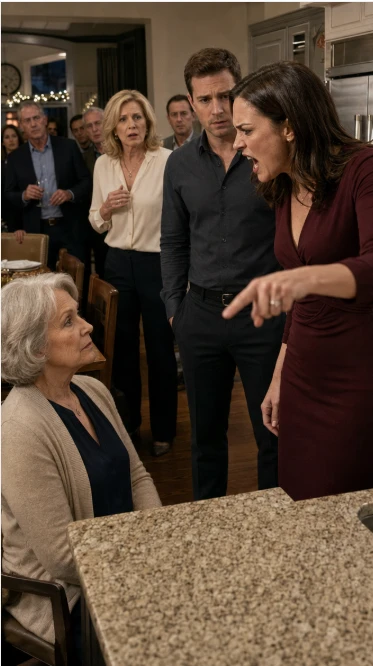
The moment Harper called me a “damn old woman” in my own kitchen, something inside me became quieter than it had been in years.
Fourteen members of her family were standing close enough to hear every word, champagne glasses suspended in their hands as though someone had frozen the room.
“Where have you been, you damn old woman?” Harper shouted. “My family is starving, and the table still isn’t set!”
My son, Liam, appeared behind her.
He looked at Harper, then at me, and finally at the floor.
That last glance hurt more than her words.
My name is Chelsea Powell, and at sixty-eight years old, I had learned that humiliation rarely arrives alone.
It usually brings clarity with it.
I sat at the little oak chair beside the kitchen table and studied the woman who had been living under my roof for four months.
Harper was wearing a burgundy blouse she had bought two days before Christmas, black trousers, and the expression of someone confronting an employee who had failed to complete an assigned task.
The absurdity of it almost made me smile.
“Chelsea?” Harper snapped.
I lifted my eyes.
“Well?” she demanded. “Aren’t you going to do something?”
“Yes,” I said.
The room remained perfectly still.
I rose carefully from the chair.
“I already did.”
Harper frowned.
“What does that mean?”
I smoothed the front of my cardigan.
“It means there isn’t any dinner.”
Someone behind her cleared his throat.
Harper stared at the spotless counters, then at the cold oven.
“You’re joking.”
“No.”
“My mother drove almost two hours.”
Her mother, Diane, stood near the doorway wearing a silver sweater and an expression that was rapidly changing from embarrassment to alarm.
“I didn’t invite your mother,” I said.
Harper blinked.
Then she laughed.
It was short and sharp.
“Oh, come on, Chelsea.”
“No.”
“You knew we were having New Year’s here.”
“You told me you were having New Year’s here.”
“That’s the same thing.”
“No, Harper.”
I looked around at the strangers occupying my living room.
“It isn’t.”
For several seconds, nobody spoke.
Then Liam stepped forward.
“Mom, maybe we should talk privately.”
I turned toward him.
“We’ve had four months to talk privately.”
His face tightened.
“Please.”
Harper folded her arms.
“No, Liam, I want to hear this.”
I nodded.
“So do I.”
Harper’s eyes narrowed.
“What exactly is your problem?”
The question was so extraordinary that I nearly admired it.
“My problem?”
“Yes.”
I looked at the kitchen around us.
My husband, Robert, and I had chosen those maple cabinets twenty-three years earlier.
We had argued for an entire afternoon about whether the countertops should be granite or quartz, and he had eventually surrendered because, as he put it, “A wise husband knows which hills are worth dying on.”
Robert had been gone six years.
Yet sometimes I could still hear his laugh in that kitchen.
Harper had been living there for four months and already spoke about knocking down its walls.
“My problem,” I said, “is that you have forgotten whose home you’re standing in.”
Harper’s cheeks reddened.
Diane quietly said, “Harper.”
But Harper ignored her.
“We live here too.”
“Temporarily.”
“That was the original plan.”
The words landed differently than she intended.
I looked at Liam.
He closed his eyes for half a second.
There it was.
Not denial.
Recognition.
I had wondered for weeks whether Harper’s plans for my house were merely fantasies she shared with my son.
Now I knew better.
“What does that mean?” I asked.
Harper realized her mistake.
“Nothing.”
“It sounded like something.”
“Chelsea, you’re turning a dinner misunderstanding into some enormous drama.”
“A misunderstanding?”
“You knew people were coming.”
“Yes.”
“And you deliberately didn’t cook?”
“Yes.”
A younger man near the living room doorway suddenly became very interested in his champagne.
Harper stared at me.
“You did this to embarrass me.”
“No.”
“Then why?”
“Because I am not your cook.”
Her mouth opened.
“And I am not your maid.”
“Chelsea—”
“And I am certainly not your tenant.”
That stopped her.
Liam stepped closer.
“Mom.”
I turned to him.
“Would you like to tell her?”
His face went pale.
Harper looked between us.
“Tell me what?”
I waited.
Liam said nothing.
Of course he didn’t.
Silence had become my son’s favorite hiding place.
I walked past Harper and into the living room.
Fourteen pairs of eyes followed me.
“First,” I said, “I owe all of you an apology.”
Harper’s expression brightened slightly.
She thought I was surrendering.
“You were invited here tonight under the impression that I had agreed to host you,” I continued. “I did not.”
Diane slowly lowered her champagne glass.
“I’m sorry,” she said. “Harper told us this was your idea.”
A strange murmur moved through the room.
I looked at Harper.
Her confidence flickered.
“She said,” Diane continued cautiously, “that you wanted everyone here because it might be your last New Year’s in the house.”
The room disappeared around me.
For one terrible second, all I could hear was the refrigerator humming behind me.
“My last New Year’s?”
Diane looked horrified.
“Harper said you were thinking of downsizing.”
I turned toward my daughter-in-law.
Harper did not look away.
Then Diane added the sentence that changed everything.
“She told us you’d already agreed to give the house to them.”
PART TWO — THE HOUSE ROBERT BUILT
There are moments when anger burns hot enough to make people shout, throw things, or say words they regret.
Mine went cold.
I looked at Liam.
“Did you know she was telling people that?”
He swallowed.
“Mom, it’s complicated.”
“No.”
My voice remained quiet.
“It’s actually becoming remarkably simple.”
Harper stepped between us.
“We discussed this.”
“You discussed it.”
“You said the house was too big for you.”
“I said the gutters were becoming difficult for me to clean.”
“That’s basically the same issue.”
Several people shifted uncomfortably.
Diane whispered, “Harper, stop.”
But Harper had spent four months mistaking my restraint for weakness, and habits are difficult to abandon.
“You’re sixty-eight,” she said. “Eventually you’re going to need something smaller.”
“Eventually you’ll be sixty-eight too.”
“That’s not the point.”
“It becomes the point surprisingly quickly.”
Liam rubbed both hands over his face.
“Can everybody just calm down?”
I looked at him.
“I am calm.”
He knew immediately that this was worse.
As a child, Liam had understood my anger better than anyone.
When I raised my voice, the storm passed quickly.
When I became quiet, decisions had already been made.
“Mom,” he said carefully, “Harper and I were going to talk to you after New Year’s.”
“About what?”
He hesitated.
“Buying the house.”
Harper spun toward him.
“Liam!”
“At least tell her the truth.”
I almost laughed.
“The truth would have been useful in October.”
Liam’s shoulders sagged.
“We’ve been looking at our finances.”
I waited.
“If we bought this place from you,” he continued, “you’d have money available for retirement, and you could stay here.”
“Where?”
He glanced toward Harper.
Neither answered.
I did it for them.
“Downstairs?”
Liam looked ashamed.
My downstairs had a small guest room beside the laundry room.
Robert had slept there for three weeks after his knee replacement because he could not manage the stairs.
Harper wanted my master bedroom.
My son wanted peace.
Apparently I was the price both of them were willing to pay.
“I overheard you,” I said.
Liam froze.
“In December.”
Harper’s expression changed.
“I heard the conversation about borrowing against the equity, renovating my bedroom, opening the kitchen, and putting me downstairs.”
“Chelsea, you heard part of a conversation.”
“I heard enough.”
Diane looked at her daughter with open disbelief.
“You told us Chelsea wanted to move downstairs.”
Harper’s face flushed.
“She doesn’t need four bedrooms.”
I stared at her.
Something remarkable happened then.
Diane put down her glass.
“Neither do you.”
Harper turned.
“Mom?”
“You don’t own this house.”
“Stay out of it.”
“You brought fourteen of us into it.”
A few relatives quietly nodded.
Harper’s humiliation was beginning to turn into fury.
She looked at me.
“So what is this?”
“What is what?”
“This performance.”
I almost pitied her.
She still believed the empty oven was my entire rebellion.
I walked to the small desk beside the dining-room window.
A blue folder rested there.
Liam saw it.
His face changed.
“Mom, what’s that?”
“Something I should have done sooner.”
Harper’s eyes followed me.
I opened the folder.
Inside were several pages.
Harper immediately assumed they were legal documents.
She stepped closer.
“Are you selling the house?”
“No.”
Her shoulders relaxed.
That was when I understood how completely she had misunderstood me.
I removed one sheet.
“It’s a thirty-day notice.”
The relief vanished.
Liam stared at me.
“Mom.”
“You and Harper will move out by January thirty-first.”
Harper laughed again, but this time there was panic beneath it.
“You can’t be serious.”
“I am.”
“Where are we supposed to go?”
“That is a question adults generally answer before their apartment lease expires.”
Liam looked as if I had struck him.
“Mom, we’re your family.”
“Yes.”
“And you’re throwing us out?”
“I am asking two employed adults in their late thirties to find somewhere else to live.”
Harper snatched the page from my hand.
Diane gasped.
I let her take it.
She scanned it.
“You actually prepared this?”
“Three days ago.”
“Because I asked you to make dinner?”
“No.”
I met her eyes.
“Because you entered my bedroom, used my belongings, invited people without permission, treated me like unpaid help, discussed taking over my house, and persuaded my son that silence was easier than respecting his mother.”
Liam whispered, “That isn’t fair.”
I turned toward him.
“No?”
His eyes were wet.
I had not expected that.
For one instant, he was eight years old again, standing in our old driveway after breaking Robert’s car window with a baseball and waiting for someone else to confess.
“Mom, I never wanted to hurt you.”
“You didn’t have to want it.”
I swallowed.
“You only had to watch it happen.”
That finally broke something in his expression.
Harper threw the notice onto the table.
“This is ridiculous.”
She turned to her family.
“Everybody get your coats.”
Diane did not move.
“Mom.”
Diane remained where she was.
“Mom!”
“I heard you.”
“Then let’s go.”
Diane looked at me.
“I think I owe Chelsea an apology.”
“You owe her nothing.”
“I believed what you told me.”
Harper stared at her mother.
Then Diane asked a question none of us expected.
“Did Chelsea really agree to sell you this house for two hundred thousand dollars?”
My heart stopped.
Liam’s head snapped toward Harper.
“What?”
Harper went perfectly still.
Diane’s face drained of color.
“You told your father and me you needed help with the down payment because Chelsea was selling you the house for two hundred thousand.”
I looked at Liam.
He looked as confused as I felt.
“Harper,” he said, “what is she talking about?”
Harper grabbed her coat.
“Nothing.”
Diane stepped in front of her.
“We gave you sixty thousand dollars.”
The room erupted.
PART THREE — THE SIXTY THOUSAND DOLLARS
If Harper had screamed again, I might have understood what happened next more easily.
Instead, she whispered.
“Mom, not here.”
Diane stared at her daughter as if seeing her for the first time.
“You told us Chelsea had agreed to sell the house to you.”
Harper glanced toward me.
“She was going to.”
“No,” I said.
“You talked about downsizing.”
“I never discussed a sale.”
Diane’s husband, Frank, had been standing near the fireplace.
Until then, he had said almost nothing.
Now he walked forward.
“Harper.”
She would not look at him.
“Where is the money?”
Liam stepped toward his wife.
“What sixty thousand dollars?”
Harper’s eyes darted around the room.
It was astonishing how quickly authority abandoned her.
Ten minutes earlier, she had been ordering me to set a table.
Now she looked like someone searching desperately for an unlocked door.
“It’s invested,” she said.
Frank’s voice hardened.
“Where?”
“In our future.”
Liam stared at her.
“What does that mean?”
Harper turned on him.
“Don’t do this.”
“Do what?”
“Act like you didn’t know we needed money.”
“I knew we needed money for a down payment someday.”
“We still do.”
“Did your parents give us sixty thousand dollars?”
Harper said nothing.
Liam’s face changed.
“Did they?”
“Yes!”
The word cracked through the room.
“And where is it?”
Harper’s lips trembled.
“I used some of it.”
“For what?”
She folded her arms.
“That isn’t anybody’s business.”
Frank laughed without humor.
“It became my business when I withdrew money from my retirement account.”
Diane covered her mouth.
That detail hurt me unexpectedly.
They were both in their sixties.
Sixty thousand dollars at that age was not simply money.
It was years of work already completed.
It was security that could not easily be replaced.
“Harper,” I said, “tell them.”
She looked at me with hatred.
“You’re enjoying this.”
“No.”
And I meant it.
“I wanted my house back, not this.”
Liam moved closer.
“Where is the money?”
Harper looked toward the floor.
“Twenty-five thousand went toward debts.”
“What debts?”
“Credit cards.”
Liam staggered backward.
“We paid those off last year.”
“My cards.”
Silence.
“What did you buy?”
“Things.”
“Harper.”
“Clothes, the salon, some travel, dinners.”
Liam stared at her.
“And the rest?”
She did not answer.
Frank asked, “Where is the other thirty-five thousand?”
Harper’s face crumpled.
For the first time that night, she looked frightened rather than angry.
“I put it into an account.”
“What account?”
“An investment.”
“What investment?”
She shook her head.
Liam reached for his phone.
“Show me.”
“No.”
“Show me the account.”
“I can’t.”
That sentence told everyone what they needed to know.
Diane sat down.
“Oh, God.”
Frank closed his eyes.
Liam whispered, “It’s gone?”
Harper began crying.
Not dramatically.
Her shoulders simply collapsed.
“I thought I could replace it.”
“With what?”
“I was trading.”
Liam stared at her.
“Trading what?”
“Options.”
I understood almost nothing about options trading.
Liam apparently understood enough.
His face became gray.
“You gambled thirty-five thousand dollars?”
“It wasn’t gambling.”
“Where is it?”
Harper said nothing.
Liam shouted for the first time.
“WHERE IS IT?”
“Gone!”
The word echoed through the house.
Nobody moved.
Harper covered her face.
“I was going to make it back.”
Liam stared at his wife.
“How?”
She looked toward me.
That was when I understood.
The house.
My house.
The equity.
She had not merely imagined inheriting my space.
She had been counting on it.
“You needed me to sell,” I said.
Harper shook her head.
“No.”
“You told your parents I had agreed because you needed their money.”
“No.”
“You expected Liam to convince me later.”
“Stop.”
“And once you owned this place, you intended to borrow against it.”
“STOP!”
Her scream shook the room.
I did not move.
The woman standing before me was no longer simply an entitled daughter-in-law.
She was drowning.
And drowning people sometimes pull down whoever is nearest.
Liam sank into a chair.
“How long?”
Harper wiped her face.
“Since October.”
October.
The month they moved into my house.
I suddenly remembered the expensive packages.
The salon appointments.
The new clothes.
The irritation whenever I mentioned groceries.
They had not been saving.
At least Harper had not.
My son looked at me.
“Mom.”
I could see the apology forming.
I raised my hand.
“Not tonight.”
He nodded.
Diane stood slowly.
“We’re leaving.”
This time nobody argued.
The party dissolved with extraordinary speed.
Champagne glasses were abandoned on tables.
Coats disappeared from hooks.
People whispered apologies as they passed me.
One of Harper’s aunts squeezed my hand.
Frank stopped at the door.
“I’m sorry we were brought into your home under false pretenses.”
“You didn’t know.”
He nodded.
Then he looked at his daughter.
“We’ll talk tomorrow.”
Harper stood motionless.
Diane followed him out without hugging her.
Within fifteen minutes, the house was nearly empty.
New Year’s decorations still shimmered above the abandoned glasses.
It looked like a celebration evacuated before a storm.
Liam sat at the dining table.
Harper stood near the window.
I began collecting glasses.
Liam immediately rose.
“Mom, don’t.”
I looked at him.
“I’ll do it.”
Something about those three words nearly broke me.
Perhaps because I had waited four months to hear them.
He gathered the glasses.
Harper laughed bitterly.
“Wonderful.”
Neither of us answered.
She looked at Liam.
“So now you’re her servant?”
He set down a glass.
“No.”
Then my son said something I had not heard from him in months.
“I’m behaving like someone who lives in another person’s house.”
Harper stared at him.
“Unbelievable.”
“What’s unbelievable is that you took sixty thousand dollars from your parents.”
“For us.”
“Don’t say us.”
Her expression froze.
Liam’s voice shook.
“You lied to them using my mother’s house.”
“I was trying to build a future.”
“You were spending money we didn’t have.”
“You think your mother’s innocent?”
I turned.
Harper pointed at me.
“She’s been waiting for this.”
“For what?”
“For me to fail.”
I shook my head.
“No, Harper.”
She laughed.
“You never liked me.”
“I liked you very much when you married my son.”
That hurt her.
I continued quietly.
“I stopped liking what you became in my home.”
Harper grabbed her purse.
“I’m leaving.”
Liam did not stop her.
The front door slammed.
For several minutes, neither of us spoke.
Then Liam sat down.
“Mom.”
I remained standing.
“I need to tell you something.”
My heart tightened.
I had already learned enough secrets for one evening.
But Liam reached into his pocket and placed a small brass key on the table.
I recognized it immediately.
It belonged to Robert’s old desk.
The desk in my locked bedroom.
I stared at my son.
“Why do you have that?”
Liam looked toward the stairs.
“Because Dad gave it to me six years ago.”
PART FOUR — ROBERT’S LAST SECRET
Robert had died on a Tuesday morning in March.
Cancer had taken eighteen months to reduce a broad-shouldered man who once built our backyard deck by himself into someone I could lift from a chair.
His final weeks had been gentle.
That was the only mercy.
He died at home with my hand inside his.
I thought I knew everything he had left behind.
Apparently I was wrong.
“Your father gave you that key?”
Liam nodded.
“When?”
“Three days before he died.”
“Why?”
“He made me promise not to give it to you unless something happened.”
I stared at him.
“Something happened six years ago.”
“Not that kind of something.”
I sat down.
“What kind?”
Liam’s eyes were red.
“He said, ‘If your mother ever starts believing she has to surrender her life just to keep the family together, give her this.’”
My breath caught.
That sounded exactly like Robert.
Infuriatingly specific.
Almost prophetic.
“What’s in the desk?”
“I don’t know.”
“You never looked?”
“He made me promise.”
I picked up the key.
“Why tonight?”
Liam looked toward the door Harper had slammed.
“Because I think Dad knew me better than I knew myself.”
We went upstairs.
My bedroom was exactly as I had left it.
Robert’s walnut desk stood beneath the window.
I had not opened its locked lower drawer since his death because I had misplaced the key and eventually stopped looking for it.
My hands trembled as I inserted the brass key.
The lock clicked.
Inside was a large cream envelope.
CHELSEA was written across the front in Robert’s handwriting.
I sat on the bed.
For several seconds, I could not open it.
Grief is peculiar.
It can sleep inside you for years and wake fully grown.
Liam stood near the doorway.
“Do you want me to leave?”
“No.”
I opened the envelope.
There was a letter.
Chelsea,
If you are reading this, then either Liam ignored me for six years or you have finally reached the day I worried would come.
I laughed through my tears.
“Sounds like Dad,” Liam whispered.
I kept reading.
Robert wrote that he had watched me spend our marriage taking care of everyone.
My mother.
His mother.
Liam.
Neighbors.
Church friends.
Him.
He wrote that generosity was the finest thing about me and also the thing he feared people might someday exploit.
Then I reached a paragraph that made me stop.
There is something about the house you do not know.
I looked at Liam.
He shook his head.
I continued.
When Robert and I bought the property, his mother, Evelyn, had quietly contributed thirty thousand dollars toward our down payment.
I knew that.
What I did not know was what happened years later.
Evelyn had inherited a substantial investment account from her brother.
Before she died, she transferred the investments to Robert with one instruction.
Protect Chelsea.
Robert had never spent them.
He had allowed them to grow.
My hands began shaking.
There was another document beneath the letter.
An account statement.
It was six years old.
The balance then had been $1,184,320.
I stared at the number.
Liam whispered, “What?”
I handed it to him.
His mouth fell open.
“Dad had over a million dollars?”
“Apparently.”
But there was more.
Robert had created a trust.
The investments belonged to me.
Not Liam.
Not future grandchildren.
Me.
He had written one final instruction.
Do not give away the house because you think age makes you a burden.
I pressed the letter against my chest.
For six years, I had worried about replacing the roof.
I had compared grocery prices.
I had postponed a trip to Maine because I decided it was extravagant.
And somewhere, untouched, was a fortune Robert had protected for me.
Liam sat beside me.
“Mom, I swear I didn’t know.”
“I believe you.”
He covered his face.
“I failed you.”
I looked at my son.
For the first time that evening, I did not see a coward.
I saw a middle-aged man discovering that avoiding conflict was not the same as keeping peace.
“Why didn’t you stop her?” I asked.
His answer came slowly.
“Because I was afraid.”
“Of Harper?”
“Of losing my marriage.”
He looked at me.
“And I convinced myself you were strong enough to handle whatever she did.”
I nodded.
“That was convenient.”
“I know.”
“Strength doesn’t mean something doesn’t hurt.”
“I know.”
His voice broke.
“I know that now.”
Downstairs, the grandfather clock began chiming eleven.
New Year’s Eve continued whether our family was ready or not.
Liam looked at the letter again.
“What are you going to do?”
I folded it carefully.
“Tomorrow, I’m calling an attorney.”
“About Harper?”
“About the trust.”
He nodded.
“And the eviction?”
“That stands.”
“I understand.”
I looked at him.
“You too, Liam.”
He closed his eyes.
“I know.”
That answer surprised me.
No argument.
No guilt.
No plea.
“I’ll find somewhere.”
I touched his hand.
“I love you.”
“I know.”
“And you still have to leave.”
A sad smile appeared.
“I know that too.”
At eleven-thirty, Harper returned.
Her mascara was smudged.
She walked into the living room and stopped when she saw us.
“I want to talk.”
Liam stood.
“So do I.”
She looked at me.
“Alone.”
“No,” Liam said.
Harper stared at him.
“This is between Chelsea and me.”
“No.”
His voice was calm.
“This is exactly how we got here.”
Harper looked exhausted.
Then she sat.
“I called my parents.”
Neither of us spoke.
“I’m going to repay them.”
“With what?” Liam asked.
“I’ll sell my car.”
“That won’t cover it.”
“I know.”
She looked at me.
“I’ll get another job.”
I waited.
“I’m sorry.”
It was the first apology I had ever heard from Harper that did not contain the word but.
I wanted to believe it.
Part of me did.
Then she said, “There’s something else.”
Liam stiffened.
“What?”
Harper reached into her purse.
She removed a folded piece of paper.
“I found this months ago.”
She placed it on the table.
I unfolded it.
It was a photocopy of an old bank statement.
Robert’s name was printed at the top.
The account balance was more than one million dollars.
My blood went cold.
Liam looked at Harper.
“You knew?”
She nodded.
“How?”
“When I was in Chelsea’s room.”
The handbag.
The day I caught her in my closet.
“I found an old envelope behind some boxes.”
I stared at her.
“You knew about Robert’s money.”
“I knew there had been money.”
“Is that why you wanted the house?”
“No.”
I said nothing.
Harper began crying again.
“Not exactly.”
Liam stepped away from her.
“What does that mean?”
She looked at him.
“I thought your mother was hiding money from us.”
“Her money.”
“Our family’s money.”
“No,” Liam said.
“Her money.”
Harper flinched.
Then she looked at me.
“I thought if we owned the house, at least we’d have something secure.”
Something inside me finally understood the entire shape of the past four months.
This had never been about dishes.
Or bedrooms.
Or roast beef.
Harper had entered my room, found evidence of Robert’s hidden assets, and decided I possessed more than I deserved.
From that moment forward, she had begun treating my home like an inheritance that had arrived early.
“You knew,” I whispered.
“I suspected.”
“And you said nothing.”
“I didn’t know how.”
“You knew exactly how to tell your parents I was selling you my house.”
She lowered her head.
Liam walked toward the window.
“Pack your things.”
Harper looked up.
“What?”
“Tonight.”
“Liam.”
“I’m done.”
She stood.
“You’re leaving me because of money?”
He turned.
“No.”
His voice was quieter than hers.
“I’m leaving because I finally understand what you were willing to do for it.”
Harper looked at me.
For a moment, I thought she might attack me verbally again.
Instead, she whispered, “You won.”
I shook my head.
“No.”
I looked around the home Robert and I had built.
“Nobody wins when a family reaches this point.”
Harper went upstairs.
At eleven fifty-eight, she came down with two suitcases.
She opened the front door.
Snow had begun falling.
She paused.
Then she looked at Liam.
“Happy New Year.”
He did not answer.
The door closed behind her.
Two minutes later, midnight arrived.
Fireworks cracked somewhere beyond the neighborhood.
Liam and I stood in my quiet living room while strangers on television celebrated beneath confetti.
I thought the worst was over.
I was wrong.
PART FIVE — THE NAME INSIDE THE TRUST
On January second, I sat across from an attorney named Rebecca Sloan.
She was seventy-one, wore bright red glasses, and had the comforting habit of reading every page twice before speaking.
Robert had named her firm as successor trustee.
She located the account within an hour.
The original investments had grown.
The current value was $2.31 million.
I sat perfectly still.
Rebecca smiled.
“Mrs. Powell, your husband planned very carefully.”
“I’m beginning to notice.”
“There is also something unusual.”
Of course there was.
By then I had stopped expecting normal.
“What?”
“The trust has a secondary beneficiary.”
My stomach tightened.
“Liam?”
“No.”
“Who?”
Rebecca turned the document toward me.
The name meant nothing at first.
EMILY ROSE POWELL.
I stared at it.
“I don’t know anyone named Emily Rose Powell.”
Rebecca looked confused.
“She was born in 1987.”
My heart stopped.
Liam was born in 1986.
“Who is she?”
Rebecca hesitated.
“The trust identifies her as Robert Powell’s daughter.”
The world tilted.
“No.”
“I’m sorry.”
“No.”
Robert had never been unfaithful.
At least that was what I had believed for forty-two years.
I drove home in silence.
Liam was packing boxes in the guest room.
He saw my face.
“Mom?”
“Who is Emily?”
The box slipped from his hands.
That was my answer.
I stared at him.
“You know.”
He sat down heavily.
“Dad told me.”
“When?”
“Before he died.”
I could barely breathe.
“Your father had a daughter?”
Liam shook his head.
“No.”
“Then who is Emily?”
He looked terrified.
“Mom, you need to sit down.”
“I have spent four months being told where to sit in my own house.”
My voice shook.
“I’m standing.”
Liam swallowed.
“Emily wasn’t Dad’s daughter.”
I stared at him.
“She was yours.”
I actually laughed.
It was the strangest sound I had ever made.
“I had one child.”
“No.”
“Liam.”
“You had two.”
He stood slowly.
“You had a daughter before me.”
I could not speak.
“You were pregnant in 1987.”
“That’s impossible.”
“You were in a car accident.”
Memory flashed.
Rain.
A hospital ceiling.
Robert holding my hand.
A doctor telling me I had suffered a severe concussion.
Weeks of headaches.
A miscarriage.
I gripped the table.
“The baby died.”
Liam’s eyes filled.
“That’s what Dad told you.”
My knees weakened.
I sat.
“Why?”
“He said you were unconscious when Emily was delivered.”
Delivered.
Not miscarried.
The word cut through me.
“She lived?”
“Yes.”
I could not breathe.
“Where is she?”
Liam began crying.
“Dad said she had serious complications.”
“WHERE IS SHE?”
“She survived.”
I stared at my son.
The room became impossibly small.
“Robert told me she died.”
“I know.”
“Why?”
Liam shook his head.
“He said Grandma Evelyn made the decision.”
My mother-in-law.
The woman whose money had created the trust.
“She believed you couldn’t care for a medically fragile baby while recovering from the accident.”
“So they gave her away?”
“Dad said it was supposed to be temporary.”
My hands were numb.
“What happened?”
“Grandma arranged for relatives to care for her.”
“Which relatives?”
Liam looked toward the floor.
“Her younger sister.”
I remembered Evelyn’s sister.
Margaret.
She had moved to Indiana around that time.
I had seen her only twice afterward.
“She raised my daughter?”
Liam nodded.
“Dad wanted to tell you.”
“When?”
“For years.”
“And he didn’t?”
“He was ashamed.”
I stood.
“Where is Emily now?”
“I don’t know.”
I stared at him.
“You knew I had a living daughter and never found her?”
“I only learned three days before Dad died.”
“You’ve had six years!”
“He made me promise.”
I slapped the table.
“STOP HIDING BEHIND PROMISES TO DEAD PEOPLE!”
Liam flinched.
I had never screamed at him like that.
I did not care.
My husband had died carrying a secret that had stolen an entire human being from me.
Then Liam said something that stopped my rage.
“Mom, I tried.”
I looked at him.
“I searched for her.”
“What?”
“I found Margaret’s family.”
My heart hammered.
“And?”
“Emily changed her name.”
“Tell me.”
He hesitated.
“Tell me her name.”
Before he could answer, the doorbell rang.
Neither of us moved.
It rang again.
I walked to the door.
A woman stood outside.
She looked to be in her late thirties.
Dark hair.
Silver sweater.
Eyes I recognized before I understood why.
She was standing beside Diane.
Harper’s mother.
My hand remained on the doorknob.
Diane looked as though she had been crying.
“Chelsea,” she said, “there is someone you need to meet.”
The younger woman stared at me.
Her face had gone completely white.
Liam appeared behind me.
He whispered one word.
“Emily.”
I turned.
He was staring at the woman.
Then I looked at Diane.
“No.”
Diane began crying.
The woman stepped forward.
“My name is Harper.”
Everything inside me stopped.
I looked at her.
At my daughter-in-law.
At the woman who had spent four months invading my house.
At the woman I had thrown out on New Year’s Eve.
Liam covered his mouth.
Diane whispered, “Her legal name is Harper Emily Rose Bennett.”
I could hear my heartbeat.
Harper stared at me.
“I didn’t know.”
Nobody spoke.
“I swear to you,” she said, “I didn’t know until yesterday.”
Diane handed me a folder.
Inside was an old adoption certificate.
Emily Rose Powell.
Born October 14, 1987.
Birth mother:
Chelsea Powell.
I almost dropped it.
Harper was crying.
“Mom found the papers after Dad told her about the money.”
Diane nodded.
“My sister Margaret couldn’t have children.”
I looked at her.
“Margaret was your sister?”
Diane nodded.
“She raised Harper for the first three years.”
Then Margaret died.
Diane and Frank adopted her.
The families had been connected all along.
Robert had known.
Evelyn had known.
And somehow, thirty-seven years later, my daughter had walked back into my life without either of us recognizing the other.
Then the final horror struck me.
Liam.
Harper.
Marriage.
I looked at my son.
His face was drained of blood.
Harper understood at the same moment.
“No,” she whispered.
Diane immediately shook her head.
“No.”
We looked at her.
“Liam isn’t Robert’s biological son.”
Silence.
I stared at Diane as if language itself had stopped making sense.
“What?”
Liam stumbled backward.
Diane covered her mouth.
“I’m sorry.”
“Explain.”
She looked at me.
“Robert knew.”
I thought I might faint.
“Robert knew what?”
Diane’s voice shook.
“That Liam was adopted.”
I laughed once.
“No.”
“He was.”
“No.”
“You lost your first pregnancy in 1986.”
My entire body went cold.
“That was Liam.”
“No.”
I remembered another hospital.
Another loss.
Another grief Robert and I rarely discussed.
Then a baby placed in my arms months later.
I had always remembered giving birth.
But suddenly the memories were fragments.
Medication.
Pain.
Robert.
A nurse.
A child.
“Robert arranged a private adoption,” Diane said. “You knew at the time.”
“I knew?”
“You were told.”
“Then why don’t I remember?”
“After the 1987 accident, you lost pieces of the previous two years.”
The room spun.
Robert had protected me from truths he believed would destroy me.
Then he had become trapped inside his own lies.
Liam sat on the stairs.
“So Harper and I aren’t related?”
“No,” Diane said.
Liam closed his eyes.
Harper leaned against the doorframe.
The impossible shape of our family slowly became visible.
The son I had raised was not biologically mine.
The daughter-in-law I had resented was the daughter I had been told was dead.
The husband I had trusted had spent decades carrying both secrets.
And Evelyn’s trust had not been created merely to protect me.
It had been created to protect Harper.
Emily.
My daughter.
I opened Robert’s trust documents again that afternoon.
This time Rebecca came to the house.
The secondary beneficiary clause was simple.
Upon my death, half the trust would pass to Emily Rose Powell.
Robert had never forgotten her.
But he had never found the courage to tell me.
Harper sat across from me at the kitchen table.
The same kitchen where she had called me an old woman.
Neither of us knew what to say.
Finally, she whispered, “I was horrible to you.”
“Yes.”
She almost smiled through her tears.
“I guess you’re not going to make this easy.”
“No.”
“I don’t deserve easy.”
“No.”
She looked down.
“I thought you had everything.”
I waited.
“A house. Money. Security. Liam’s loyalty.”
Her voice cracked.
“I spent my whole life feeling like something had been taken from me, and I never knew what.”
I looked at her face.
My daughter’s face.
Perhaps somewhere beneath all that entitlement had been an old wound neither of us could name.
That did not excuse what she had done.
But explanation and excuse are not the same thing.
“I can’t erase New Year’s Eve,” she said.
“I don’t want you to.”
She looked up.
“Why?”
“Because consequences matter.”
I reached across the table.
“And so does what happens after them.”
She stared at my hand.
Then slowly placed hers in it.
I felt something inside me break open.
Not forgiveness.
Not yet.
Something more cautious.
Possibility.
Harper sold her car.
She repaid the first twenty-eight thousand dollars to Diane and Frank within three months.
She took evening bookkeeping work and arranged a repayment plan for the rest.
She and Liam separated for nearly a year.
They attended counseling separately before they ever considered attending together.
I did not interfere.
Liam moved into a small apartment.
For the first time in his adult life, my son learned that loving people sometimes requires disappointing them.
Harper rented a studio apartment across town.
She never asked me for money.
Not once.
That mattered.
We began meeting for coffee on Sundays.
At first, we talked about ordinary things.
Weather.
Gardening.
Books.
Then we began talking about the years we had lost.
On her thirty-eighth birthday, she called me Mom.
She immediately apologized.
I cried so hard the waitress brought napkins.
Two years later, Liam and Harper remarried in my backyard.
There were twenty-two guests.
I did not cook.
Harper hired a caterer.
Before dinner, she stood beside me beneath the maple tree Robert had planted when Liam was five.
“I owe you something,” she whispered.
“What?”
She smiled.
“A properly set table.”
I laughed.
For the first time, the memory of that New Year’s Eve no longer hurt.
After dinner, Liam handed me a champagne glass.
Harper stood on my other side.
Midnight was still hours away, but the backyard lights shimmered above us like small stars.
I thought about Robert.
I was still angry with him.
Love does not require rewriting the dead into saints.
He had made terrible choices because he believed protecting me mattered more than trusting me with the truth.
But he had also left behind one final chance for the truth to find us.
I eventually used part of the trust to establish a foundation for grandparents raising grandchildren and older adults suddenly responsible for vulnerable family members.
The house remained mine.
I never transferred it to anyone.
At seventy-one, I renovated the downstairs guest room.
Not because Harper wanted me to move there.
Because I turned it into an art studio.
The master bedroom remained upstairs.
Mine.
One New Year’s Eve, three years after the night everything changed, Harper arrived carrying a roast beef.
Diane brought scalloped potatoes.
Liam carried champagne.
I opened the door.
Harper grinned.
“Before you ask, yes, we brought dinner.”
I stepped aside.
“And the table?”
“Already handled.”
We laughed.
Later that night, as midnight approached, Harper and I stood alone in the kitchen.
She touched the countertop.
“Do you ever think about that night?”
“Yes.”
“I still hate who I was.”
I shook my head.
“Don’t.”
She looked surprised.
“Why?”
“Because if you spend your life hating the person you used to be, you waste the person you fought to become.”
Her eyes filled.
Outside, neighbors began counting down.
Ten.
Nine.
Eight.
Harper took my hand.
Seven.
Six.
Five.
I looked at my daughter.
The daughter I had lost without knowing I had lost her.
The daughter who returned disguised as the person I thought was taking my family away.
Four.
Three.
Two.
One.
The neighborhood erupted.
Harper hugged me.
“Happy New Year, Mom.”
I held her tightly.
“Happy New Year, sweetheart.”
And standing there in the kitchen where she had once demanded that an old woman serve her dinner, I finally understood the strange mercy hidden inside the worst night of my life.
I had believed I was throwing someone out of my house.
Instead, after thirty-seven years, I had finally found the person who had been missing from it.