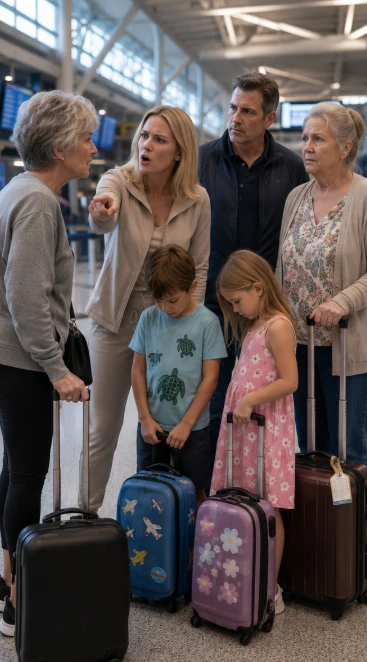
For several seconds, I could not move. Around me, Chicago O’Hare continued as if nothing had happened. Suitcases rolled across the polished floor, boarding announcements echoed overhead, and exhausted travelers hurried toward security with coffee cups in their hands.
Jessica stood in front of me with her arms folded, wearing the calm expression of someone who believed the matter had already been settled.
“We gave your seat to my mother,” she repeated. “The children are closer to her. It makes more sense.”
Then my son Kevin looked away and quietly added, “Mom, it’s just one vacation.”
Just one vacation.
The ten-day Hawaii trip I had spent six months planning.
The trip that had cost me forty-seven thousand dollars.
The trip I had designed around my grandchildren, right down to Tyler’s sea-turtle excursion and Emma’s special dinner in the blue dress she had been talking about for weeks.
I looked at my grandchildren. Neither of them could meet my eyes.
Jessica gave a small shrug. “You can go home. We’ll send you pictures.”
I did not argue.
I did not raise my voice.
I smiled, nodded once, turned my suitcase around, and walked away.
They must have thought I had accepted what they had done.
One minute later, standing beside a quiet row of windows several gates away, I took out my phone and made a call.
By the time they boarded their flight, the forty-seven-thousand-dollar vacation they believed belonged to them had changed completely.
And before that day ended, so had my $5.8 million estate plan.
The rest of the story is in the first comment.
I stopped near an empty seating area and looked through the enormous airport windows at the gray Chicago morning.
My hands were steady now.
That surprised me.
For most of my life, I had believed anger was loud. I had watched people argue in hospital hallways, conference rooms, family meetings, and parking garages. I had seen people say things they regretted simply because they needed everyone around them to know they were hurt.
But standing in O’Hare that morning, I discovered something different.
Sometimes the deepest disappointment makes you quiet.
I opened my contacts and called the travel concierge who had helped me finalize the Maui reservations.
“Good morning, Dr. Hayes,” she said. “Are you already at the airport?”
“Yes,” I replied. “And I need to make several changes.”
There was a short pause.
“Of course. What would you like changed?”
“Everything that is in my name and paid through my account.”
For the next several minutes, I calmly reviewed the reservation.
The two oceanfront suites.
The private airport transfers.
The luau.
The snorkeling excursion.
The helicopter tour.
The Road to Hana driver.
The children’s marine program.
Emma’s special dinner reservation.
I did not cancel my grandchildren’s airline tickets. I did not strand anyone. I did not interfere with their ability to travel safely.
I simply withdrew the luxury vacation I had personally purchased after they had decided I was no longer welcome on it.
The concierge confirmed that because I was the primary guest and purchaser, several hotel and activity reservations could be canceled or modified directly by me.
The airline arrangements were more complicated, but Jessica had already taken care of my canceled seat herself.
That part almost made me laugh.
They had removed me from the trip before making sure the trip could continue without me.
When I ended the call, I stood silently for a moment.
Then I made another appointment.
Not with a travel agent.
With my estate attorney.
At 11:30 that morning, while my son and his family were somewhere above the western United States believing they had successfully replaced me, I sat across from an attorney who had known me for nearly twenty years.
“I want to revise the plan,” I told her.
She looked surprised.
“Substantially?”
“Yes.”
My grandchildren would still be protected.
Their education trusts would remain.
Funds would still be available for college, graduate school, medical needs, and eventually a carefully managed inheritance when they were old enough to make decisions without pressure from anyone else.
But Kevin would no longer control those trusts.
Jessica would never control them.
And the large unrestricted inheritance I had once planned to leave my son would be redirected.
Part would go to a cardiac scholarship program.
Part would support young physicians entering public-service medicine.
Part would establish a family foundation managed by independent trustees.
Kevin would still receive something.
But he would never again confuse my love with unlimited access to what I had spent a lifetime building.
I signed the preliminary instructions.
Then I turned my phone off.
By the time I turned it back on that evening, I had twenty-three missed calls.
The rest of the story is in the first comment.
My alarm had gone off at 3:30 that morning, although I had already been awake for hours.
I had been lying in bed in my Lincoln Park brownstone, too excited to sleep, mentally reviewing every detail of our family vacation to Hawaii.
Ten days.
Maui.
My son.
My daughter-in-law.
My grandchildren.
All of us together.
For six months, that trip had occupied a special place in my mind. I pictured breakfasts overlooking the ocean, afternoons by the pool, Tyler asking endless questions about sea turtles, and Emma wearing the tiny plastic tiara I had secretly packed in my carry-on.
My name is Dr. Margaret Hayes. I am sixty-seven years old and a retired cardiologist.
For four decades, I worked at Chicago Memorial Hospital and later built a successful private practice. I published research, trained younger physicians, consulted on difficult cases, and spent more holidays in hospital corridors than I could count.
I did well financially.
Very well.
But money had never interested me simply as a number on a statement.
Money meant choices.
Security.
Education.
Time.
And, whenever possible, experiences with the people I loved.
After my husband Thomas passed away when Kevin was still a child, my son became the center of my world.
I raised him while working an exhausting schedule. I attended parent conferences between hospital rounds. I helped with science projects after late shifts. I sat through freezing soccer games with a pager clipped to my coat.
When Kevin was accepted to Northwestern, I cried harder than he did.
When he graduated, I was in the front row.
When he married Jessica, I welcomed her sincerely.
When Tyler and Emma were born, I rearranged my schedule so I could be present without becoming intrusive.
At least, I believed I had done that.
Jessica and I had never been especially close, but for years our relationship remained polite.
She was organized, confident, socially polished, and very protective of the life she had built with Kevin.
Before becoming a mother, she worked in marketing for a technology company downtown. After the children arrived, she stayed home and became heavily involved in school activities, community events, and the complicated social world of neighborhood parenting.
There had been moments when she made comments that bothered me.
“Margaret likes doing things her own way.”
“Margaret has very specific opinions.”
“Margaret doesn’t understand how families work now.”
I usually ignored them.
I told myself that every daughter-in-law and mother-in-law needed boundaries.
I did not want to become the sort of mother who made her adult son choose sides.
So I gave space.
I also gave generously.
I helped Kevin and Jessica with the down payment on their first house.
I contributed to the children’s education accounts.
I paid for summer camps when Jessica said the programs were becoming expensive.
When their kitchen needed unexpected repairs, I covered part of the cost without asking for repayment.
Not because Kevin demanded it.
Not because I wanted control.
Because he was my son.
And because I could.
The Hawaii trip had been my biggest family gift yet.
I had begun planning it after Emma asked me one afternoon whether the ocean in Hawaii was really as blue as the pictures.
“You’ll have to see it yourself someday,” I told her.
She looked at me with complete seriousness.
“Can you come too, Grandma?”
That question stayed with me.
A week later, I called Kevin.
“What would you think about a family vacation to Maui?”
He laughed.
“Mom, that would be incredible.”
Jessica sounded equally enthusiastic when he put the phone on speaker.
Within days, I started planning.
I compared resorts in Wailea and Kaanapali.
I chose Wailea because the resort had excellent family amenities while still being comfortable for adults.
I booked oceanfront accommodations rather than standard rooms because I wanted the children to wake up and see the Pacific from the balcony.
Tyler loved sea turtles, so I researched educational marine programs.
Emma loved dolphins and anything that made her feel like a princess, so I found a responsible animal program and a beautiful restaurant for one special evening.
I arranged a luau, a snorkeling trip, a scenic helicopter tour, and a private Road to Hana excursion.
I paid for business-class flights because I wanted everyone to arrive rested.
Forty-seven thousand dollars.
It was an extraordinary amount of money for a vacation.
I knew that.
But I also knew how quickly children grew.
Tyler was already eight.
Emma was six.
Soon there would be sports, friends, teenage schedules, college applications, and lives of their own.
I wanted ten days when nobody was rushing anywhere.
Ten days when we could simply be a family.
That morning, I dressed in black leggings, a gray Northwestern sweatshirt, and comfortable running shoes.
I checked my suitcase twice.
Passport.
Wallet.
Printed confirmations.
Medication.
Phone charger.
The tiny tiara for Emma.
At 5:00 a.m., a black sedan arrived outside my brownstone.
As we drove along Lake Shore Drive, the city was still mostly dark. Chicago’s skyline rose against the early morning, familiar and beautiful.
I remember smiling in the back seat.
I felt lucky.
That is the detail I remember most.
Not proud.
Not wealthy.
Lucky.
At 5:45, I entered O’Hare and walked toward the check-in area where we had agreed to meet.
I spotted Kevin first.
Tall, broad-shouldered, dark hair beginning to gray slightly at the temples.
Then Jessica.
Blonde, perfectly dressed despite the early hour, wearing an expensive neutral-colored travel outfit.
Then Tyler and Emma.
Tyler wore the sea-turtle shirt I had bought him.
Emma wore a pink sundress patterned with tiny hibiscus flowers.
Both had matching children’s carry-ons I had purchased for the trip.
And beside them stood Linda.
Jessica’s mother.
Linda was sixty-three and someone I had known casually for years through birthdays, school events, and holidays.
She was pleasant enough.
We had never had a conflict.
Which was why I was initially more confused than suspicious when I saw the Maui luggage tag hanging from her suitcase.
I walked toward them.
“Good morning,” I said. “Is everybody ready for paradise?”
Normally, the children would have greeted me immediately.
That morning, they did not.
Tyler gave me a quick smile and looked down.
Emma held tightly to her suitcase.
Jessica turned toward me.
“Margaret, the plans changed.”
There are sentences that sound ordinary until you hear the tone behind them.
I stopped.
“What changed?”
Jessica glanced at Linda and then back at me.
“We gave your seat to my mother.”
For several seconds, I genuinely believed I had misunderstood.
“What?”
“The children are closer to her,” Jessica said. “She doesn’t travel much, and she deserves a vacation. We decided it would make more sense if she came.”
I looked at Linda.
She looked uncomfortable.
That mattered to me later.
At that moment, however, I could barely process what Jessica was saying.
“You decided Linda would come instead of me?”
Jessica nodded.
“Yes.”
“And you canceled my ticket?”
“We handled it.”
I turned toward Kevin.
He would explain.
Surely.
Perhaps Jessica was presenting some misunderstanding badly.
Perhaps there had been an issue with reservations.
Perhaps Kevin would laugh and tell me this had all been communicated incorrectly.
Instead, he stared toward a sign beyond my shoulder.
“Kevin?”
He shifted his weight.
“Mom, Linda doesn’t get much time with the kids.”
“That wasn’t my question.”
He finally looked at me.
“It’s just one vacation.”
I will always remember those four words.
Not because they were particularly cruel on their own.
Because of everything behind them.
Six months of planning had become “just one vacation.”
Forty-seven thousand dollars had become irrelevant.
More importantly, my presence had become optional.
Jessica stepped in again.
“The kids are closer to Mom. You see them all the time.”
I looked at Tyler.
He stared at the floor.
Emma twisted the fabric near the edge of her sleeve.
Neither child spoke.
I understood then that they had been prepared for this conversation.
Perhaps not fully.
But enough to know they were not supposed to disagree.
Jessica continued.
“You can just go home.”
The words were delivered so casually that they hurt more than if she had shouted them.
Then she added, “We’ll send you pictures.”
Something changed inside me at that moment.
For years, I had solved family discomfort by making myself easier to deal with.
If Jessica wanted Christmas at her house, I agreed.
If Kevin forgot an important date, I pretended not to mind.
If plans changed at the last minute, I adjusted.
If they needed financial help, I gave it.
If they canceled dinner, I said we would try another week.
I had mistaken flexibility for harmony.
Standing in O’Hare, I finally understood the cost.
They had become so accustomed to my accommodation that they believed they could remove me from my own gift and I would quietly absorb the humiliation.
So I did something unexpected.
I quietly absorbed nothing.
I nodded.
“All right.”
Jessica blinked.
Perhaps she expected an argument.
Kevin looked relieved.
That expression told me more than anything else.
“Have a good flight,” I said.
Then I turned around and walked away.
I heard Emma say, “Grandma?”
My steps almost stopped.
Almost.
But I knew that if I turned around, Jessica would use my love for those children to pull me back into the same pattern.
So I kept walking.
Several gates away, I found an empty seat near the windows.
I took a slow breath.
Then I called my travel concierge.
Her name was Rebecca.
She had spent weeks helping me finalize the Maui arrangements.
“Dr. Hayes,” she answered warmly. “You must be at O’Hare.”
“I am.”
“Everything ready?”
“Not exactly.”
I explained the situation without embellishment.
There was a long silence.
“I’m sorry,” Rebecca finally said.
“Thank you. Now I need to know exactly which reservations are under my name and which can be modified.”
We went through them one by one.
The resort reservation listed me as the primary guest and purchaser.
Both suites had been charged through my account.
Several excursions had been prepaid by me directly.
Transportation had been booked under my name.
The restaurant and special programs were tied to my reservation profile.
“I would like to cancel the luxury arrangements,” I said.
Rebecca hesitated.
“All of them?”
“Yes.”
“Would you like me to cancel the children’s activities too?”
That question made me pause.
The sea turtles.
Emma’s dinner.
The little tiara in my bag.
For a moment, I felt guilty.
Then I reminded myself that I was not taking anything from my grandchildren that belonged to them.
I was withdrawing a gift that their parents had decided could continue without the person who gave it.
“Yes,” I said. “Cancel the prepaid package.”
I made one exception.
I asked Rebecca to keep a standard hotel reservation available for two nights using a separate credit I had accumulated, enough to ensure no one would arrive without somewhere safe to stay while they made their own arrangements.
That choice mattered to me.
I wanted boundaries.
Not chaos.
When Rebecca finished, she said quietly, “The remaining refundable amount should return to your original payment methods, though some bookings have cancellation fees.”
“That’s fine.”
“What about your own travel?”
I looked out at the runway.
“I’ll decide later.”
After we ended the call, I called my estate attorney, Helen Price.
“Helen, I need an appointment today.”
“Is everything okay?”
“Yes,” I said.
And for the first time that morning, I meant it.
“I just learned something important.”
At 11:30, I sat across from Helen in her downtown office.
She had handled my financial planning since before Kevin married Jessica.
My estate was worth approximately $5.8 million, depending on the markets and property valuations.
The old plan was simple.
Kevin would receive the majority.
The grandchildren had education trusts.
Several hospitals and charities would receive smaller gifts.
I had always assumed Kevin would manage everything responsibly.
That assumption no longer felt reasonable.
“I don’t want to punish anyone,” I told Helen. “I want the documents to reflect reality.”
“What reality?”
“That access to my estate should not depend on whether people remember to treat me like family.”
Helen leaned back in her chair.
“Tell me what you want.”
I changed Kevin’s role as successor trustee.
An independent professional trustee would manage the grandchildren’s funds.
Neither Kevin nor Jessica could borrow against them, redirect them, or control distributions.
Tyler and Emma would have educational expenses covered and later receive structured access to their inheritance as adults.
Kevin’s unrestricted inheritance would be reduced significantly.
A substantial portion would instead fund scholarships for medical students from families who could not afford tuition.
Another portion would support community cardiac screening programs.
The remainder would stay in trusts designed to preserve the estate rather than hand control to one person immediately.
Helen looked at me carefully.
“Are you certain?”
“I have never been more certain.”
“Do you want Kevin disinherited?”
“No.”
That answer came easily.
“He is still my son.”
I paused.
“But being my son does not automatically make him responsible for everything I built.”
Helen nodded.
“That is a very different decision.”
“Yes.”
And it was.
I was not trying to erase Kevin from my life.
I was correcting an assumption.
By late afternoon, my phone had begun filling with messages.
The first came from Jessica.
CALL ME.
Then another.
WHAT DID YOU DO TO THE HOTEL?
Then Kevin.
Mom, please answer.
Then Jessica again.
This is unbelievable.
I did not respond immediately.
I went home.
I changed into comfortable clothes.
I made tea.
I unpacked my carry-on.
When I found Emma’s little plastic tiara, I sat at my kitchen island holding it for several minutes.
That was the first time I cried.
Not because of the money.
Not because of Hawaii.
Because I missed the version of my family I had believed existed twenty-four hours earlier.
Eventually, I turned my phone back on.
Twenty-three missed calls.
Seven voicemails.
Fourteen text messages.
I listened to Kevin’s first voicemail.
“Mom, there’s been some kind of problem with the resort. They say the reservation was changed. Call me.”
The second sounded more irritated.
“Mom, Jessica says you canceled the excursions too. We need to understand what’s happening.”
By the fourth, his tone had changed.
“Mom, please. The kids are upset. Just call me.”
I called him.
He answered immediately.
“Mom.”
“Hello, Kevin.”
“What happened?”
“You removed me from the trip.”
“I know, but—”
“So I removed my money from the trip.”
Silence.
Jessica’s voice appeared in the background.
“Put her on speaker.”
Kevin did.
Jessica began immediately.
“You cannot cancel a family vacation just because your feelings are hurt.”
I almost smiled.
“It was my reservation.”
“It was a gift.”
“It was a gift for a vacation I was invited to attend.”
“You’re being petty.”
“No, Jessica. I’m being clear.”
Kevin interrupted.
“Mom, we’re already in Honolulu. We have another flight soon. What are we supposed to do?”
“You have your airline tickets. You have two nights of standard accommodation available when you reach Maui. After that, you are adults. You can choose what vacation you would like to purchase.”
Jessica sounded stunned.
“You expect us to pay for it ourselves?”
“Yes.”
There was another silence.
It was remarkable how strange that concept sounded to her.
Then Kevin said the sentence I had been expecting.
“What about the kids?”
I closed my eyes.
“The children are safe. They are with their parents. Their basic accommodation is covered for two nights. Nothing is preventing you from taking them to the beach, swimming, exploring Maui, or spending time together.”
“But the activities—”
“Were part of the vacation I planned for us.”
Jessica cut in.
“You’re punishing them because you’re angry with me.”
“No. I’m refusing to finance a luxury trip from which I was deliberately excluded.”
Kevin exhaled.
“Can we just fix this?”
“What does fixing it mean?”
“Put everything back.”
There it was.
Not: We were wrong.
Not: I’m sorry.
Not: We should never have treated you that way.
Put everything back.
I looked around my kitchen.
For years, I had been the person who put everything back.
I repaired missed birthdays with nicer gifts.
I repaired forgotten dinners by offering another date.
I repaired awkward comments by pretending not to hear them.
I repaired financial problems by writing checks.
I repaired tension by becoming easier.
“No,” I said.
Kevin went quiet.
Jessica did not.
“This is going to change our relationship forever.”
I considered that.
“I think what happened at O’Hare already did.”
Then I ended the call.
The next morning, Linda called me.
I almost ignored it.
But I answered.
“Margaret, I owe you an apology.”
I said nothing.
Linda continued.
“Jessica told me you had decided not to come because you were tired and thought the trip would be too much.”
I closed my eyes.
“She told you that?”
“Yes. She said you suggested I take your place.”
For the first time, one piece of the puzzle shifted.
“Did Kevin know she told you that?”
“I don’t know.”
Linda sounded deeply uncomfortable.
“When you arrived yesterday and I saw your face, I realized something was wrong. I should have asked you directly before accepting.”
I believed her.
Not because I wanted to.
Because her discomfort at the airport suddenly made sense.
“What are you going to do?” I asked.
“I’m flying home tomorrow.”
“You don’t have to.”
“I know. But this doesn’t feel right.”
We spoke for another ten minutes.
Before hanging up, Linda said something I would remember.
“You were not replaced because the children love me more, Margaret. Please don’t believe that.”
That sentence mattered.
More than she knew.
Two days later, Kevin called again.
This time, he asked to speak without Jessica on the line.
“Mom, I’m sorry.”
I waited.
“I should have stopped it.”
“Yes.”
“I knew Jessica wanted Linda to come. I thought you would be upset, but I convinced myself you’d get over it.”
“That was convenient.”
“I know.”
His voice sounded tired.
“We ended up changing hotels. We canceled most of the paid activities. The kids keep asking why you didn’t come.”
“What did you tell them?”
Another pause.
“The truth.”
“What truth?”
“That we made a decision without asking you and it hurt you.”
That was the first moment I felt something soften.
Not disappear.
Soften.
“Good,” I said. “They deserve an honest answer that does not make them responsible.”
Kevin was quiet.
Then he asked, “Did you really change your estate plan?”
I had not told him.
Which meant Jessica had guessed or perhaps remembered that I had an estate attorney.
“Yes.”
“How much?”
“That is private.”
“Mom.”
“It should always have been private.”
He exhaled slowly.
“Is this because of the vacation?”
“No.”
“Then why?”
“Because the vacation showed me something.”
“What?”
“That I built a family system where everyone knew I would provide, adjust, forgive, and pay, but nobody had to consider what any of that cost me emotionally.”
Kevin said nothing.
I continued.
“I love you. I love Tyler and Emma. That has not changed. But love and financial control are not the same thing.”
He was silent for so long that I thought the call had dropped.
Finally, he said, “I understand.”
I was not sure he did.
But it was a beginning.
They returned to Chicago six days later instead of ten.
I did not go to the airport.
Kevin came to my house alone the following weekend.
When I opened the door, he looked older than he had a week earlier.
He sat at my kitchen island, the same place where I had planned the Hawaii trip.
For a while, neither of us spoke.
Then he said, “I failed you.”
I looked at him.
He did not look away this time.
“I knew what Jessica was planning. I knew it was wrong. I didn’t want the argument, so I let you take the hurt instead.”
That was perhaps the most accurate thing he could have said.
“I taught you better than that,” I replied.
“I know.”
“You were the person in that airport whose opinion mattered most to me.”
His eyes lowered.
“I know.”
I did not rush to comfort him.
Some conversations need room to remain uncomfortable.
After several minutes, he said, “Jessica is furious about the money.”
“That is her problem.”
“She thinks you’re trying to control us.”
“If I were trying to control you, I would use the money to force you to behave differently. I’m doing the opposite. I’m removing money from the relationship so we can find out whether there is still a relationship underneath it.”
Kevin looked at me for a long moment.
Then he nodded.
That became the turning point.
Not the airport.
Not the canceled resort.
Not the estate documents.
That sentence.
For the first time in years, my son and I began talking without a financial transaction sitting quietly between us.
It was not easy.
Jessica did not apologize immediately.
For several weeks, she barely spoke to me.
When she finally came to my house, she was defensive.
She said she had been trying to create a trip where her mother could bond with the children.
I asked why that required removing me.
She said she assumed I would understand.
I asked why she had lied to Linda.
She had no good answer.
Then she said something revealing.
“You always make everything possible. I thought you’d just… make this possible too.”
There it was.
The family role I had created without realizing it.
Margaret makes things possible.
Margaret pays.
Margaret adjusts.
Margaret forgives.
Margaret absorbs the inconvenience.
I looked at her.
“I can make many things possible,” I said. “But I will no longer make disrespect convenient.”
She did not like hearing that.
But she heard it.
Over the following months, the relationship changed.
Kevin and Jessica stopped assuming I would pay for large expenses.
When they invited me somewhere, the invitation no longer came attached to a financial expectation.
When plans changed, they asked instead of informing me.
I saw Tyler and Emma regularly.
I never discussed the dispute with them beyond saying that sometimes adults make mistakes and need time to work things out.
One afternoon, Emma sat beside me at the kitchen island and noticed the tiny plastic tiara still sitting on a shelf.
“Was that for Hawaii?” she asked.
“Yes.”
“For me?”
“Yes.”
She placed it on her head.
“Can I keep it?”
I smiled.
“Of course.”
Then she asked, “Are we ever going to Hawaii together?”
That question stayed in the room between us.
I could have promised immediately.
The old Margaret would have.
She would have opened her laptop that evening and started searching flights.
Instead, I said, “Maybe someday. But if we go, we’ll plan it together.”
Emma smiled.
“Okay.”
A year later, we did.
Not ten days.
Not forty-seven thousand dollars.
Not business class and private tours.
Just five days.
Kevin paid for his family’s airfare.
Jessica booked their room.
I paid for my own.
We shared meals.
We spent one afternoon watching sea turtles from a respectful distance along the coast.
Emma wore her plastic tiara to dinner one night even though she was now old enough to feel slightly embarrassed by it.
Linda came too, but on her own reservation.
That part made me smile.
The trip was simpler than the one I had originally planned.
And somehow, it was better.
No one owed anyone access.
No one confused generosity with entitlement.
No one assumed that the person paying had the least right to belong.
As for my estate plan, I never changed it back to the original version.
The independent trusts remained.
The scholarship fund remained.
The community medical program remained.
Kevin would inherit enough to know he was loved, but not enough to mistake inheritance for a guarantee.
Tyler and Emma would be protected.
And much of what I had spent a lifetime earning would continue doing something I believed in long after I was no longer making the decisions myself.
Kevin eventually told me he understood.
“I used to think changing the estate was your way of getting even,” he said one Sunday afternoon.
“And now?”
“Now I think the airport made you realize you had been giving us too much control.”
I smiled.
“That is closer.”
He looked toward the backyard, where Tyler and Emma were playing.
“You know what the strange part is?”
“What?”
“We’re closer now.”
I thought about that.
He was right.
The relationship had become smaller in certain ways.
Fewer expensive gifts.
Fewer automatic rescues.
Fewer assumptions.
But it had become more honest.
And honesty turned out to be worth far more than the things I had been buying in its place.
People sometimes ask whether I regretted canceling that first Hawaii vacation.
I do not.
I regret that it took an airport confrontation for me to see what had been happening.
I regret that my grandchildren were caught in an uncomfortable situation created by adults.
I regret that Linda was brought into something she did not fully understand.
And I regret that I spent years believing peace meant never allowing anyone to be disappointed with me.
But I do not regret walking away from that gate.
I do not regret making the phone call.
And I do not regret changing the documents.
At sixty-seven, after a lifetime spent solving complicated problems for other people, I finally learned something surprisingly simple.
Generosity is not measured by how much you are willing to give.
Sometimes it is measured by whether you know when to stop giving without becoming bitter.
Family should not have to earn love.
But access, trust, responsibility, and control are different things.
Those should be earned.
That morning at O’Hare, Jessica believed she was deciding who deserved my seat on an airplane.
What she did not realize was that the real decision had nothing to do with a seat.
It forced me to decide whether I would continue living as the person everyone could rearrange whenever it was convenient.
For the first time, my answer was no.
And that single quiet answer changed far more than a vacation.
It changed the way my family saw me.
More importantly, it changed the way I finally saw myself.