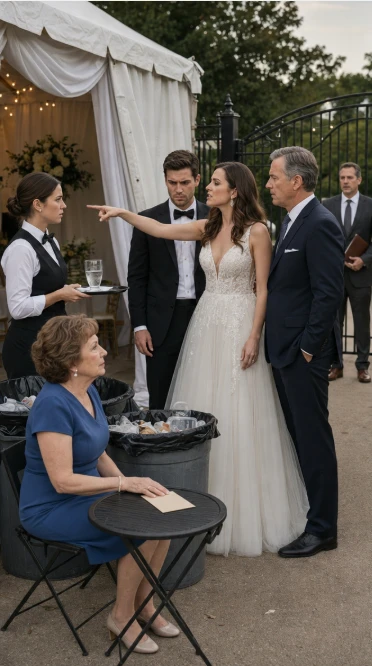
I arrived at my son’s wedding in Nashville with a small envelope held carefully against my chest. Inside was the deed to the lake house where Daniel had spent every summer of his childhood. Three weeks earlier, I had quietly made the final mortgage payment. Daniel had no idea. Madison had no idea. I had planned to hand them the property that evening as my wedding surprise, completely debt-free.
I thought it would be the beginning of something beautiful for them.
Then Madison’s mother looked me up and down.
Her eyes paused on my simple blue dress before she frowned.
“You’re Daniel’s mother?”
Before I could answer, she placed a small seating card in my hand.
I glanced at the table number and followed one of the staff members around the side of the reception tent. That was when I saw where I had been placed.
Behind the main reception area.
Beside the service entrance.
Next to two large trash containers.
I stared at the little table as if perhaps I had misunderstood.
“There must be a mistake,” I said.
Madison appeared behind me.
She looked stunning in her wedding gown, but there was nothing warm in her expression.
“There isn’t enough room for everyone important,” she said quietly.
My throat tightened.
“I’m the groom’s mother.”
“And this is my family’s wedding,” she replied. “Please don’t embarrass Daniel.”
Several nearby guests heard her.
A few looked away.
No one stepped forward.
I found Daniel near the dance floor a few minutes later.
“Son, may I speak with you?”
Madison immediately reached for his arm.
“Your mother is creating another scene.”
Daniel looked exhausted, but what hurt most was that he would not meet my eyes.
“Mom, can you please cooperate for one night?”
I stared at the man I had raised almost entirely on my own after his father passed away.
“You knew where she seated me?”
Daniel said nothing.
He didn’t need to.
I walked back outside and sat at the little table beside the service area while music and laughter floated from inside the tent.
A young server named Lily approached with a glass of water.
“This doesn’t seem right,” she whispered.
“Thank you,” I said.
Before she could set the glass down, Madison came quickly around the corner.
“I told the staff not to serve her until the family tables are finished.”
Lily froze.
I looked at Madison for a long moment, then opened my purse.
I took out the envelope and placed it carefully on the table.
Madison noticed Daniel’s name written across the front.
She gave a short laugh.
“If that’s your wedding present, just leave it with the other cards.”
Then her father stepped outside.
His attention moved from Madison to me, then to the envelope.
He suddenly stopped.
I watched his expression change when he recognized the address written beneath my signature.
“Madison,” he said slowly, “do you know who owns that lake house?”
She rolled her eyes.
“Some lonely older woman, apparently.”
Her father stared at her.
Then he reached toward the envelope.
His hand never touched it.
At that exact moment, a man in a charcoal suit walked through the reception gate carrying a leather folder.
My attorney.
He approached the table and looked directly at me.
“Mrs. Carter,” he said, “I brought the cancellation documents you requested.”
The rest of the story is in the first comment.
Madison’s father went completely still.
“Cancellation documents?” Madison repeated.
My attorney, Mr. Bennett, did not answer her. He placed the leather folder beside my purse and waited for me to speak.
Daniel had followed him outside.
“What cancellation documents?” he asked.
I looked at my son.
For years, I had imagined the moment when I would give him the lake house.
I remembered him at nine years old running down the wooden dock with a fishing pole too large for him. I remembered him learning to swim there. I remembered summer breakfasts on the porch and rainy afternoons playing cards at the kitchen table.
After his father was gone, that house became the one place where Daniel and I could still feel that our little family had not disappeared completely.
I had protected it for years.
I had worked extra shifts.
I had skipped vacations.
I had refinanced once when money became difficult.
And three weeks before the wedding, I had finally paid off every remaining dollar.
The property was mine without debt.
And I had planned to make it his.
“I was going to transfer the lake house to you tonight,” I told Daniel.
His expression changed instantly.
“What?”
Madison turned toward him.
“You said your mother still had a mortgage on that place.”
“She did,” Daniel said.
“I paid it off three weeks ago,” I replied.
Madison’s father slowly lowered himself into the empty chair beside the table.
He knew something the others did not.
Years earlier, he had attempted to purchase several properties around that lake for a development project. Mine had been one of the few owners who refused to sell.
The location had become considerably more valuable since then.
Madison looked at her father.
“Why are you acting like this?”
He stared at her.
“Because that property is worth far more than you think.”
The air seemed to change.
For the first time that evening, Madison looked at me without dismissal.
Daniel stepped closer.
“Mom, you were giving us the house?”
“I was.”
The single word hung between us.
Madison immediately softened her voice.
“Mrs. Carter, I think tonight has gotten completely out of hand.”
I almost smiled.
Five minutes earlier, I had been someone who was not important enough to sit beneath the reception tent.
Now that she understood what was inside the envelope, suddenly the situation was a misunderstanding.
“It hasn’t gotten out of hand,” I said. “It has become very clear.”
Madison looked toward the guests gathering near the opening of the tent.
“We can move your table.”
I looked at her.
“This was never about the table.”
Daniel closed his eyes for a moment.
He understood.
At least part of him did.
The chair beside the service area was embarrassing, but I could have survived embarrassment.
What mattered was that my son knew about it.
What mattered was that he had seen me being treated as though I were an inconvenience and had asked me to cooperate.
Mr. Bennett opened the folder.
“The transfer documents have not been recorded,” he explained. “Mrs. Carter can simply withdraw them.”
Daniel stared at the papers.
Madison’s father looked at his daughter.
“You had no idea what she was giving you?”
Madison folded her arms.
“How could I?”
Her father’s expression hardened.
“You could have started by treating her like Daniel’s mother rather than judging her by a dress.”
Madison looked stunned.
Daniel stepped toward me.
“Mom, can we talk privately?”
I shook my head.
“Not tonight.”
His face fell.
I had spent decades solving problems for Daniel before he even realized they existed.
That habit ended beside that little table.
I signed the first cancellation page.
Then the second.
Mr. Bennett gathered them together.
Madison watched every movement.
When I finished, I returned the pen.
The house was still mine.
But what happened next surprised everyone more than the cancellation itself.
Because Mr. Bennett removed another document from his folder.
And when Madison’s father saw the heading, he stood up again.
“Elaine,” he said quietly, “you already created a trust?”
I looked at him.
“Yes.”
Daniel stared at me.
“A trust for who?”
I placed my hand over the document.
“For the person who eventually understands what that house actually represents.”
PART 2 IS IN THE FIRST COMMENT.
The lake house had never been the most impressive property in Nashville.
It was two hours away from the city, tucked beside quiet water and surrounded by tall trees. The porch leaned slightly to one side. The kitchen cabinets were older than most of the appliances. One bedroom still had pale blue paint Daniel had chosen when he was twelve.
But to me, it was priceless.
My husband, Thomas, and I bought it when Daniel was six.
We had almost no money then.
Thomas worked for a small construction company, and I managed the front office of a medical clinic. Every month, we put a little aside. When we finally signed the papers, Thomas stood on the porch overlooking the lake and told me, “Someday Daniel will bring his own family here.”
For years, that was exactly what I imagined.
Then Thomas passed away unexpectedly when Daniel was still young.
Life became quieter after that.
Harder too.
There were bills I had never handled before, repairs Thomas had always taken care of and decisions I suddenly had to make alone.
The lake house became my promise to myself.
No matter how difficult things became, I would keep it.
Daniel deserved one place that remained connected to the happiest years of his childhood.
So I kept working.
Daniel grew up.
He went to college, moved to Nashville and built a career in commercial insurance. I was proud of him.
When he introduced me to Madison, I wanted to like her.
And at first, I did.
She was polished, confident and ambitious. She worked in event marketing and came from a family that cared deeply about appearances.
There was nothing wrong with that.
The problem began gradually.
Whenever I invited them to dinner, Madison always seemed busy.
Whenever Daniel visited me alone, she called repeatedly.
When we attended events with her family, she introduced me politely but rarely included me in conversations.
I told myself I was imagining it.
Daniel was happy.
That mattered more than my pride.
Then the wedding planning began.
Madison’s parents offered to organize most of it. Her mother, Caroline, selected the venue, flowers, caterers and seating plan.
I was occasionally asked for an opinion, but almost nothing I suggested was used.
Again, I let it go.
This was Daniel’s wedding, not mine.
I wanted the day to belong to him and the woman he loved.
Meanwhile, I was quietly arranging my own surprise.
The mortgage on the lake house had only a small balance remaining.
I had enough savings to eliminate it without hurting my retirement.
So I did.
When the bank confirmed the loan had been satisfied, I sat at my kitchen table staring at the paperwork for almost an hour.
Then I called my attorney, Charles Bennett.
“I want to give the house to Daniel after the wedding,” I told him.
“Completely?”
“Yes.”
He hesitated.
“Elaine, are you sure?”
“I’ve been sure for years.”
He prepared a deed transferring the property into Daniel’s name, with instructions that I would sign the final documents after the ceremony.
I placed a copy inside a cream-colored envelope.
I even wrote a small note.
For all the summers we shared, and all the summers still ahead.
I carried that envelope into the wedding.
That morning, I had felt almost foolishly happy.
I wore the blue dress Daniel once told me reminded him of summers at the lake.
It was not designer clothing.
It wasn’t meant to be.
But it was elegant, comfortable and meaningful to me.
When I arrived at the venue, Caroline greeted me near the entrance.
Her gaze moved immediately to my dress.
“You’re Daniel’s mother?”
The question surprised me.
We had met twice.
“Yes, Caroline.”
“Oh.”
She handed me a place card.
“I believe they’ve arranged your seat.”
I followed a member of the staff around the tent.
The main reception area was beautiful.
Long tables stood beneath strands of warm lights. White flowers covered the centerpieces. Music played softly from speakers near the dance floor.
Then we kept walking.
Past the family tables.
Past the bar.
Past the catering station.
Finally, the server stopped beside a tiny round table behind the tent.
Two large trash containers stood nearby.
I thought he was mistaken.
“There must be another table with this number.”
He checked his sheet.
“No, ma’am. This is the seat listed for you.”
I stood there trying to understand.
Then Madison appeared.
“There isn’t enough space for everyone important,” she said.
The words were so casual that for a moment I wondered whether I had heard correctly.
“I’m Daniel’s mother.”
She leaned closer.
“This is my family’s wedding. Please don’t embarrass Daniel.”
My first instinct was to leave.
My second was to find my son.
I chose the second.
Daniel was speaking with two friends beside the dance floor.
When he saw my face, he excused himself.
“Mom, what happened?”
“I’ve been seated outside the reception area.”
Before he could respond, Madison arrived.
“Your mother is creating another scene.”
Daniel sighed.
That sound hurt more than Madison’s words.
“Mom, can you please cooperate for one night?”
I looked at him.
“You knew where she seated me?”
He looked toward Madison.
Then toward the floor.
That was my answer.
I returned to the table.
I did not cry.
I did not argue.
I did not make a public announcement.
I simply sat down.
Lily, a young server, noticed me.
She brought water and quietly told me she thought the situation was unfair.
Madison came outside almost immediately and told her to return to the main reception.
That was when something changed inside me.
I had spent most of my adult life protecting Daniel from discomfort.
When he was worried, I reassured him.
When he struggled financially after college, I helped him.
When his apartment lease ended unexpectedly, I let him stay with me.
When he wanted to propose to Madison but worried about the cost of the ring, I quietly gave him money I had been saving for a vacation.
I never kept score.
He was my son.
But sitting beside that service area, I finally understood that love without boundaries could teach the wrong lesson.
Daniel had become so accustomed to my understanding that he assumed I would understand anything.
Even disrespect.
I opened my purse and placed the envelope on the table.
Madison saw Daniel’s name.
“If that’s your wedding gift, leave it with the other cards.”
Then her father, Richard, stepped outside.
Richard was a real-estate investor.
Years earlier, one of his companies had attempted to purchase several properties along our lake. A broker had contacted me twice.
I had declined both offers.
Richard apparently remembered the address.
He stared at the envelope.
“Madison, do you know who owns that lake house?”
She gave an impatient shrug.
“Some lonely older woman, apparently.”
Richard’s face changed.
Before he could say anything else, Charles Bennett entered through the gate.
I had texted him twenty minutes earlier.
My message contained only seven words.
Please bring the cancellation documents tonight.
Charles did not ask questions.
He arrived with his leather folder and walked directly to me.
“Mrs. Carter, I brought the cancellation documents you requested.”
Daniel came outside.
“What documents?”
I looked at him.
“The lake house.”
His brow furrowed.
“What about it?”
“I paid off the mortgage three weeks ago.”
Daniel stared.
“You did?”
“Yes.”
Madison turned toward him.
“You told me she still owed money on it.”
“She did the last time we talked about it.”
I removed the deed from the envelope.
“I intended to give you the house tonight.”
No one spoke.
Richard slowly sat down.
Daniel looked as though he had forgotten where he was.
“You were giving it to me?”
“To both of you, really. I wanted you to build your own memories there.”
Madison’s eyes moved toward her father.
“How much is it worth?”
That question ended whatever doubt remained inside me.
Not “Why would you do that for us?”
Not “Are you sure?”
Not even “I’m sorry.”
How much is it worth?
Richard answered reluctantly.
“Significantly more than she probably paid for it.”
Madison looked back at me.
Her entire tone changed.
“Mrs. Carter, tonight has been stressful. I think there’s been a misunderstanding.”
“No,” I said. “I understand perfectly.”
“We can move your seat.”
“That is not the issue.”
Daniel finally found his voice.
“Mom, I’m sorry.”
I believed that part of him meant it.
But apologies spoken after learning the value of an envelope are complicated things.
“You knew where I was seated,” I reminded him.
He looked down.
“I didn’t want an argument today.”
“Neither did I.”
“I thought it would be easier if you just went along with it.”
I nodded.
“For you, perhaps.”
Charles opened the cancellation documents.
I signed them.
There was no dramatic announcement.
No shouting.
No spectacle.
Just the quiet scratch of a pen across paper.
The transfer was withdrawn.
The house remained mine.
Madison stared at the signed documents.
“You’re taking away our wedding gift because of a seating arrangement?”
“No,” I said. “I’m keeping my home because tonight showed me that I was about to make an important decision for the wrong reasons.”
Richard looked at his daughter.
“You placed his mother out here?”
Madison’s expression hardened again.
“There wasn’t enough room.”
Richard glanced toward the enormous reception tent.
“There are empty chairs inside.”
She said nothing.
Daniel sat across from me.
“Mom, please.”
I loved him.
That never changed.
But love did not require pretending nothing had happened.
“Go back to your wedding,” I told him.
He looked stunned.
“We’ll talk another day.”
Madison pulled gently at his arm.
“Daniel.”
He didn’t move.
For once, he looked at me rather than at her.
“I really am sorry.”
“I hope you are.”
Then Charles removed another set of papers.
Richard recognized them immediately.
“You created a trust?”
“Yes.”
Daniel looked confused.
“For the lake house?”
I nodded.
Charles explained that several weeks earlier, while preparing the original transfer, he had suggested a backup plan.
If I ever decided not to transfer the property directly, it could eventually be placed into a family trust with conditions protecting it from sale, outside debt or decisions made without careful consideration.
At first, I thought the idea was unnecessary.
That evening, it felt wise.
Madison asked, “Who gets it?”
I looked at Daniel.
“That depends on what happens next.”
Her face tightened.
“So now there are conditions?”
“There have always been conditions,” I said. “They just weren’t written down before.”
Respect.
Responsibility.
Gratitude.
Things I once assumed did not need to be explained.
I left the wedding shortly afterward.
Lily quietly helped me gather my purse and coat.
As I walked toward the parking lot, I heard Daniel call my name.
I stopped.
He approached alone.
“Can I come see you tomorrow?”
“Not tomorrow.”
His face fell.
“Then when?”
“When you’re ready to talk about what happened without explaining it away.”
He nodded.
I drove home.
For the first time that evening, I cried.
Not because I had lost a house.
Not because I had lost money.
Because I had realized how far my son and I had drifted without either of us admitting it.
For the next week, Daniel called several times.
I did not ignore him forever.
I simply gave myself time.
When we finally met, it was not at my house.
It was at the lake.
Daniel arrived alone.
He stood on the old porch with his hands in his pockets.
For several minutes, neither of us spoke.
Then he looked toward the water.
“I remember Dad teaching me to fish from that dock.”
“So do I.”
“I haven’t thought about that day in years.”
I waited.
He turned toward me.
“I knew the seating arrangement two days before the wedding.”
Hearing the truth still hurt.
“Why didn’t you change it?”
“Madison said her mother had already finalized everything. She said changing it would create problems.”
“And you believed my humiliation was the easier problem.”
He closed his eyes.
“Yes.”
There was no excuse in his voice.
That mattered.
“I kept choosing whatever avoided conflict,” he said. “I told myself I was keeping the peace.”
“You were moving the conflict onto someone you thought would forgive you.”
He nodded.
“That’s exactly what I did.”
Daniel apologized without mentioning the lake house.
For the first time, I believed he understood.
He told me he and Madison had spent the week arguing about far more than the cancelled gift.
The wedding had exposed disagreements they had been avoiding for months.
Money.
Family expectations.
Boundaries.
The influence of her parents.
Daniel’s habit of remaining silent whenever situations became uncomfortable.
“I don’t know what happens next,” he admitted.
“That’s between you and Madison.”
He looked at the house.
“What happens to this place?”
“For now?”
“Yes.”
“I keep it.”
He nodded.
No argument.
No disappointment.
Just acceptance.
That was the beginning of our relationship changing.
Not returning to what it had been.
Changing.
Daniel began visiting more often.
Sometimes he came to repair something.
Sometimes he simply sat on the porch with me.
He never asked about the deed again.
Madison did not visit for several months.
When she finally did, she looked different.
Not physically.
Something in her confidence had softened.
She stood at my front door holding no gift, no flowers, nothing meant to make the conversation easier.
“I owe you an apology,” she said.
I invited her inside.
She sat across from me at the kitchen table.
“I was horrible to you at the wedding.”
I said nothing.
“I cared too much about what everything looked like,” she continued. “My mother had spent months telling me the wedding needed to impress people. I started treating the day like a production instead of a family event.”
“That explains it,” I said. “It doesn’t excuse it.”
“I know.”
She looked down at her hands.
“I also knew you didn’t fit the image my mother wanted.”
There it was.
The truth.
The blue dress.
The modest lifestyle.
The widow who lived quietly and drove an older car.
They had mistaken simplicity for insignificance.
Madison continued.
“When Dad told me what the lake property was worth, I realized how quickly my attitude changed. That embarrassed me more than anything.”
I appreciated her honesty.
“You thought money changed who I was.”
“Yes.”
“It didn’t.”
“I know that now.”
Forgiveness did not arrive instantly.
Trust rarely does.
But I accepted her apology.
Months passed.
Daniel and Madison began counseling.
They established clearer boundaries with both families.
Caroline never apologized directly, although she eventually sent me a polite letter.
Richard did.
His apology was brief.
He said he should have paid more attention to the way I was being treated instead of only reacting when he recognized the property.
I respected that.
A year after the wedding, Daniel and Madison returned to the lake together.
We ate dinner on the porch.
Nothing dramatic happened.
No one discussed property values.
No one mentioned deeds.
After dinner, Madison helped me wash dishes while Daniel replaced a loose board near the steps.
At one point she looked through the kitchen window.
“He really loves this place.”
“He always has.”
She nodded.
“I understand why you didn’t give it away.”
I dried a plate.
“I didn’t decide never to give it away.”
She looked at me.
I smiled.
“I decided not to make that decision until I knew the house would be valued for the right reasons.”
Several years later, the lake house was placed into the family trust.
Daniel was named one of its future beneficiaries, but the property could not simply be sold for quick cash or used as collateral without safeguards.
That was Charles’s suggestion.
I agreed.
The house would remain what Thomas and I intended it to be.
A family place.
Not a financial shortcut.
Not a prize.
Not proof of anyone’s importance.
Sometimes I still think about that small table behind the wedding tent.
I remember the music drifting through the fabric walls.
I remember Lily’s quiet kindness.
I remember Daniel refusing to meet my eyes.
And I remember the envelope resting beneath my hand.
For years, I thought the greatest gift I could give my son was a paid-off house.
I was wrong.
The greater gift was finally allowing him to experience the consequences of his own choices.
And perhaps the greatest gift I gave myself was learning that generosity does not require surrendering dignity.
That night, Madison believed she had seated an unimportant woman beside the service area.
She had no idea I was carrying the future she had already begun imagining.
But the real surprise was not that I could take that future away.
It was that the future was never truly inside the envelope.
It depended on the kind of family we chose to become afterward.