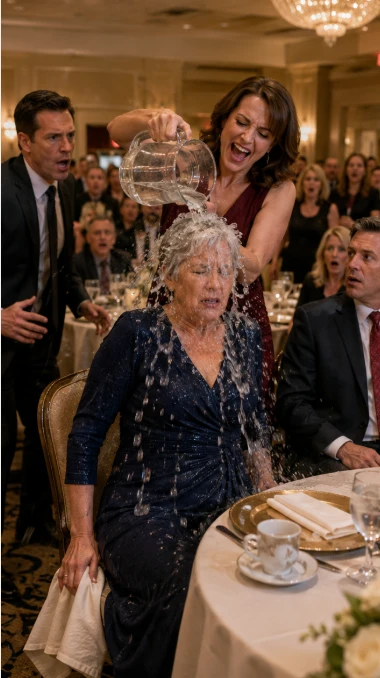
My daughter lifted a crystal pitcher over my head at my retirement dinner and dumped every drop of ice water onto my silver hair, my navy dress, and the pearl necklace my late husband had given me.
“There,” Kendra said, laughing loudly enough for nearly two hundred former coworkers to hear. “Maybe that’ll cool down your ego.”
I stood up dripping wet, looked at the daughter I had spent thirty-seven years protecting, and handed her the linen towel from the back of my chair.
“You’ll need this more than I will in about five minutes.”
Part 1 — The Retirement Dinner I Was Never Supposed to Control
For three seconds, Kendra looked as if she hadn’t understood me.
Then she laughed again.
It was the kind of laugh people use when they desperately need everyone else to believe they are still in control.
“Mom,” she said, rolling her eyes toward the people seated around our table, “please don’t start being dramatic.”
I wiped water from my cheek with the back of my hand.
A melting ice cube slid from my shoulder and struck the ballroom carpet.
“I’m not the one holding the pitcher.”
That got a few uncomfortable chuckles.
Kendra’s face tightened.
We were inside the Grand Meridian Hotel in Tulsa, Oklahoma, on a warm Friday evening in late May.
Hawthorne Industrial Systems had rented the ballroom for my retirement dinner after thirty-eight years with the company.
There were white tablecloths, copper-colored centerpieces, framed photographs from old company projects, and a stage displaying a large screen that read:
THANK YOU, LORETTA VAUGHN — 38 YEARS OF SERVICE.
I was sixty-seven years old.
Until five o’clock that afternoon, I had been Hawthorne’s senior director of operations strategy.
That title sounded impressive.
The truth was less glamorous.
For most of my career, I had been the woman people called when a factory was six weeks behind schedule, when a supplier disappeared, when a multimillion-dollar contract started bleeding money, or when two executives refused to sit in the same room.
I fixed things.
Mostly quietly.
I never cared much about being photographed beside the finished product.
My late husband, Frank, used to tease me about that.
“You’ll build the bridge,” he would say, “and let some man with cleaner shoes cut the ribbon.”
He wasn’t entirely wrong.
Frank had been gone eight years.
Cancer.
Fourteen months from diagnosis to funeral.
I had worked through most of it because his medical care was expensive, his insurance was complicated, and the mortgage still arrived on the first of every month whether our hearts were breaking or not.
After his death, work became both shelter and habit.
Kendra had been twenty-nine then.
She was thirty-seven now, tall and polished, with dark blond hair cut just above her shoulders and an expensive cream pantsuit she had bought for the dinner.
She worked for a fast-growing logistics technology company called Elevanta Solutions.
Six months earlier, she had been promoted to vice president of regional partnerships.
It was the biggest job she had ever held.
I had sent flowers.
She had posted them online.
She had not mentioned who sent them.
That should have told me more than it did.
“Kendra,” said my younger son, Travis, from two seats away.
He was forty-one, a high school counselor in Norman, and the only person at the table who had stood the moment the water hit me.
“What the hell are you doing?”
“Oh, relax,” Kendra snapped. “It was water.”
“It was humiliation,” Travis said.
“It was a joke.”
Nobody laughed this time.
My former assistant, Priya Shah, rushed toward me carrying napkins.
I shook my head gently.
“I’m fine.”
“You’re soaked.”
“Still fine.”
I removed my wet navy jacket and draped it over the empty chair beside me.
Underneath, I wore a sleeveless blue-gray dress.
Water had darkened the fabric from my shoulders to my waist.
Kendra crossed her arms.
“This is exactly what I mean.”
I looked at her.
“What do you mean?”
“This.”
She gestured at the ballroom.
“All of this.”
Her voice had risen.
People at nearby tables were no longer pretending not to listen.
I stared at her.
I hadn’t organized a single detail of the dinner.
The company had.
In fact, I had asked for something smaller.
A lunch.
Maybe cake in the cafeteria.
Former CEO Howard Sutter had laughed when I suggested it.
“Loretta,” he had said, “you kept this place alive through two recessions, a plant fire, and the Redfield acquisition. You’re getting the ballroom.”
Apparently Kendra had decided gratitude was vanity.
“This evening wasn’t my idea,” I said.
“Of course not.”
She used that same dismissive tone she had begun using with me over the previous year.
The tone that implied everything I said required translation by someone younger and more important.
Her husband, Grant, remained seated beside her.
Grant Felton was forty.
He was a commercial real estate broker who wore his ambition like cologne.
He rarely insulted me directly.
He preferred small corrections.
Actually, Loretta…
Technically…
What Kendra means is…
That night, though, Grant looked uncomfortable.
“Kendra,” he murmured, “maybe enough.”
She ignored him.
“You know what people at my company say?” she continued.
I felt something inside me change.
Not break.
Settle.
“What do they say?”
“They say I got where I am because I’m Loretta Vaughn’s daughter.”
A woman at the next table turned her face away.
I understood then.
This wasn’t about retirement.
It wasn’t even about me.
It was about shame.
Kendra was ashamed that the mother she had relied on for decades was still visible enough to cast a shadow.
“And you believe throwing water on me fixes that?” I asked.
She gave a short laugh.
“I believe maybe once in your life you could let somebody else have the spotlight.”
I almost smiled at the absurdity of it.
I had spent most of my life stepping out of hers.
When Kendra was nine, I had turned down a six-month project in Germany because she had begun having panic attacks after Frank’s mother died.
When she was seventeen, I spent every Tuesday and Thursday driving ninety minutes each way for competitive dance.
When she went to college, Frank and I refinanced our house rather than let her graduate with private student loans.
When she was twenty-six and divorced her first husband, I paid six months of her rent without telling Travis because she was embarrassed.
When she wanted to move into corporate consulting, I introduced her to three people I trusted.
When she needed childcare after her son Owen was born, I rearranged my schedule twice a week for almost a year.
I had never kept a ledger.
Love does not need receipts.
But entitlement eventually creates them.
Kendra picked up her champagne glass.
“I’m done talking about it.”
I watched her take a sip.
Then I glanced toward the stage.
Howard Sutter stood beside the curtain.
Seventy-two years old, retired for three years, bald except for a thin silver rim of hair, Howard wore the same black-framed glasses he had worn for two decades.
In his left hand was a dark gray folder.
Across the front, printed in bright orange, was a logo I knew very well.
ELEVANTA SOLUTIONS.
Kendra’s company.
Howard saw me looking.
He did not smile.
He simply nodded once.
That folder was the mysterious thing Kendra had not noticed when she arrived.
I had.
I had known it would be there.
Just not exactly when Howard intended to use it.
Two weeks earlier, he had called me.
“Loretta,” he had said, “I need your permission before I do something.”
“For what?”
“To tell the truth in public.”
That sentence had stayed with me.
At first, I told him no.
I didn’t want my retirement dinner turned into a trial.
I especially did not want Kendra embarrassed.
Even after everything.
That was my mistake.
I was still protecting her.
But then, four days before the dinner, I received an email that changed the equation.
It was from Elevanta’s chief compliance officer.
Her name was Celeste Avery.
She asked whether I would consent to an interview concerning materials submitted by one of their executives during an internal promotion review.
One of their executives.
My daughter.
I called Celeste.
The conversation lasted fifty-two minutes.
At the end, I opened the locked filing cabinet in my home office and removed a flash drive I had hoped never to use.
The drive contained seventeen years of consulting notes, project files, prototype models, presentation drafts, and correspondence.
Including one project I created entirely on my own after retirement planning had already begun.
A project Kendra had recently presented to Elevanta as hers.
I did not know that when she got promoted.
I learned it four days before my retirement dinner.
And she apparently still thought I knew nothing.
“Mom.”
Travis touched my elbow.
“You want to leave?”
I looked at my son.
Then at Kendra.
Then at Howard.
“No.”
I sat back down.
“I’ve spent too many years leaving rooms to make other people comfortable.”
Kendra rolled her eyes again.
“There she goes.”
I turned toward her.
“No, sweetheart.”
My voice stayed calm.
“There I stay.”
The band near the stage stopped playing.
Howard stepped toward the microphone.
He did not carry my retirement plaque.
He carried the Elevanta folder.
“Ladies and gentlemen,” he said, “before we continue with Loretta’s retirement program, there is a professional matter we need to address.”
Kendra froze.
Grant slowly lowered his champagne glass.
Howard looked directly at my daughter.
“Kendra Felton, I believe this concerns you.”
And for the first time that night, my daughter stopped laughing.
Part 2 — The Promotion That Wasn’t Hers
Kendra stood so quickly her chair scraped the floor.
“What is this?”
Howard remained beside the microphone.
“I think you know enough to let me finish.”
“No, I don’t.”
She turned toward me.
“What did you do?”
That question hurt more than the ice water.
Not because she accused me.
Because it revealed what she believed about me.
That if consequences arrived, they must have been manufactured by her mother.
“I answered questions,” I said.
“What questions?”
“The ones your employer asked.”
Her face drained.
Grant leaned toward her.
“Kendra?”
“Stay out of it.”
That was the first moment I realized Grant might not know.
Until then, I had assumed they were together in whatever had happened.
I had been wrong.
Howard raised a hand.
“For everyone wondering why this is being discussed here, I want to be clear.”
He looked around the ballroom.
“Tonight’s program included a section about Loretta’s work on the Horizon Routing Model because Hawthorne granted permission three years ago for her to continue developing it independently after her planned departure from the company.”
A few former coworkers immediately began murmuring.
They knew the name.
Horizon had started as a side project during the supply-chain crisis four years earlier.
Hawthorne manufactured industrial cooling equipment.
Our deliveries involved enormous components coming from plants, foundries, rail terminals, trucking companies, and ports across several states.
When one supplier slipped, everything downstream moved with it.
I built Horizon initially as a crude decision model.
Not software.
Just logic.
A way to reroute production and delivery schedules before delays cascaded.
The first version lived on spreadsheets taped across my dining-room table.
Frank would have loved it.
He had been an engineer who believed every impossible problem was merely “badly organized information.”
Over three years, I improved the model.
When Hawthorne no longer needed it internally, then-CEO Howard Sutter and our legal department formally released the nonproprietary framework back to me under a written separation agreement.
That distinction mattered.
A lot.
After Howard retired, I kept working on Horizon at home because I liked solving the puzzle.
Kendra knew that.
She had sat at my kitchen counter while I worked.
She had asked questions.
Hundreds of them.
At the time, I thought she was interested in me.
That memory became painful in a new way.
Howard opened the folder.
“Six months ago, Elevanta Solutions promoted Kendra Felton after she led a presentation for something called the Adaptive Corridor Framework.”
Grant frowned.
He whispered, “The thing you built?”
Kendra didn’t answer.
My stomach twisted.
Grant really hadn’t known.
Howard continued.
“According to Elevanta’s internal review documents, Ms. Felton represented that framework as the result of approximately eighteen months of independent development.”
I closed my eyes for one second.
Eighteen months.
She had looked me in the face at Christmas and said she had finally found a way to prove herself.
I had hugged her.
I had believed her.
Howard lifted a page.
“The Adaptive Corridor Framework contains structural models, naming conventions, data hierarchies, error flags, and three proprietary workflow sequences that substantially match Loretta Vaughn’s Horizon project.”
Kendra pushed her chair back.
“This is ridiculous.”
She looked around as if someone might rescue her.
“Horizon was a Hawthorne project.”
“No,” Howard replied. “The original operational version was.”
He removed another document.
“The expansion architecture was not.”
Kendra’s mouth tightened.
“You can’t prove where ideas came from.”
Howard’s expression changed.
Not anger.
Disappointment.
“Yes, we can.”
He held up the gray folder.
“Because Loretta dates everything.”
That was true.
It was an old habit from operations.
Every revision.
Every meeting note.
Every version.
Every calculation.
I labeled them with dates, initials, and version numbers.
Frank used to call it my “paper trail obsession.”
It had saved the company from lawsuits twice.
Now it was about to save me from being erased by my own daughter.
Kendra looked at me.
“You gave him my files?”
“No.”
“Then how does he have this?”
“Your employer provided what you submitted during its internal review.”
Her lips parted.
I continued.
“I provided my files.”
“Why?”
The word came out almost childlike.
That nearly broke me.
“Because they asked me whether your work was yours.”
“And you couldn’t just say yes?”
A strange heaviness moved through my chest.
Not grief exactly.
Recognition.
There are moments when a parent realizes the child standing before them is asking for a kind of love that requires dishonesty.
That is not love.
It is surrender.
“No,” I said.
Her eyes flashed.
“You could have.”
“Yes.”
I paused.
“I could have lied.”
The ballroom had become unbearably attentive.
I hated that.
Not for myself.
For her.
Even then, some part of me wanted to pull the curtains closed around my daughter.
But she had dumped water over my head in front of two hundred people because she believed my silence belonged to her.
That part needed to end.
Grant stood.
“Kendra, what did you submit?”
She turned on him.
“Not now.”
“What did you submit?”
“I said not now.”
He stared at her for a long moment.
Then he sat back down, but not beside her.
He pulled his chair several inches away.
Howard closed the folder.
“There is more.”
Kendra laughed sharply.
“Of course there is.”
She pointed at me.
“This is what she does.”
Several faces turned toward her.
“She builds files on everybody,” Kendra said. “She remembers every favor, every date, every conversation.”
“No,” Travis said.
My son was standing now.
“You remember every favor because you keep asking for them.”
“Stay out of this.”
“No.”
His voice was calm.
“You soaked Mom in front of two hundred people because you’re mad people respect her.”
“You don’t know anything about my career.”
“I know she paid your MBA tuition.”
Kendra’s eyes narrowed.
“That has nothing to do with this.”
“It has everything to do with how you treat her.”
“Travis.”
I said his name quietly.
He looked at me.
I shook my head.
I didn’t want the evening to become a catalogue of family debts.
This wasn’t about money.
At least, I still believed it wasn’t.
Howard stepped away from the microphone.
“I think we should take ten minutes.”
But before he could, a woman near the ballroom entrance raised her hand.
“Actually, Mr. Sutter, I would prefer that we continue.”
I recognized her immediately.
Celeste Avery.
Elevanta’s chief compliance officer.
She was fifty-four, with close-cropped dark hair and a charcoal pantsuit.
Unlike Howard, she had not been part of the original dinner program.
She had asked whether she could attend only after learning Hawthorne intended to recognize Horizon publicly.
I had agreed on one condition.
No ambush.
Any employment action had to be handled according to Elevanta procedure.
She had promised.
Celeste approached the stage.
Kendra stared at her.
“You followed me here?”
“No,” Celeste said. “I was invited by Ms. Vaughn after our compliance review expanded to include intellectual-property attribution.”
“You can’t do this at my mother’s party.”
Celeste’s eyebrows lifted slightly.
“I didn’t pour water on anyone.”
Someone coughed into a napkin to hide a laugh.
Kendra’s cheeks reddened.
Celeste turned toward me.
“Loretta, may I proceed with the question we discussed?”
I nodded.
She faced the audience.
“We are not here to announce disciplinary findings.”
Then she looked directly at Kendra.
“But I can confirm that Elevanta has placed Ms. Felton on administrative leave pending completion of an independent review.”
Kendra gripped the back of her chair.
“For what?”
Celeste held her gaze.
“For potential misrepresentation of authorship, inaccurate statements made during an executive promotion process, and possible use of third-party confidential materials.”
“They weren’t confidential.”
“The review will determine that.”
Kendra looked at me again.
“You’re really doing this.”
I stood.
Water still clung coldly to the hem of my dress.
“No, Kendra.”
I walked one step closer to her.
“You did this.”
Her eyes filled.
For one foolish heartbeat, I wanted to hug her.
Instead, I kept my arms at my sides.
Then Celeste said something I had not expected.
“There is another document we need to discuss.”
She removed a paper from her leather portfolio.
“This one is financial.”
I looked at Howard.
He looked confused.
So did I.
Celeste turned toward me.
“Loretta, were you aware that Elevanta paid an outside consulting entity called North Vale Strategy Group forty-eight thousand dollars during development of the Adaptive Corridor Framework?”
“No.”
Kendra stopped breathing.
At least, that was how it looked.
Celeste continued.
“Were you aware that North Vale’s registered mailing address corresponds to a mailbox leased by Grant Felton?”
My eyes went to my son-in-law.
Grant’s face went white.
“What?”
Kendra whispered, “Celeste—”
Grant rose.
“What does she mean?”
Celeste looked at him.
“Mr. Felton, did you establish North Vale Strategy Group?”
“No.”
His answer came instantly.
“Did you authorize anyone to establish it using your office address?”
“No.”
Kendra backed away from the table.
Now I understood why Celeste had insisted on attending.
The stolen work was only the first layer.
Someone had been paid for it.
Forty-eight thousand dollars.
And whatever I thought I knew about my daughter’s promotion was about to become much worse.
Part 3 — What I Had Actually Been Paying For
The dinner paused for nearly twenty minutes.
People moved awkwardly toward the coffee stations.
Some stepped into the hall.
Others stayed seated, pretending to check phones while listening to every word around them.
Priya brought me a hotel robe from upstairs.
I refused.
“I’m not finishing my retirement dinner dressed like I lost my luggage.”
She almost smiled.
“You always were impossible.”
“I prefer particular.”
She found me another solution.
One of Hawthorne’s event coordinators kept an emergency clothing bag for damaged formalwear.
Ten minutes later, I changed into a simple black wrap dress.
The pearls stayed.
So did my wet hair.
I twisted it back and fastened it with a clip.
When I returned, Kendra was standing in the corridor arguing with Grant.
I did not intend to listen.
Then I heard my name.
“You told me Loretta agreed,” Grant said.
Kendra lowered her voice.
“She basically did.”
“What does that mean?”
“She said I could use anything that helped me learn.”
“Learn?”
Grant gave a humorless laugh.
“You submitted it as your own.”
“You think nobody borrows ideas?”
“Not like this.”
I stopped behind the half-open ballroom door.
Kendra whispered something I couldn’t hear.
Grant answered louder.
“And the company?”
Silence.
Then:
“What company, Kendra?”
My heart began pounding.
Grant continued.
“Celeste just said North Vale uses my business mailbox.”
“I needed an address.”
“For what?”
“Keep your voice down.”
“No.”
His voice cracked.
“For what?”
“Consulting.”
“You don’t consult.”
“I was doing work.”
“What work?”
Kendra didn’t answer.
Grant swore under his breath.
Then he said, “Whose name is on it?”
She whispered.
I couldn’t hear.
Grant could.
He stepped backward.
“You used Owen?”
I felt the floor shift beneath me.
Owen.
My grandson.
Nine years old.
I pushed the door open.
Kendra saw me.
Grant turned.
I looked at my daughter.
“What did you use Owen for?”
“Mom, not now.”
“What did you use my grandson for?”
“It isn’t what it sounds like.”
“Then explain it.”
Grant dragged one hand down his face.
“The LLC.”
“What about it?”
He looked at me.
“She registered North Vale under a custodial structure connected to Owen.”
I stared at him.
“A what?”
Kendra stepped between us.
“It was temporary.”
I turned toward her.
“You put company payments through an entity connected to your nine-year-old son?”
“It wasn’t illegal.”
“That is not an answer.”
“I had a CPA.”
“Then call him.”
Her jaw tightened.
“Kendra.”
My voice lowered.
“Call him.”
She stared at me.
For the first time all night, there was fear in her expression that had nothing to do with public embarrassment.
“I can’t.”
“Why?”
“Because he stopped representing me.”
“When?”
She looked away.
“Two months ago.”
Grant laughed once, disbelieving.
“Two months?”
“Grant—”
“You told me we changed accountants because his fees went up.”
“I was trying to handle it.”
He walked several steps away.
That sentence told me everything.
Not the facts.
The pattern.
I was trying to handle it.
Kendra had used those words since she was fourteen.
After she dented Frank’s truck.
After she failed a college class and hid the notice.
After her first marriage collapsed under debts she never told her husband about.
Whenever reality became inconvenient, Kendra tried to outrun the moment when somebody else would have to know.
For years, I had helped her land softly.
Maybe too softly.
Celeste appeared at the end of the hall.
She was accompanied by a man in his early sixties carrying a slim laptop case.
“Loretta.”
She approached us.
“This is Martin Keane, the forensic accountant retained by Elevanta’s audit committee.”
That explained another piece.
Authority had not wandered into my retirement dinner by coincidence.
The audit was already underway.
Martin nodded politely.
“Ms. Vaughn.”
“Mr. Keane.”
He looked at Kendra.
“We should probably move this conversation somewhere private.”
Kendra crossed her arms.
“So now I’m being interrogated at a hotel?”
“No,” Martin said. “You have counsel available through the process, and you are not required to answer questions tonight.”
He turned to me.
“But there is one issue concerning Ms. Vaughn that needs clarification because company funds may have been characterized as payment for her intellectual property.”
I blinked.
“My intellectual property?”
“Yes.”
We moved into a small conference room across the hall.
Only seven people entered.
Me.
Kendra.
Grant.
Travis.
Howard.
Celeste.
Martin.
The door closed.
Martin opened his laptop.
“North Vale invoiced Elevanta four times.”
He turned the screen.
“Each invoice states: strategic modeling consultation and licensed methodology.”
I read the amounts.
$12,000.
$12,000.
$12,000.
$12,000.
Forty-eight thousand total.
My name did not appear.
But one phrase did.
HORIZON-DERIVED ADAPTIVE ROUTING.
My stomach turned.
“She sold it.”
Nobody answered.
I looked at Kendra.
“You didn’t just take my work.”
“Mom—”
“You sold it.”
“I was going to tell you.”
“When?”
“I don’t know.”
“Before or after your next promotion?”
She flinched.
I did not apologize.
Martin tapped another document.
“There’s another issue.”
Of course there was.
He explained that the money from North Vale had not remained in a business account.
Thirty thousand dollars had gone toward personal credit-card balances.
Eight thousand had paid delinquent property taxes on Kendra and Grant’s rental property.
Six thousand had been transferred to a savings account.
The remaining four thousand had covered business-related expenses.
Grant sat rigidly.
“We don’t have a rental property.”
Martin turned toward him.
“According to county records, your wife does.”
Grant stared at Kendra.
My daughter closed her eyes.
“Where?” he asked.
She said nothing.
Martin answered carefully.
“Broken Arrow.”
“What property?”
“A townhouse.”
Grant’s confusion changed into something darker.
“Why do you own a townhouse in Broken Arrow?”
Kendra pressed both hands against her forehead.
“I bought it as an investment.”
“With what money?”
“Mine.”
“We’re married.”
“I know that.”
“Apparently not in the way I thought.”
I turned away.
This was no longer my business.
Their marriage was theirs.
But then Martin slid another page toward me.
“Ms. Vaughn, this is where your role becomes financially relevant.”
I read the document.
It was a home-equity line of credit.
Against my house.
My house.
The little brick colonial Frank and I had bought twenty-nine years earlier.
I looked up.
“That isn’t possible.”
Martin’s expression was grim.
“The application was never funded.”
“Application?”
“Yes.”
“For how much?”
“One hundred twenty-five thousand dollars.”
Travis shot to his feet.
“What?”
I kept reading.
Borrower: Loretta Mae Vaughn.
Secondary authorized contact: Kendra Felton.
Purpose: home renovation and family investment.
I had never applied for it.
There was a signature near the bottom.
It looked like mine.
Almost.
The L curled incorrectly.
Frank always joked that my handwriting looked like a cardiogram.
Whoever had copied it made it too pretty.
I raised my eyes to Kendra.
She looked sick.
“Did you sign my name?”
“No.”
Martin spoke before she could continue.
“The bank flagged the application because the signature did not sufficiently match older mortgage records.”
“Who submitted it?”
“It originated through an online portal.”
He glanced at Kendra.
“The authentication used an email address connected to Ms. Felton.”
Grant swore softly.
Travis stepped toward his sister.
I caught his arm.
“No.”
He looked at me.
“She forged your signature.”
“I heard him.”
“You’re just going to stand there?”
“Yes.”
“Why?”
“Because this is not a bar fight.”
I released his arm.
“Truth doesn’t get stronger because you shout it.”
Kendra started crying.
Not delicately.
Her shoulders shook.
“I didn’t sign it.”
“Then who did?”
“I started the application.”
The admission landed heavily.
“I was trying to see whether it would work.”
I stared at her.
“That sentence should frighten you.”
“I needed money.”
“You had a six-figure salary.”
“We had debt.”
Grant looked at her.
“How much?”
She looked down.
“How much, Kendra?”
“One hundred eighty-six thousand.”
Grant stepped back as if struck.
“Jesus.”
“Most of it was from before.”
“Before what?”
“Before we got married.”
“You told me you had twenty thousand.”
“I was ashamed.”
And there it was.
Not greed alone.
Shame.
Status.
Fear.
A woman who had spent years trying to prove she was not living in her mother’s shadow had built a life she could not afford, then hidden the cost because admitting it felt like failure.
I understood the emotion.
I did not excuse the behavior.
“Why my house?” I asked.
Kendra wiped her face.
“Because you don’t owe anything on it.”
My throat tightened.
“No.”
“You paid it off after Dad died.”
“No.”
She looked confused.
“No what?”
“You don’t get to say that as if the house were an unused asset sitting on a shelf.”
I moved closer.
“Your father made twenty-nine years of payments on that house.”
My voice shook.
“I worked overtime when interest rates changed.”
I swallowed.
“We skipped vacations.”
Kendra cried harder.
“That house isn’t empty equity.”
I touched my chest.
“It is years of our lives.”
“I know.”
“No.”
I shook my head.
“You knew the number.”
I pointed toward the application.
“You forgot the cost.”
No one spoke for several seconds.
Then Martin cleared his throat.
“There is one additional matter.”
I almost laughed.
“One more?”
“Yes.”
He looked at Howard.
“This is actually the reason Mr. Sutter contacted us.”
Howard straightened.
Martin continued.
“During our document comparison, we found evidence that Horizon was not the only work Ms. Felton claimed.”
Kendra’s head snapped up.
“What are you talking about?”
Martin opened another file.
“Three years ago, Elevanta began negotiating a regional service partnership with Hawthorne.”
I remembered immediately.
The deal had collapsed.
We had spent seven months discussing it.
At the time, Kendra worked in mid-level business development for Elevanta.
I had intentionally recused myself from negotiations because she was my daughter.
Howard had handled the Hawthorne side.
The partnership never happened.
Or so I believed.
Martin looked at me.
“Ms. Vaughn, do you remember preparing a risk analysis concerning that proposed agreement?”
“Yes.”
“A forty-one-page report?”
“Yes.”
“Did you share it with your daughter?”
“No.”
Kendra stared at the table.
Howard said, “I did.”
I turned to him.
He looked ashamed.
“Not directly.”
He explained.
Three years earlier, while negotiating with Elevanta, Howard had sent the risk report to his external consultant.
That consultant had accidentally included Kendra on a reply-all email.
The mistake was caught sixteen minutes later.
But she had already downloaded the attachment.
“I asked her to delete it,” Howard said.
“She said she had.”
Martin rotated the laptop toward me.
“She didn’t.”
The report later appeared in modified form inside an Elevanta executive strategy package.
That package had been credited to Kendra.
And that package was what first moved her name onto the list for senior leadership.
The promotion six months ago had not been the beginning.
It was the culmination.
My daughter had been building her career partly from my work for three years.
Suddenly, dozens of memories rearranged themselves.
Her strange questions.
Her new confidence.
The projects she refused to describe in detail.
The promotion announcements.
The industry award.
The speeches where she talked about “developing instincts no one taught me.”
I had felt proud.
Now I felt foolish.
Not because I had trusted my daughter.
Parents should be able to trust their children.
I felt foolish because warning signs had appeared, and I had interpreted every one through love.
Kendra whispered, “I didn’t know what else to do.”
I looked at her.
“You could have done your own work.”
“You make that sound easy.”
“No.”
I shook my head.
“I make it sound necessary.”
Tears slipped down her cheeks.
“You have no idea what it’s like being your daughter.”
That sentence stunned me.
Then she said the thing she had apparently been carrying for years.
“Everywhere I went, somebody knew you.”
Her voice broke.
“Every conference.”
“Every supplier.”
“Every executive.”
“I would walk into a meeting and someone would say, ‘Oh, you’re Loretta Vaughn’s daughter.’”
She pressed her fist against her chest.
“Do you know how humiliating that became?”
I considered the question.
“Yes.”
She looked surprised.
“I do.”
“How?”
“Because I spent twenty years being Frank Vaughn’s wife in rooms full of engineers before people learned my name.”
Her expression changed.
“I know what it feels like to want your work to belong to you.”
I stepped closer.
“And because I know that feeling, I also know what you did is worse.”
She covered her mouth.
I continued quietly.
“You were so determined not to live in my shadow that you stole the lamp.”
Nobody moved.
That was the moment I stopped seeing Kendra as a cruel daughter who had embarrassed me at dinner.
I saw something sadder.
A frightened woman who had spent years manufacturing proof that she was enough.
And in doing so, she had destroyed the very thing she wanted most.
The ability to say her success was hers.
Part 4 — The Truth Belonged to Everyone She Had Lied To
We could have ended the evening there.
I wanted to.
Every motherly instinct still left in me begged to take Kendra home, close the curtains, make coffee, and find some private way through the wreckage.
Then Celeste asked one question.
“Loretta, do you want us to keep the remainder of tonight’s discussion private?”
Kendra looked at me immediately.
That look was familiar.
Please fix it.
Please cover it.
Please absorb the consequence.
I had seen that expression at fourteen, twenty-two, twenty-six, thirty-one.
For decades, I had answered it the same way.
I would handle the teacher.
I would call the landlord.
I would lend the money.
I would smooth things over with Frank.
I would help write the résumé.
I would introduce the executive.
I would explain the misunderstanding.
I would protect.
That evening, something finally became clear.
Every time I spared Kendra a consequence she had earned, I taught her that love meant somebody else would stand between her and reality.
I couldn’t keep teaching that lesson.
I looked at Celeste.
“What exactly were you planning to discuss publicly?”
Celeste answered carefully.
“Only matters connected to your authorship and Hawthorne’s licensing history.”
“Not the debt?”
“No.”
“The property?”
“No.”
“The attempted loan?”
“Absolutely not.”
“Her marriage?”
“No.”
I nodded.
“Then yes.”
Kendra whispered, “Mom.”
I faced her.
“I will not humiliate you.”
Her eyes moved to my wet jacket still hanging over the conference chair.
The irony was obvious.
“I won’t discuss your private finances,” I continued.
“I won’t discuss your house.”
“I won’t discuss your marriage.”
I paused.
“But I will not lie about my work so you can keep credit for it.”
Her chin trembled.
“Please.”
My heart broke.
Still, I said it.
“No.”
Sometimes no is the most loving word left.
When we returned to the ballroom, the event coordinator had removed the pitcher from our table.
I almost smiled at that.
Someone had also replaced the soaked chair.
The stage lights were warm.
The screen still displayed my name.
I walked to the podium first.
Howard started toward me.
I stopped him with a small gesture.
“I’d like to say something.”
He nodded.
I looked over the faces in front of me.
People I had known for decades.
Some had worked beside me when I was thirty.
Some had been interns I trained.
Some had once been supervisors who thought women belonged in scheduling rather than strategy.
Some had become dear friends.
And standing near the back was my daughter.
I did not want to destroy her.
I wanted to stop disappearing for her.
“I had a speech prepared,” I began.
A few people laughed softly.
“It was four pages.”
More laughter.
“Priya told me that was too long.”
Priya called from the front table, “It was six.”
That helped.
The tension loosened.
I smiled.
“Fine.”
“Six.”
Then I looked down at the podium.
“When I started at Hawthorne in 1988, I was twenty-nine years old.”
“I had two inexpensive suits, a four-year-old Ford, one toddler, and absolutely no idea I would stay thirty-eight years.”
Several former coworkers smiled.
“I learned a great deal here.”
“I learned that machines fail.”
“Contracts fail.”
“Forecasts fail.”
“And people fail.”
I looked toward Kendra.
“So do mothers.”
Her face crumpled slightly.
“I made a mistake with my daughter.”
People became still.
“I thought protecting someone from pain was always the same thing as loving them.”
I shook my head.
“It isn’t.”
“Sometimes love is paying the bill.”
“Sometimes love is sitting beside a hospital bed.”
“Sometimes love is making one more phone call after midnight.”
“And sometimes love is refusing to cover a lie.”
I saw Travis lower his head.
I continued.
“Some of you have heard questions tonight about the Horizon Routing Model.”
“It is true that I developed the expanded framework independently after Hawthorne released the applicable rights to me.”
“I have dated records, agreements, and source documents.”
I paused.
“It is also true that portions of my work were later presented inside another company without my permission.”
No gasps.
No melodrama.
Just a deep, uncomfortable recognition moving across faces.
“That company is reviewing the matter.”
“I will cooperate.”
“And I will tell the truth.”
I looked at Kendra.
“Even when telling it hurts someone I love.”
My voice almost broke.
I let it.
Strength is not the absence of pain.
It is deciding pain does not get to choose your principles.
I stepped away from the podium.
Howard approached.
He opened the gray folder.
“For those who worked with Loretta on Horizon,” he said, “I want to clarify one important point.”
He displayed the separation agreement.
“Hawthorne formally assigned the expanded methodology rights to Loretta Vaughn in March 2023.”
“Those rights were not corporate property afterward.”
“Any external use required her authorization.”
He turned a page.
“No such authorization was granted to Elevanta Solutions, North Vale Strategy Group, or Kendra Felton.”
Celeste joined him.
She did not announce termination.
She did not accuse.
She did what professionals do when the truth matters.
She stated only what had been verified.
“Elevanta has suspended use of the Adaptive Corridor Framework while authorship and licensing issues are reviewed.”
“Any payment or commercial agreements based on the disputed material are also under review.”
Then came the second twist.
One I had known about only since that morning.
Celeste looked at me.
“Ms. Vaughn, with your permission, I would also like to clarify why Elevanta initially became concerned.”
I nodded.
“Three weeks ago, another member of our strategy department raised questions about version history.”
Kendra looked toward her.
Celeste continued.
“That employee noticed references inside Ms. Felton’s presentation materials to LV-HR revision tags.”
I closed my eyes.
LV.
Loretta Vaughn.
HR.
Horizon Routing.
Kendra had changed titles.
Changed formatting.
Changed colors.
Changed company names.
But buried inside six spreadsheet formulas were my original revision tags.
The thing that exposed her was not a rival.
Not me.
Not Howard.
Not luck.
It was metadata she had failed to understand.
Celeste said, “Our employee searched the initials and found public references to Ms. Vaughn’s Hawthorne work.”
Howard looked at Kendra.
“Your mother did not report you.”
That mattered.
I saw the impact hit her.
Until that moment, some part of Kendra still believed I had initiated the investigation.
That I had retaliated.
That the evening was revenge.
It wasn’t.
The truth had already begun moving before I knew anything.
Celeste continued.
“Once our team identified the overlap, we contacted Loretta.”
There it was.
The complete reversal.
I had not used my power to destroy my daughter.
I had used what little power I still possessed to prevent the company from acting before verifying the facts.
I had asked Celeste for forty-eight hours.
I had encouraged her to review every version rather than assume intentional theft.
I had provided records that included places where Kendra’s work was genuinely original.
I had separated what was mine from what was hers.
Even after discovering betrayal, I had protected the truth from becoming crueler than necessary.
Howard knew that.
Celeste knew it.
Now Kendra did too.
“You delayed the investigation?” she whispered from the back.
Celeste looked at her.
“Your mother requested enough time to provide source documentation so our reviewers could distinguish independently developed material from copied material.”
Kendra stared at me.
I said nothing.
Howard added quietly, “She protected you from being accused of things you didn’t do.”
My daughter’s face folded.
Not from fear of losing her title.
From realizing I had been fair to her when she had not been fair to me.
She walked toward the front.
People shifted as she passed.
Halfway to the stage, she stopped.
“Mom.”
I waited.
She looked at the audience.
Then back at me.
“I poured water on you.”
“Yes.”
“I thought you called them.”
“No.”
She covered her face.
“I thought you were trying to ruin me.”
My chest tightened.
“No.”
“What happens now?”
It was the same question she had asked me in different forms for thirty years.
Mom, what do I do?
Mom, can you fix this?
Mom, can you make this go away?
This time my answer changed.
“I don’t know.”
She stared at me.
“I really don’t.”
I stepped down from the stage.
“But whatever happens next, you will face it yourself.”
Tears ran down her face.
“You’re my mother.”
“I am.”
“How can you say that?”
“Because I am your mother.”
I took her hand.
“And I should have said it years ago.”
Then I let go.
Part 5 — The Part of Motherhood Nobody Applauds
Elevanta completed its review six weeks later.
Kendra was not arrested.
There was no dramatic courtroom scene.
No police officer arrived at dawn.
Real consequences are often quieter.
They still hurt.
The company terminated her employment for material misrepresentation during the promotion process and unauthorized use of third-party work.
Elevanta also demanded repayment of the forty-eight thousand dollars paid to North Vale.
Because the company concluded that several executives had failed to adequately review the underlying work, two other managers received disciplinary action.
That mattered to me.
I did not want Kendra used as a convenient villain for failures larger than her own.
The attempted home-equity loan was referred to my bank’s fraud department.
Because the loan had never funded and Kendra cooperated, I decided not to pursue a separate civil claim against her.
That was my choice.
Not an erasure.
Not forgiveness without accountability.
A choice.
The bank permanently removed her authorization from every account connected to me.
I changed passwords.
Updated my estate documents.
Moved financial files into a secure digital vault.
For the first time in my life, I stopped assuming family automatically deserved access.
That decision upset people.
My sister, Darlene, called from Kansas City.
“She’s your daughter.”
“I know.”
“You’re really changing your trust?”
“Yes.”
“Isn’t that harsh?”
“No.”
“What do you call it?”
“Accurate.”
Darlene was silent.
I softened my voice.
“I still love her.”
“Then why do this?”
“Because love and access are not the same thing.”
That became one of the hardest lessons of my retirement.
Boundaries look cruel to people who benefited from your lack of them.
Grant filed for legal separation three months after the dinner.
Not because of the stolen work alone.
The hidden debt had damaged their marriage long before I knew anything.
The townhouse turned out not to be an affair apartment, as Travis initially feared.
Kendra had bought it eighteen months earlier intending to renovate and resell it.
Then construction costs rose.
A contractor walked away.
The property began draining money.
Instead of admitting she had made a bad investment, she borrowed from credit cards.
Then she borrowed from another card to pay the first one.
Then she created North Vale.
Then Elevanta paid North Vale.
Then she tried to tap my home equity.
One bad decision did not become a catastrophe.
A chain of hidden decisions did.
Grant eventually agreed to couples counseling before deciding whether the separation would become divorce.
I stayed out of it.
That was another new thing for me.
Kendra called me nine days after she lost her job.
I watched her name appear on my phone.
I almost answered immediately.
Habit.
Instead, I waited three rings.
“Hello?”
“Mom.”
Her voice sounded small.
“Hi.”
“Can I come over?”
I looked around my kitchen.
Morning sunlight spilled across the oak table where I had once built Horizon.
“No.”
She was quiet.
“Why?”
“Because Owen is staying with you this week, isn’t he?”
“Yes.”
“Then spend the evening with your son.”
“I need you.”
The words pierced me.
But I had finally learned that being needed is not always proof of being loved.
Sometimes it means you have become the nearest emergency exit.
“What do you need?”
“I don’t know.”
“Then figure that out first.”
“Mom.”
“I’ll meet you Saturday morning.”
She started crying.
“You really won’t let me come over?”
“Not tonight.”
There was a long pause.
Then she whispered, “Okay.”
Saturday morning, she arrived at a small diner near Riverside Drive wearing jeans, sneakers, and no makeup.
I had not seen her dressed so simply in years.
She sat across from me.
For several minutes, neither of us spoke.
Then she placed an envelope on the table.
“What is this?”
“My first repayment.”
Inside was a cashier’s check for five thousand dollars.
“For Elevanta?”
“For you.”
I pushed it back.
“You don’t owe me money.”
“I used your work.”
“Then settle whatever legal obligation you have with Elevanta.”
She shook her head.
“I mean everything else.”
“You cannot repay thirty-seven years of being my daughter.”
“I let you pay for too much.”
“That was my decision.”
She looked down.
“I took advantage of it.”
“Yes.”
She flinched.
The old me would have softened the sentence.
The new me allowed it to remain true.
She folded her hands.
“I keep trying to figure out when I became this person.”
I stirred my coffee.
“I don’t think you woke up one morning and became anybody.”
She looked at me.
“I think you made a lot of small choices.”
I paused.
“So did I.”
“You didn’t steal anything.”
“No.”
“But I taught you that I would catch you.”
Her eyes filled.
“I shouldn’t have.”
“You were helping.”
“I was.”
I smiled sadly.
“My kindness was a choice, Kendra.”
I leaned forward.
“It was never permission.”
She nodded.
Then she asked the question I had been expecting.
“Do you forgive me?”
I looked through the diner window.
A cyclist passed.
Two women walked dogs along the sidewalk.
Life continued with astonishing indifference to our family crisis.
“I don’t know yet.”
She absorbed that.
“You always forgive me.”
“That might be part of our problem.”
Her eyes dropped.
I reached across the table and touched her fingers.
“I love you.”
She squeezed my hand.
“But love does not require me to pretend I’m healed before I am.”
“I understand.”
“I hope you do.”
She wiped one eye.
“Can I earn your trust back?”
“Yes.”
Hope flashed across her face.
“But not by asking me when it’s finished.”
The hope steadied into something more mature.
“What do I do?”
“Tell the truth when nobody is clapping for you.”
She nodded.
“Do work that belongs to you.”
Another nod.
“Pay what you owe.”
She looked at our joined hands.
“And stop using your pain as permission to hurt people.”
Her mouth trembled.
“I hated being compared to you.”
“I know.”
“I hated walking into rooms and hearing your name.”
“I know.”
“I thought if I could build something bigger, people would finally stop.”
“Did they?”
“No.”
A tear fell onto the table.
“I became more obsessed.”
I squeezed her fingers once.
“Then perhaps losing the title is not the worst thing that happened.”
She looked at me.
“No.”
Her voice was nearly a whisper.
“It isn’t.”
Later that month, Howard invited me to lunch.
We met at a barbecue restaurant near his house.
He ordered ribs.
I ordered a turkey sandwich.
“You are ruining retirement,” he told me.
“How?”
“You keep answering emails.”
“I like email.”
“No retired person likes email.”
“I do.”
He wiped barbecue sauce from his thumb.
“Want a job?”
I laughed.
“No.”
“Consulting?”
“No.”
“Board seat?”
“Absolutely not.”
“Thank God.”
I raised an eyebrow.
“Then why ask?”
“I needed proof you had finally learned to say no.”
I laughed harder than I had in months.
Then Howard became serious.
“There is something I think you should consider.”
He told me three smaller manufacturing businesses had asked whether the Horizon framework could be adapted for companies without massive software budgets.
Before the dinner, I would have said yes and spent six months helping for nearly nothing.
Instead, I asked a new question.
“What would they pay?”
Howard grinned.
“There she is.”
I hired an intellectual-property attorney.
Her name was Jolene Park.
Forty-six years old, sharp-eyed, practical, and entirely unimpressed by emotional family stories.
I liked her immediately.
She helped me create a simple licensing company.
Vaughn Operations Lab.
Nothing flashy.
No glass headquarters.
No billionaire fantasy.
My office remained the second bedroom of my paid-off house.
I hired Priya part-time.
We licensed simplified versions of Horizon to four regional manufacturers.
The first year projection was modest.
Enough to supplement my retirement.
Enough to fund scholarships.
Enough to prove that something I had created quietly at my kitchen table belonged to me.
That mattered more than the money.
Kendra found work again seven months after Elevanta terminated her.
Not as a vice president.
Not even as a director.
She accepted a project manager position at a midsize freight company in Wichita.
The salary was almost forty percent lower.
She took it anyway.
Before accepting, she told the hiring manager the full reason she had left Elevanta.
He hired her on probation.
When she called to tell me, she sounded embarrassed.
“I have to report to someone younger than me.”
“So?”
“I don’t know.”
She sighed.
“Old Kendra would have hated that.”
“What does current Kendra think?”
“That maybe I should learn something.”
I smiled.
“Sounds promising.”
She hesitated.
“Are you proud of me?”
There it was.
The question beneath so many of her mistakes.
I answered carefully.
“I’m proud that you told the truth when lying would have been easier.”
She exhaled.
“That’s enough.”
“Yes.”
“For now.”
We rebuilt slowly.
There were no magical apologies.
No single hug restored everything.
Sometimes she became defensive.
Sometimes I became suspicious.
Sometimes Owen asked why his parents were living in different homes and both of us cried after he left the room.
Grant and Kendra eventually chose to continue their marriage.
With separate finances for the first year.
With counseling.
With full disclosure.
With consequences.
I respected Grant more for refusing both revenge and denial.
He never blamed me.
Once, months later, he came by to repair a loose gutter.
While we stood in my driveway, he said, “I owe you an apology.”
“For what?”
“I thought you spoiled her.”
I laughed.
“You weren’t entirely wrong.”
“No.”
He looked embarrassed.
“I mean I used to think you did things because you needed to feel important.”
That hurt.
But I appreciated the honesty.
“And now?”
“Now I think you did too much because you loved all of us.”
I looked up at the gutter.
“Both can be true.”
He nodded.
“I won’t let it happen again.”
“Good.”
He smiled faintly.
“See?”
“What?”
“You still sound like an operations director.”
“Some conditions are permanent.”
Warm Conclusion — Eight Months Later
Eight months after my retirement dinner, I stood in the same Grand Meridian ballroom.
This time my hair was dry.
That detail amused me.
Hawthorne was hosting an annual scholarship luncheon.
Vaughn Operations Lab had funded three scholarships for women returning to technical careers after age forty.
I had insisted the scholarship not carry my name.
Howard had ignored me.
The Loretta and Frank Vaughn Second Start Scholarship.
When I saw Frank’s name on the program, I stopped arguing.
Kendra attended.
She sat in the third row beside Owen.
She wore a navy blouse and gray trousers.
No designer suit.
No executive title printed beneath her name.
When I walked onto the stage, Owen clapped before anyone else.
“Go, Grandma!”
Two hundred people laughed.
I laughed too.
Kendra looked at me.
For a second, I saw the woman she had been that terrible night.
Then she stood.
She applauded.
Not reluctantly.
Not because anyone was watching.
She looked proud.
After the luncheon, we walked toward the parking lot together.
Owen ran ahead to inspect a fountain.
Kendra touched my arm.
“Mom.”
“Yes?”
“I’ve wanted to ask you something for months.”
“That sounds dangerous.”
She smiled.
Then her expression became serious.
“Why did you say I’d need the towel more than you?”
I knew exactly what she meant.
The retirement dinner.
The pitcher.
My answer.
You’ll need this more than I will in about five minutes.
I smiled.
“Because Howard was carrying that folder.”
“So you knew?”
“I knew enough.”
“You knew I was going to be exposed?”
“I knew your work was under review.”
“And you still invited Celeste?”
“Yes.”
She looked toward Owen.
“Did part of you want to embarrass me?”
It was a fair question.
I took my time.
“Part of me was angry enough to imagine it.”
She looked at me.
“But no.”
I touched her shoulder.
“I wanted the truth to have witnesses because the lie already had an audience.”
She swallowed.
“I deserved it.”
“That isn’t how I think about it.”
“How do you think about it?”
“You deserved the truth.”
I looked across the parking lot, where winter sunlight reflected off car windows.
“So did I.”
Kendra nodded.
Then she smiled faintly.
“I still can’t believe I dumped ice water on you.”
“I can.”
“Mom.”
“You had excellent upper-body commitment.”
She laughed.
A real laugh.
For a few moments, we were simply mother and daughter again.
Not victim and offender.
Not savior and dependent.
Not famous mother and jealous daughter.
Just two imperfect women walking toward a little boy who was calling for us to come see something in the fountain.
I did not get my old daughter back.
That was not the victory.
She did not get her old mother back either.
That was part of the victory too.
The woman I had been believed love meant being endlessly available.
The woman I became understood something stronger.
I could help without rescuing.
I could forgive without forgetting.
I could love someone without financing their denial, carrying their secrets, or standing between them and the consequences of their own choices.
And I could finally take credit for the life I had built.
Not because I needed applause.
Not because I wanted anyone beneath me.
But because disappearing had never been humility.
It had only made it easier for other people to confuse my generosity with weakness.
My daughter once dumped ice water over my head because she thought I needed to be brought down.
Eight months later, she stood beside me knowing the truth neither of us had understood before.
My kindness had always been a choice.
And so was the day I finally chose myself.